




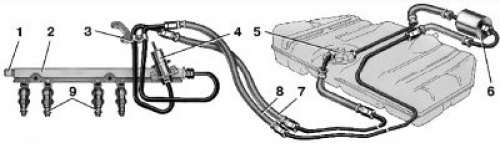
4.19. Fuel supply system with distributed injection: 1 – fuel pressure control nipple; 2 – fuel rail; 3 – bracket; 4 – fuel pressure regulator; 5 – electric fuel pump; 6 – fuel filter; 7 – fuel drain line; 8 – fuel supply line; 9 – injectors
Air filter 1 is installed in the front part of the engine compartment on rubber supports. The filter element is paper, flat, with a large filtering surface area.
Throttle assembly controls the amount of air entering the intake manifold. The amount of air entering the engine is regulated by a throttle valve connected to the accelerator pedal drive. The throttle assembly includes a throttle position sensor 4 (Fig. 4.20) and an idle speed regulator 5. In the flow part of the throttle assembly (before and after the throttle valve) there are vacuum extraction holes required for the operation of the crankcase ventilation system and the adsorber of the gasoline vapor recovery system. If the latter system is not used, the nipple for purging the adsorber is closed with a rubber plug 7.
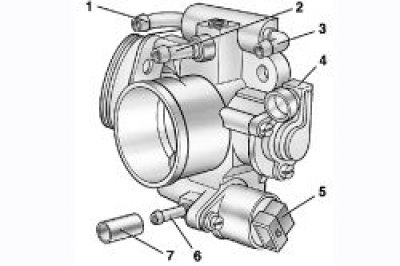
4.20. Throttle assembly: 1 – coolant supply pipe; 2 – crankcase ventilation system pipe at idle speed; 3 – coolant drain pipe; 4 – throttle position sensor; 5 – idle speed controller; 6 – nipple for purging the adsorber (used in a closed-loop distributed injection system); 7 – plug
Idle speed control valve 5 regulates the crankshaft speed in idle mode by controlling the amount of air supplied bypassing the closed throttle valve. It consists of a two-pole stepper motor and a cone valve connected to it. The valve extends or retracts according to signals from the controller. When the regulator needle is fully extended (which corresponds to 0 steps), the valve completely closes the air passage. When the needle is pushed in, the air flow is proportional to the number of steps the needle moves away from the seat.
Fuel supply system includes electric fuel pump 5 (see fig. 4.19), fuel filter 6, fuel lines and fuel rail 2 assembled with injectors 9 and fuel pressure regulator 4.
Fuel pump — with electric drive, two-stage, rotary type, non-separable, installed in the fuel tank, which reduces the possibility of vapor locks, since the fuel is supplied under pressure, and not under the action of vacuum. It provides fuel supply under pressure of more than 284 kPa.
Fuel filter 6 is built into the feed line between the electric fuel pump and the fuel rail, installed under the body floor behind the fuel tank. The filter is non-separable, its body is steel with a paper filter element.
Fuel rail 2 is a hollow bar with injectors and a fuel pressure regulator installed on it. The ramp is secured with two bolts to the intake pipe. On the left side (in the picture) on the ramp there is a fitting 1 for monitoring the fuel pressure, closed with a threaded plug.
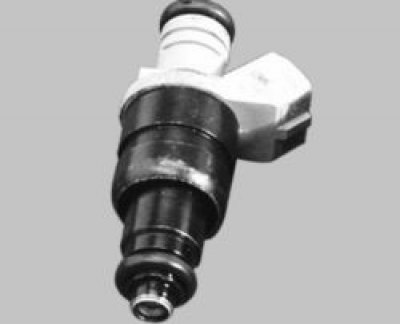
Nozzles 9 (see fig. 4.19) are attached to the ramp from which fuel is supplied to them, and their sprayers enter the holes of the intake pipe. In the holes of the ramp and intake pipe, the injectors are sealed with rubber sealing rings. The injector is an electromagnetic valve. When a voltage pulse is sent to it from the controller, the valve opens and the fuel is injected through the sprayer in a finely atomized stream under pressure into the intake pipe onto the intake valve. Here the fuel evaporates, coming into contact with heated parts, and in a vaporous state enters the combustion chamber. After the supply of an electrical pulse ceases, the spring-loaded valve of the injector shuts off the fuel supply.
Fuel pressure regulator 4 is installed on the fuel rail and is designed to maintain a constant pressure difference between the air pressure in the intake pipe and the fuel pressure in the rail.
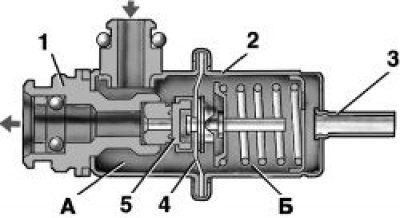
4.21. Fuel pressure regulator: 1 – housing; 2 – lid; 3 – Vacuum hose connection; 4 – diaphragm; 5 – valve; A – fuel cavity; B – vacuum cavity
The regulator consists of valve 5 (Fig. 4.21) with diaphragm 4, pressed by a spring to the seat in the regulator body. When the engine is running, the regulator maintains the pressure in the injector rail within 284–325 kPa. The regulator diaphragm is affected by fuel pressure on one side and by pressure on the other (underpressure) in the intake pipe. When the pressure in the intake pipe decreases (the throttle valve closes) the regulator valve opens at lower fuel pressure, bypassing excess fuel through the drain line back to the tank. The fuel pressure in the rail decreases. When the pressure in the inlet pipe increases, (when opening the throttle valve) the regulator valve opens at a higher fuel pressure and the fuel pressure in the rail increases.
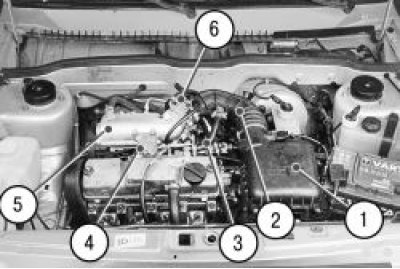
The arrangement of the power supply subsystem elements of the distributed fuel injection system without feedback: 1 – air filter; 2 – air supply pipe; 3 – fuel pressure regulator; 4 – fuel rail; 5 – receiver; 6 – throttle assembly