




Open large image in new tab »
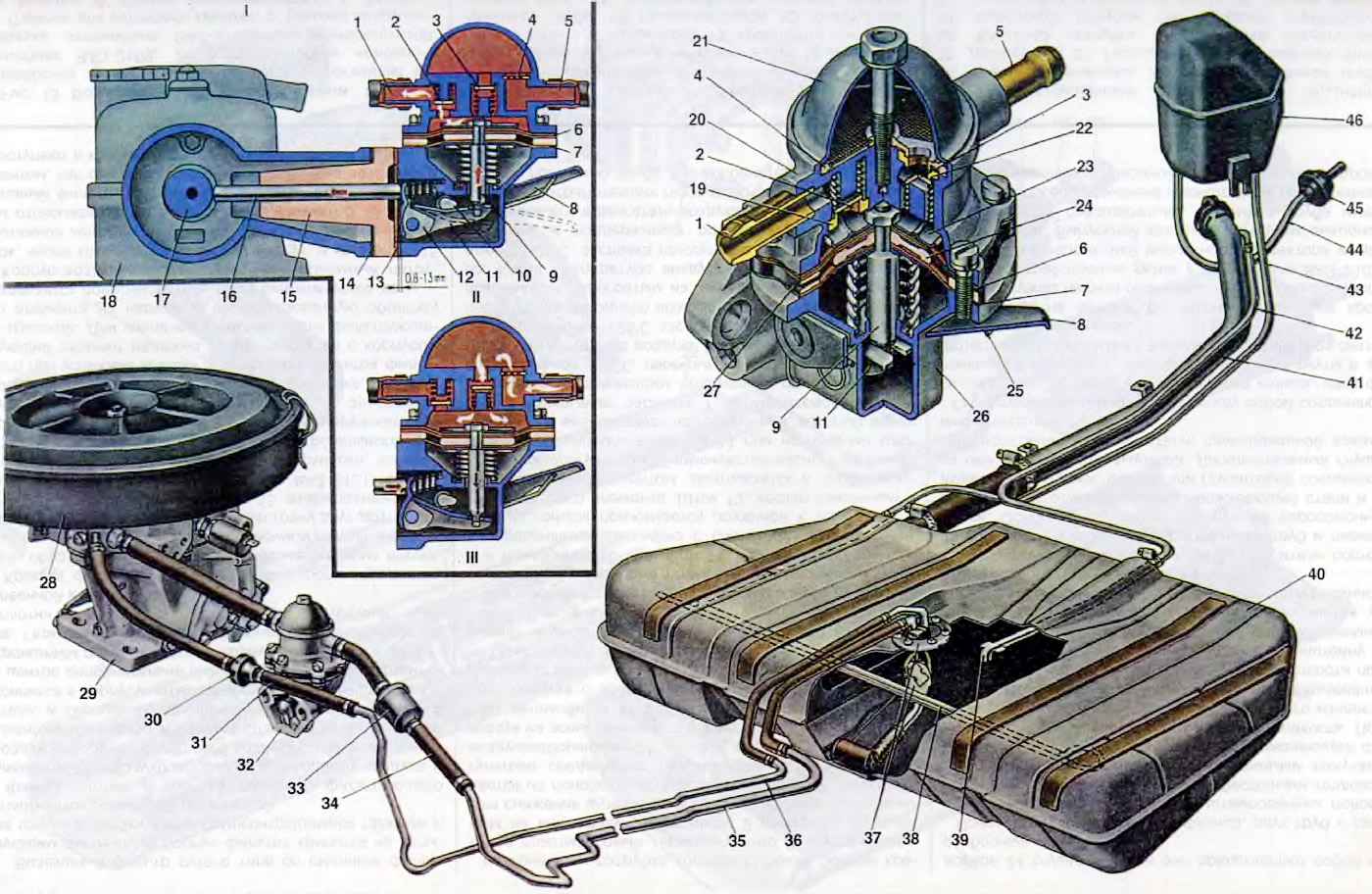
Figure 12. Power supply system: 1. Discharge pipe; 2 Discharge valve; 3. Suction valve; 4. Filter; 5. Suction pipe; 6. Upper diaphragms; 7. Lower diaphragm; 8. Manual fuel pump lever; 9. Rod; 10. Cam; 11. Balance beam; 12. Pump mechanical drive lever; 13. Fuel pump gasket; 14 Laying the heat-insulating spacer; 15. Fuel pump heat-insulating spacer; 16. Pusher; 17. Camshaft eccentric; 18 Cylinder head; 19. Discharge valve seat; 20. Upper pump body; 21. Pump cover; 22. Suction valve seat; 23. Diaphragm plate; 24. Internal spacer gasket; 25. Lever spring; 26. Lower pump housing; 27. External spacer gasket; 28. Air filter; 29. Carburetor; 30. Check valve; 31. Fuel drain hose; 32. Fuel pump; 33. Fine fuel filter; 34. Fuel supply hose to the fine filter; 35. Fuel supply line; 36. Fuel drain line; 37. Fuel level indicator sensor; 38. Drainage tubes; 39. Filler pipe hose branch; 40. Fuel tank; 41. Filling pipe; 42. Filler pipe hose; 43. Hose from fuel tank to separator; 44 Hose from separator to check valve; 45. Two-way check valve; 46. Gasoline vapor separator; I. Scheme of operation and installation of the fuel pump; II. Injection; III. Suction.
The fuel system includes the following devices: fuel tank 40, separator 46 of gasoline vapors, filter 33 of fine fuel purification, fuel pump 32, check valve 30, two-way check valve 45, fuel lines and hoses, air filter 28 with thermostat, carburetor 29, intake pipe and exhaust devices.
Fuel supply with a reverse drain of part of the fuel from the carburetor back into the fuel tank through a calibrated hole in the carburetor pipe with a diameter of 0.70 mm. Check valve 30, installed on the drain hoses, prevents fuel from draining from the tank through the carburetor when the car is overturned. The fuel tank is connected by hose 43 to separator 46, which serves to condense gasoline vapors. To prevent fuel from leaking out of the tank through the separator, a double-acting check valve is installed on the second hose 44 of the separator. The valve works in both directions: as the fuel is consumed, it lets atmospheric air into the tank, and when the pressure in the tank increases, it releases air with fuel vapors from the fuel tank.
Air is supplied through a thermostat, air filter 28, carburetor 29, from which it enters the engine cylinders in the form of a combustible mixture through the intake pipe.
Fuel tank 40 stamped, welded from two steel sheets. To increase corrosion resistance, the tank is lead-lined on both sides. Tank capacity is 43 l, including fuel reserve.
The filler neck is located in a niche in the right rear wing. The plug has a torque limiter; on some cars, a lock may be installed in the plug.
Two drainage tubes 38 are installed in the fuel tank. They are inserted one into the other and have a common outlet in the branch pipe connected to the separator 46 of gasoline vapors. The capacity of the separator is 7 liters. Gasoline vapors, condensing in the separator, drain back into the tank. The ends of the drainage tubes in the tank are located on the right and left sides, respectively, in order to prevent fuel from leaking out when the car turns.
Fuel pump 32 is a diaphragm type with a mechanical drive and is equipped with a manual fuel pumping lever. Capacity is 60 l/min. It is driven by pusher 16 from eccentric 17 of the camshaft.
A heat-insulating spacer 15 and adjusting gaskets 13 and 14 are installed between the pump and the drive housing.
The fuel pump consists of a lower housing 26 with drive levers, an upper housing 20 with valves and pipes, a diaphragm unit and a cover 21. Three diaphragms 6 and 7 are installed between housings 20 and 26: the two upper ones are working ones for fuel supply, the lower one is a safety one to prevent fuel from entering the drive housing if the working diaphragms are damaged. Between the working and safety diaphragms, there are an outer 27 and an inner 24 spacer gaskets. The outer gasket has an opening for fuel to escape if the upper working diaphragms are damaged. Diaphragms 6 and 7 with plates are installed on a rod 9 and are secured from above with a nut. A compressed spring is located on the rod under the diaphragm unit. The rod is inserted with a T-shaped tailpiece into a slot in the balancer 11. The slot allows the diaphragm unit to be removed without disassembling.
In the lower housing 26, levers 12, 8 and balancer 11 are installed. In the upper housing, there are valves, suction 3 and discharge 2. Gaskets made of diaphragm material are placed under the valves. The valves are pressed to the seats by springs. From above, the cover 21 is fastened to the upper housing of the pump with a central bolt. A plastic mesh filter 4 is installed between the housing and the cover. The upper housing 20 has discharge 1 and suction 5 branches.
Fuel is supplied by the manual pumping lever 8 by the action of the cam 10 on the balancer 11 and the diaphragm of the fuel pump. In the case of idle running of the lever 8 when filling the float chamber of the carburetor with fuel, it is necessary to turn the engine crankshaft one revolution so that the eccentric 17 releases the pusher 16 and the balancer 11. The crankshaft is turned clockwise with a key for the bolt at the end of the shaft.
For correct installation of the fuel pump on the engine, adjusting linings 13 and 14 are used, installed between the pump and the heat-insulating spacer, between the drive housing and the spacer (see fuel pump installation diagram). Two of the three following gaskets are used: Gasket A - 0.27-0.33 mm thick; gasket B - thickness 0.70-0.80 mm; gasket C - thickness 1.10-1.30 mm.
There must always be a gasket A between the drive housing and the heat-insulating spacer
Fuel lines and fine fuel filter
Fuel lines 35 and 36 are made of steel leaded or galvanized tubes. The tubes are connected to the fuel pump and the tank with rubber hoses in a fabric braid and secured with screw clamps. The fuel pump is connected to the carburetor with a rubber hose.
Information copied from the portal VAZBOOK.ru
The fuel feed line 35 is made with a diameter of 8 mm, the drain line 36 with a diameter of 6 mm. In front of the fuel pump 32, a fine fuel filter 33 is installed on the hoses and is secured to the hoses with screw clamps. The filter is of a non-separable design with a paper filter element in a plastic housing. The plastic housing and the cover are welded using ultrasonic welding or high-frequency currents.