




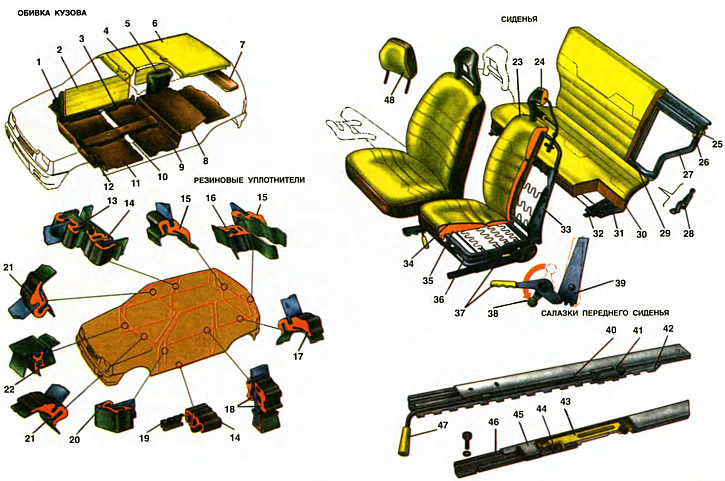
1. Front side panel trim. 2. Front door trim. 3. Rear sill trim. 4. Side panel trim. 5. Rear wheel arch trim. 6. Roof trim. 7. Luggage compartment shelf. 8. Rear seat and trunk mat. 9. Rear seat mat. 10. Rear tunnel soundproofing trim. 11. Front seat mat. 12. Front shield soundproofing trim. 13. Lowering window seal. 14. Front door opening seal. 15. Tailgate glass seal. 16. Tailgate opening seal. 17. Side panel glass seal. 18. Lowering window seals. 19. Door opening seal frame. 20. Seat guide channel seal. 21. Windshield seal. 22. Air intake box seal. 23. Front seatback. 24. Headrest. 25. Seatback lock latch. 26. Seatback lock handle. 27. Rear seatback frame. 28. Rear seatback hinge. 29. Rear seatback padding. 30. Rear seat cushion padding. 31. Rear seat cushion frame. 32. Cushion hinge. 33. Front seatback frame. 34. Front seat cushion upholstery. 35. Front seat cushion padding. 36. Front seat cushion frame. 37. Seatback tilt adjustment handle. 38. Seatback smooth tilt adjustment handle. 39. Upper link of the seatback tilt adjustment mechanism. 40. Latch spring. 41. Seat movement mechanism latch. 42. Lock. 43. Slide limiter. 44. Roller. 45. Slide slider. 46. Slide guide. 47. Seat movement mechanism handle. 48. Headrest variant from VAZ-2108 car.
Front seats
The front seats are separate, with headrests, with individual adjustments of the seat position and backrest tilt. Each seat is mounted on skids, along which it can move forward and backward within 300 mm.
The seat runners consist of guides 46 and sliders 45, stamped from sheet steel. The sliders can move along the guides on two rollers 44 each. A plastic limiter 43 is installed between the rollers. The handle 47 of the seat movement mechanism is rigidly connected to the latch 41, which, under the action of the spring 40 (in the form of a torsion bar) enters the grooves of the comb-shaped retainer 42, welded to the inner guide of the runners. When the handle 47 is raised upwards, the latch is released and the seat can be moved to the desired position.
The seat runners are attached to the front floor cross member and to brackets welded to the body floor.
The seat has coarse and fine adjustment of the backrest tilt. The backrest tilt adjustment mechanism consists of upper links 39, mounted pivotally on the rear pins of the cushion frame. The frame 33 of the seat back is welded to the upper links. At the bottom, the outer upper links 39 have teeth, which engage the finger of the lever with the handle 37 of the backrest tilt adjustment (rough adjustment). The lever is pivotally mounted on the frame 36 of the cushion and is pressed against the teeth of the upper link 39 by a spring.
When the handle 37 is raised upwards, the lever pin disengages from the teeth of the upper link and the backrest moves forward with the help of a torsion bar, the ends of which are fixed to the frames 33 and 36 of the backrest and seat cushion. The driver or passenger, with the handle 37 in the upper position, can push the seat back to the desired position. When the handle 37 is lowered, the backrest is fixed by the lever pin behind one of the teeth of link 39.
To ensure fine adjustment of the backrest tilt, the lever with handle 37 is mounted on the eccentric located on the front pin of the cushion frame. When the eccentric is turned by handle 38, the lever will shift, turning link 39 by its teeth and smoothly tilting the seat back forward or backward.
When passengers are seated in the back seat, lift handle 37 upwards, releasing the teeth of link 39, and tilt the seat back forward. To form sleeping places, tilt the seat back and lower it back, having first removed the headrests.
The frame 36 of the cushion is made in the form of a frame stamped from sheet steel. The frame 33 of the back is made of a pipe to which the reinforcements with the upper links 39 are welded. Wire springs in the form of snakes are attached to the frames 36 and 33 using metal brackets. To prevent the brackets from squeaking, the ends of the springs are covered with polyamide resin.
The cushion and backrest frames are fitted with polyurethane foam padding. The seat upholstery is made of artificial leather with a synthetic backing, which allows for clear decorative reliefs to be obtained after dielectric welding.
The headrests 24 of the front seats are height-adjustable and consist of polyurethane foam padding with a steel pipe frame. The vertical ends of the frame have recesses into which spring clamps fit, inserted into the grooves of the guide tubes of the frame 33. Instead of the headrest 24, headrests 48 from VAZ-2108 cars can be installed.
Back seat
The rear seat consists of a cushion and a backrest. The cushion is secured in front with two loops 32. The fixed links of the loops are secured with nuts to welded bolts on the body floor brackets and are covered with polyethylene linings. The movable links are secured with bolts to the frame 31 of the rear seat cushion. The rear part of the frame 31 rests on the pins of the locks installed in the body brackets.
The seat back is mounted on the cushion frame at the bottom using loops 28, and is locked at the top. This design allows you to place the seat back on the cushion, and then, together with the cushion, lift them up to the vertical position on loops 32 to the backs of the front seats. As a result, the area of the luggage compartment is significantly increased.
The frames of the 31 and 27 cushions and backrests are stamped from sheet steel. The frames are fitted with foamed polyurethane padding. The seat upholstery is made of artificial leather.
In the normal position, the seat back is fixed with locks that are attached to the frame with 27 screws. In the lock housing there is a spring-loaded latch with a handle 26. The latch engages with the lock installed on the body frame and fixes the seat back. To lower the seat back, it is necessary to lift both handles 26 of the locks up and disengage the latches from the locks.
Car interior upholstery
The interior trim is selected in shape and color in a single style that meets modern aesthetic requirements. The upholstery and trim materials of the interior have a matte surface that does not produce glare.
The color of the door, seat, and side trims is selected depending on the body color. The roof trim 6 is made of perforated polyvinyl chloride film (PVC) of light gray color. For heat and noise insulation, a 6 mm thick non-woven synthetic fiber cloth is glued to the roof panel under the trim with 88 NP-35 glue. The edges of the roof trim 6 are held in the door and windshield window openings with clamps and covered with body opening seals. Five wire arcs are inserted into the transverse folds of the trim, the ends of which enter plastic anti-squeak bushings inserted into the body openings.
(The original is on the portal: VazBook.ru)
The car can also be equipped with integrally molded roof linings made of polyurethane foam coated with PVC film.
The upholstery of the 4 sidewalls is made of three layers: wood-fiber board (WFB), non-woven synthetic fabric and PVC film, the edges of which are welded to the WFB with high-frequency currents (HFC). The upholstery is fastened in the holes of the inner panel of the body side with plastic holders fixed in the WFB.
The upholstery of the 1 front side panels is made of waterproof cardboard. Along the rear edge, the upholstery is fixed in the body openings using rubber holders, the front part is fixed using a wire holder.
The upholstery of the front doors is made similarly to the upholstery of the side panels. It is attached with plastic holders. In the middle part, the upholstery is additionally attached with screws of the armrest handle.
The 7th shelf of the trunk is made of light-grey polypropylene and is installed on axles in the holes of the body.
The floor of the passenger compartment is covered with mats 8, 9 and 11, the outer surface of which has a decorative finish. The mats are attached to the body with buttons. Front mats 11 and rear 9 are made of 2.5 mm thick rubber. Mat 8 of the rear floor and trunk is made of 1.3 mm thick PVC film with embossing on the front side. The floor thresholds are covered with facings 3 made of polypropylene, the front surface of the facings also has embossing.
The front, central and rear body pillars do not have trim; they are painted black.
Body sealing
To ensure the tightness of the car body interior, rubber seals of various profiles, rubber plugs for technological holes, sealing mastics are used, and all mating parts are carefully adjusted.
The air intake box and the rear door opening are sealed with rubber seals 22 and 16, which are attached to the flanges of the body openings with metal perforated frames.
Seals 14 of the front door openings are made of sponge rubber in the form of a tube, to which a plastic facing edge with a metal perforated frame 19 is welded. The frame ensures the fastening of the seal on the flange of the door opening. The internal cavity of the seal is connected to the atmosphere by holes in the sponge rubber.
Removal and installation of seals with metal frames requires care to avoid crushing the frame or forming corrugations.
The windshield, side windows and tailgate are sealed with rubber seals 21, 17 and 15, which have special tabs for reliable sealing.
The upper seals of the door drop-down windows, seals 13 and 20 of the guide grooves and the lower seals 18 of the windows are made of rubber of special profiles that prevent water leakage. Water that leaks between the seals and the drop-down windows flows into the door cavity, from where it flows out through the drain holes.
The gaps in the joints of the body parts are sealed with non-drying mastic 51-G-7, and the welded seams of the body after priming are sealed with plastisol D-4A, which hardens during the treatment of the body in the drying chambers of the paint line.
Technological holes used for the flow of primer and paint into the internal cavities of the body are sealed with rubber plugs.