

Dynamometer 02.7812.9501
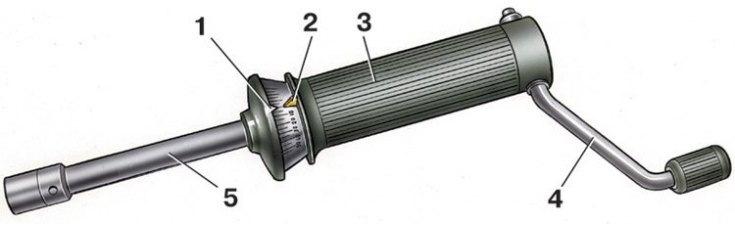
1 - movable pointer; 2 - torque limit indicator; 3 - body; 4 - handle; 5 - a rod with a tip inserted into the adapter sleeve of the nut of the pinion flange
To limit the axial displacements of the drive gear under operating loads, it is very important to create a preload in its bearings within the specified limits. Preload is controlled by a dynamometer 02.7812.9501, which measures the moment of resistance to turning the drive gear.
The torque of resistance to rotation determines the degree of tightening of the bearings. It should be 156.8–196 Ncm (16–20 kgf cm) for new bearings and 36.2–58.8 Ncm (4–6 kgf cm) for bearings after a run of 30 km or more.
Tighten the flange nut with a torque of 117.6–254.8 N·m (12–26 kgf·m), periodically checking with a dynamometer the moment of resistance of the bearings to turning the drive gear.
Checking the moment of resistance
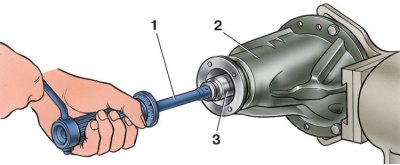
1. To check the moment of resistance, put a dynamometer 1 on the adapter sleeve 3 (2 - crankcase), set pointer 2 (see fig. Dynamometer 02.7812.950) torque limit per scale division corresponding to 196 Ncm (20 kgf cm), and turn the handle a few turns clockwise. While turning the drive gear, the movable pointer 1 must not go beyond the pointer 2 and must show at least 156.8 N cm (16 kgf cm).
2. If the torque is less than 156.8 Ncm (16 kgf cm), and for bearings after a run of 30 km - 39.2 N cm (4 kgf cm), then tighten the pinion flange nut (without exceeding the specified tightening torque) and check again the moment of resistance to turning the drive gear.
3. If the moment of resistance to rotation is more than 196 Ncm (20 kgf cm), and for run-in bearings 58.8 N cm (6 kgf cm), indicating that the bearing preload is too high, replace the spacer sleeve with a new one, as it has deformed from excessive load to a size that does not allow for correct adjustment. After replacing the spacer sleeve, repeat assembly with appropriate adjustments and checks.