




Contents: Camshaft ↓ Camshaft Bearing Housing ↓ Tensioner ↓ Camshaft drive chain ↓ Camshaft Drive Belt ↓ Belt tensioning mechanism ↓
Camshaft
The bearing journals of the camshaft must not have any scoring, nicks, scratches, or aluminum drag from the bearing housings. The working surfaces of the cams must not have wear exceeding 0.5 mm, nor must scoring or cam wear in the form of faceting.
Place the camshaft with its outer journals on two prisms placed on the surface plate and measure the radial runout of the middle journals with an indicator, which should be no more than 0.04 mm. If the runout exceeds the specified value, straighten the shaft on a straightening press.
When replacing the camshaft with a new one, it is necessary to replace the valve drive levers at the same time.
Camshaft Bearing Housing
Rinse and clean before testing (especially the oil supply channels), and then check the diameters of the holes in the bearings and journals of the camshaft. If the difference in the diameters of the holes in the bearings and journals exceeds 0.2 mm, replace the housing.
The internal support surfaces of the bearing housing must be smooth and free of burrs. If there is damage, replace the bearing housing.
Tensioner
To check the chain tensioner parts (Fig. 25), it must be disassembled. In this case, unscrew the cap nut 7 from the housing 2, remove the cracker 9 and the spring ring 4, then take out the plunger 7, spring 5 and rod 3 together with spring 8 and washer 6.
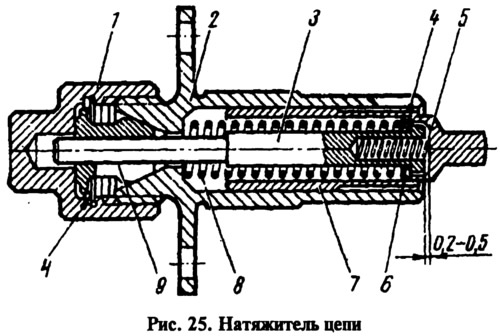
After disassembling the chain tensioner, check for any scuff marks on parts 9 and 3, or deep scratches on the mating surfaces of the shoe and plunger of the chain tensioner. If there is damage, replace the parts.
In addition, check the elasticity of the tensioner spring 8. Its length in a free state should be 62 mm, under a load of 12.5±0.6 kgf - 47 mm, and under a load of 18.5±1.0 kgf - 40 mm.
If the spring is less elastic, replace it. Also check the wear on the shoe and damper. If there are deep grooves on the rubber surface or the rubber is worn down to the metal base, replace the shoe and damper.
Camshaft drive chain
Before checking, wash the chain in kerosene, and then check the condition of the links. There should be no chips, cracks or other damage on the rollers and chain cheeks.
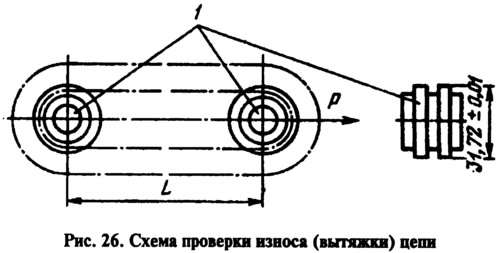
When the engine is running, the chain stretches. It is considered to be in good working order if the tensioner provides its tension, i.e. if the chain has stretched no more than 4 mm. Check the chain stretch on a device with two rollers 7 (Fig. 26), on which the chain is put on. The stretch is determined by the distance between the roller axes. But before measuring the distance, stretch the chain with a force of P = 30 kgf, then reduce it to 15 kgf, increase the force again to 30 kgf, and then reduce it again to 15 kgf and take the measurement. For a new chain, the distance between the roller axes is 485.775+0,5+0,1 mm for engines 2101 and 495.3+0,5+0,1 mm for 2103 engines. The chain is replaced if it has stretched to 490 mm for 2101 engines or to 499.5 mm for 2103 engines.
Camshaft Drive Belt
The surface of the toothed part should have a clear tooth profile, without wear, folds, cracks, undercuts and delamination of the fabric from the rubber. There should be no delamination or fraying on the end surfaces, but a slight protrusion of the fabric fringe is allowed. The surface of the outer flat part should be smooth, without folds, cracks, depressions and bulges.
Belt tensioning mechanism
The working surface of the tension roller must be smooth, without nicks or burrs.
The information is published on the website: VAZBOOK.RU
The tension roller ball bearing should rotate smoothly without jamming.
Check the elasticity of the tension roller bracket spring by its length in a free state and under load. The length of the spring, measured between the inner edges of the rounded ends of the spring, should be 70 mm in a free state, and 120 mm under a load of 13.2±1.3 kgf.