




Contents: Cylinder head ↓ Valve seats ↓ Valves ↓ Valve guide bushings ↓ Oil deflector caps of guide bushings ↓ Valve Levers ↓ Valve springs and valve levers ↓ Cylinder head gasket ↓ Notes ↓
Cylinder head
Before checking, install the cylinder head on a support in the form of a metal or wooden frame, remove carbon deposits from the walls of the combustion chambers and from the surface of the exhaust channels with a regular metal brush or a rotating electric drill. Clean and inspect the intake channels and oil supply channels to the valve drive levers.
If there have been cases of coolant getting into the oil, then the tightness of the cylinder head is checked by installing plugs on the head, which are included in the A.60344 device kit, and pumping water into the head under a pressure of 5 kgf·m. There should be no water leakage from the engine cylinder head within 2 minutes.
The cylinder head can be checked with compressed air, for which the parts included in the A.60334 device are installed on the cylinder head, it is lowered into a bath of water heated to 60-80°C, and allowed to warm up for 5 minutes. Compressed air is supplied into the head under a pressure of 1.5-2 kgf/cm². No air should be observed escaping from the head for 1-1.5 minutes.
If cracks are detected, the cylinder head is replaced.
Valve seats
The saddles (Fig. 14) should not have any chamfers on the working surfaces (contact area with valves) pinholes, corrosion and other damage. Minor damage on the surface of the working chamfers is removed by grinding with a grinding machine or manually.
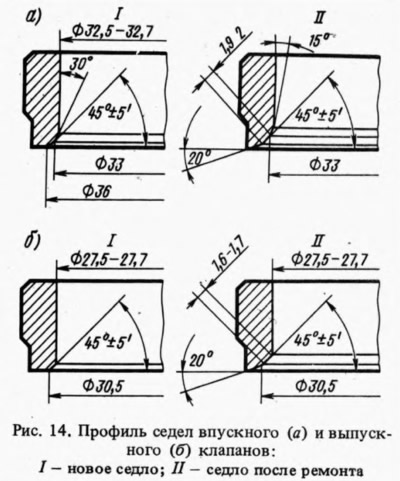
For grinding, install the cylinder head on a stand in a metal or wooden frame and insert the A.94059 rod into the valve guide bushing (there are two rods of different diameters: A.94059/1 for intake valve guide bushings and A.94059/2 for exhaust valve guide bushings). Remove carbon deposits and work hardening from the seat chamfers using countersinks A.94031 and A.94092 for exhaust valve seats and countersinks A.94003 and A.94101 for intake valve seats. Countersinks are placed on mandrel A.94058 and centered using guide rods A.94059.
After cleaning the chamfers, put the spring A.94059/5 on the rod A.94059, install the conical circle A.94078 for the seats of the exhaust valves or the circle A.94100 for the seats of the intake valves on the mandrel A.94069, fix the mandrel in a grinding machine and grind the seat, removing as little metal as possible.
When the wheel touches the saddle, the machine must be switched off, otherwise vibration will occur and the chamfer will be incorrect. It is recommended to correct the wheel with a diamond more often.
After grinding, the width of the working chamfer is brought to the values indicated in Fig. 14. To finish the chamfer of the exhaust valve seat, place the countersink A.94031 (angle 20°) on the mandrel A.94058, then place the mandrel with the countersink on the guide rod A.94059 and countersink the seat to ∅ 30.5 mm. Then, use the countersink A.94092 to bring the width of the chamfer to 1.6-1.7 mm (see fig. 14, b).
To finish the chamfer of the inlet valve seat, place the countersink A.94003 on the mandrel A.94058 and countersink the seat to ∅ 33 mm (see fig. 14,a), then place the countersink A. 94101 on the mandrel and bring the width of the working chamfer to 1.9-2 mm.
If grinding fails to eliminate damage to the working chamfer of the seat, the cylinder head is replaced.
Valves
Before checking the valves, remove carbon deposits from them with a regular brush or on a polishing machine with rotating brushes, after which they check: whether the stem is deformed, whether there are cracks on the plate, whether the working chamfer is too worn or damaged. If the stem is deformed and the plate is cracked, the valve is replaced. If there is minor damage to the working chamfer of the valve, it is ground on a grinding machine, maintaining a chamfer angle of 45°30' ±5', and ensuring that the thickness of the cylindrical part of the valve plate after grinding is not less than 0.5 mm and that the layer of hard alloy fused to the chamfer is not removed from the outlet valve.
Valve guide bushings
When checking the valve guide bushings, check the clearance between them and the valve stems by measuring the diameter of the valve stem and the bore of the guide bushing. The clearance should correspond to the data in Table 2. If it is greater than the permissible value, replace the valve. If the excessive clearance between the guide bushing and the valve stem cannot be eliminated by replacing the valve alone, replace the guide bushing as well. Use the A.60153/R mandrel for this operation1. Press in the guide bushings with the retaining ring on until the ring rests against the cylinder head plane. To replace the two guide bushings of the intake and exhaust valves of the 1st and 4th cylinders, unscrew the two studs securing the camshaft bearing housing, as they interfere with the installation of the mandrel.
After installing the guide bushings, ream the holes in them with reamers (A.90310/1 for inlet valve bushings and A.90310/2 for outlet valve bushings). Then the valve seat is ground and the width of the working chamfer is brought to the required dimensions, as indicated above.
Oil deflector caps of guide bushings
The caps must not have rubber peeling off from the fittings, cracks or excessive wear of the working edge. When repairing the engine, it is recommended to always replace the oil-deflecting caps with new ones.
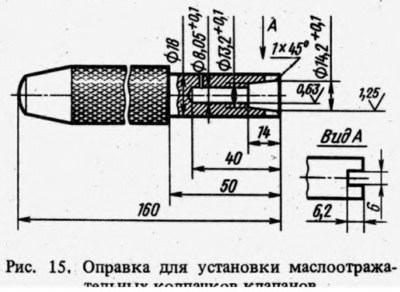
It is recommended to replace damaged oil deflector caps with the cylinder head removed, so as not to bend the valve stems. To press on the caps, use mandrel 41.7853.4016 (Fig. 15).
Valve Levers
The condition of the working surfaces of the valve levers that come into contact with the valve stem, the camshaft cam, and the spherical end of the adjusting bolt is checked. If there are any burrs or scratches on them, the lever is replaced with a new one. If deformation or other damage is found on the adjusting bolt bushing or on the bolt itself, the damaged parts are also replaced.
The article is taken from the website (VAZbook)
Valve springs and valve levers
The springs are checked for elasticity and cracks. The elasticity of the valve springs is checked by the length of the spring in a free state (39.2 mm - internal and 50 mm - external) and under load: 13.9 kgf and (28.1±1.4) kgf for the internal (in this case the length should be equal to 29.7 and 20 mm respectively); 28,9+2,3-1,5 kgf and (46.1±2.3) kgf for external (the length is 33.7 and 24 mm respectively).
The data for checking the valve lever springs is as follows. The length of the spring in a free state is 35 mm, and under a load of 5.2-7.5 kgf - 43 mm.
Cylinder head gasket
The surfaces of the gasket must be smooth, without dents, cracks, swellings and fractures. Peeling of the lining material from the reinforcement is not allowed. There must be no cracks, burnouts or delamination on the edging of the holes.
Notes
1. Step mandrel with diameter and length of 12.5 and 58 mm respectively. Centering shank diameter 7.75 mm.