Contents: Clutch housing, gearbox housing,…↓ Oil seals, sealing gaskets ↓ Shafts ↓ Gears ↓ Bearings ↓ Rods, forks ↓ Hubs, couplings, synchronizer…↓ Differential ↓ Gear selection mechanism and gear…↓
Before inspection, the gearbox parts are cleaned. Using a brush or scraper, remove all deposits and clean the holes, internal ring grooves in the secondary shaft gear bushings and splines from possible contamination, then wash and blow with a stream of compressed air. It is especially necessary to blow out the bearings well, directing the stream of compressed air so that rapid rotation of the rings does not occur.
Clutch housing, gearbox housing, cover
There should be no cracks or chips on the gearbox and clutch housings, and no wear or damage on the surface of the bearing bores. There should be no dents, scratches or other damage on the surfaces of the clutch and gearbox housing joints that could lead to loss of tightness of the unit.
Check the condition of the breather and make sure it is not dirty and in working order. Check the condition of the rear cover and make sure the oil level indicator is intact, and that the surface of the cover that comes into contact with the gearbox housing is not damaged. Clean the magnet from wear particles. Minor damage to the surfaces is removed with sandpaper.
During assembly, damaged areas are lubricated with a sealant used for the engine (see section. "Cylinder head assembly"). If the parts are badly damaged or worn out, replace them with new ones.
Information copied from the portal vazbook
Oil seals, sealing gaskets
The condition of the working edges is checked. No unevenness or significant wear is allowed on the edges. Formation of a cylindrical belt of more than 1 mm as a result of wear on the working edge is not allowed. There should be no nicks or dents on the seating surface of the seal frame. Even if there is minor damage, the seal is replaced with a new one. It is recommended to replace the sealing gaskets with new ones.
Shafts
Check the condition of the teeth of the gears of the primary and secondary shafts. The teeth should not have chips, nicks or wear. There should be no scoring or wear on the landing belts of the shafts on which the bearings are located.
The splines should not have dents or nicks that make it difficult to assemble the parts. If necessary, remove defects with emery cloth or a velvet file. If shaft defects cannot be removed; replace the shaft with a new one.
Gears
There should be no significant crushing or chipping on the ends of the synchronizer ring teeth. The contact patch between the teeth of the gears in engagement should extend over the entire working surface of the teeth; the specified surface of the teeth must not have wear.
Bearings
Ball, roller and needle bearings must be in perfect condition. The radial clearance of ball and roller bearings must not exceed 0.05 mm. No damage is allowed on the surfaces of balls, needles and rollers, as well as on the raceways of rings, bushings and gears. Damaged bearings, bushings and gears are replaced with new ones. Needles and separators of needle bearings must not have damage or signs of wear.
Rods, forks
Deformation of forks, rods and gear selection and shift levers is not allowed. The rods must slide freely in the crankcase holes and in the bushings. The condition of the springs and locking balls is checked. Parts that show signs of wear or seizure are replaced with new ones.
Hubs, couplings, synchronizer locking rings
Check that the hubs are not damaged, especially on the sliding surfaces of the couplings. Pay special attention to the condition of the ends of the coupling teeth. There should be no excessive wear of the locking rings: if the axial clearance between the end of the locking ring and the end of the toothed rim of the gear synchronizer is 0.6 mm or less, the rings are replaced with new ones. No damage or traces of seizure on the balls, springs and crackers are allowed. Possible irregularities that prevent the sliding of the couplings and locking tracks are removed with a velvet file. Parts that are damaged and worn are replaced with new ones.
Differential
Check the condition of the surface of the satellite axle, half-axle gears, washers, satellites and the surface of the differential box. Check the condition of the seat belts on the differential box.
In case of minor damage to the surfaces, the unevenness is removed with fine-grained sandpaper, and in case of significant damage, the parts are replaced with new ones.
Gear selection mechanism and gear shift drive
Check the condition of the gear selector lever, its springs and the lever axis. Replace worn and damaged parts. Check the condition of the gear selector rod, the fastening and condition of the gear selector lever, the condition of the seal and protective cover. Replace worn and damaged parts. Check the fit of the gear shift lever in the ball joint. The lever should rotate freely in the support, without jamming and have no free play. There should be no noticeable play in the hinge connecting the gear shift lever to the drive rod. Deformation of the drive rod and the reaction rod and damage to the protective cover are not allowed.
Deformed rods are replaced or straightened.
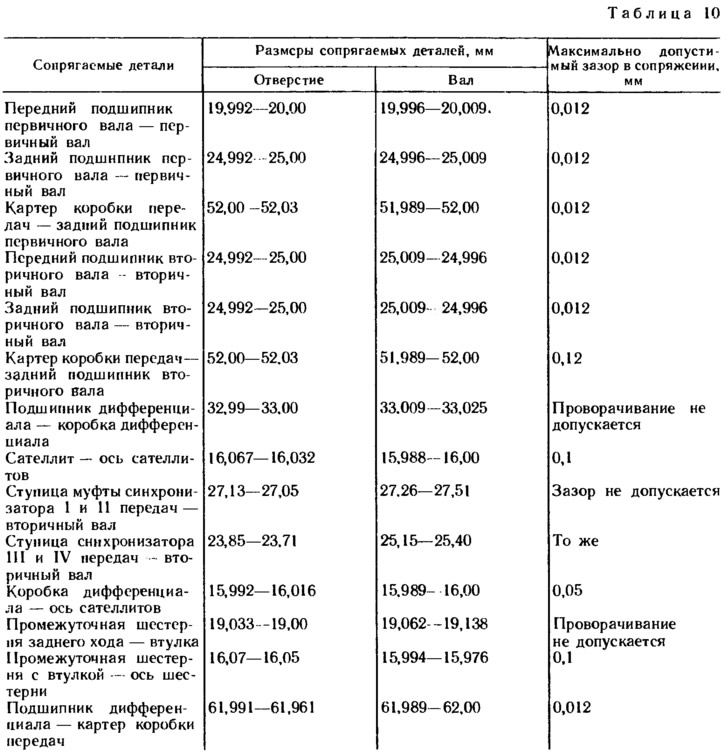
The dimensions of the main mating parts and the limits of permissible wear during operation are given in Table 10.