




Cardan transmission
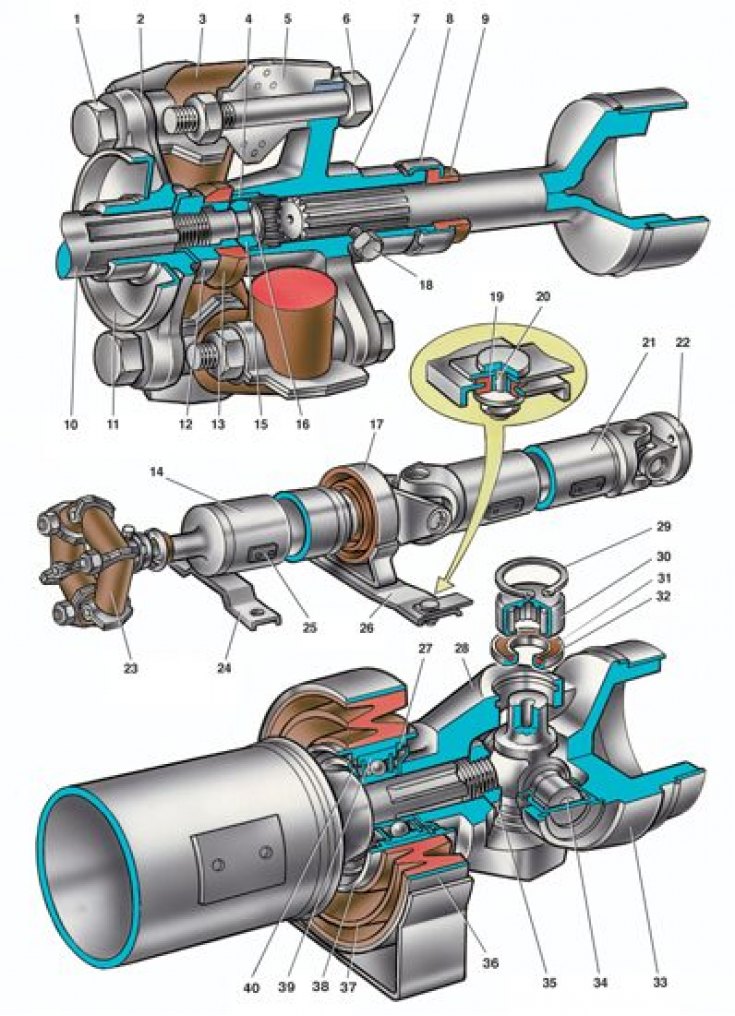
1 – bolt for fastening the elastic coupling to the flange of the secondary shaft of the gearbox; 2 – secondary shaft flange of the gearbox; 3 – rubber element of the elastic coupling; 4 – centering sleeve of the front propeller shaft flange; 5 – elastic coupling insert; 6 – bolt for fastening the elastic coupling to the flange of the cardan shaft; 7 – front propeller shaft flange; 8 – oil seal cage; 9 – oil seal; 10 – secondary shaft of the gearbox; 11 – mud deflector; 12 – secondary shaft flange fastening nut; 13 – centering ring seal; 14 – front propeller shaft; 15 – centering ring; 16 – retaining ring; 17 – intermediate support; 18 – cork; 19 – rubber bushing; 20 – spacer sleeve; 21 – rear propeller shaft; 22 – Cardan joint flange fork; 23 – elastic coupling; 24 – safety bracket; 25 – balancing plate; 26 – intermediate support crossbar; 27 – retaining ring; 28 – front propeller shaft fork; 29 – retaining ring; 30 – needle bearing; 31 – oil seal; 32 – crosspiece seal collar; 33 – cardan joint fork; 34 – crosspiece; 35 – fork mounting nut; 36 – intermediate support bracket; 37 – elastic pillow; 38 – bearing housing; 39 – bearing; 40 – mud deflector
The cardan transmission consists of two tubular shafts connected to each other by a cardan joint, an elastic coupling 23 (see fig. Cardan transmission) and intermediate support 17.
The front propeller shaft 14 is made of a thin-walled pipe, to both ends of which splined tips are welded. On the splines of the front tip there is a flange 7, which is connected through a rubber coupling 23 to flange 2 of the secondary shaft 10 of the gearbox by six bolts 1 and 6. The alignment of the connected shafts is ensured by a centering ring 15, pressed onto the end of the secondary shaft, and a centering sleeve 4, pressed into flange 7 of the propeller shaft. Ring 15 is fixed on the shaft by a retaining ring 16.
The splined connection is lubricated through an opening closed by plug 18. The lubricant is retained by rubber seal 9, which is located in steel housing 8, and on the other side by seal 13, put on nut 12 and pressed by it.
The rear splined end of shaft 14 rests on ball bearing 39 of the intermediate support. The fork 28 of the intermediate cardan joint is secured to the splines of the end with nut 35.
The rear propeller shaft is also made of a thin-walled pipe, with cardan joint forks welded to the ends.
The intermediate support absorbs vibrations of the cardan transmission. It consists of a bracket secured to the crossmember 26 with bolts and nuts. The crossmember, in turn, is secured with nuts on bolts welded to the body. Steel spacer bushings 20 and rubber insulating bushings 19, pressed with washers, are installed on the crossmember fastening bolts. A rubber cushion is located in the bracket, which is vulcanized to the surfaces of the bracket and the bearing housing. A radial ball bearing 39 with seals is located in the bearing housing, which is fixed in the housing with a retaining ring 27. Dust deflectors installed on both sides of the bearing protect the bearing from environmental influences.
The elastic coupling absorbs noise and vibrations of the cardan transmission. It is made of six rubber elements 3, between which metal inserts 5 with holes for bolts 1 and 6 are placed. There are six projections on the inserts, three of which enter the grooves of the secondary shaft flange of the gearbox, and the rest - in the grooves of the elastic coupling flange. This ensures the centering of the elastic coupling on the flanges.
(The article is taken from an online resource VazBook.ru)
The cardan joint consists of two forks 28 and 33 fixed on shafts, which are connected to each other by a crosspiece 34. The housings of needle bearings 30 are placed on the hollow pins of the crosspiece. The crosspiece bearing is sealed by a gland 31, located in a metal housing 32.
The assembled needle bearings are fixed in the fork holes with retaining rings 29, which are divided into five thickness sizes. The selection of the retaining ring ensures the axial clearance of the crosspiece within 0.01–0.04 mm.
Since 1988, cars have been equipped with a cardan transmission with high-durability joints. It is distinguished externally by the increased thickness of the forks at the place of installation of needle bearings, the absence of metal collars under the crosspiece seals and a sharper transition of the front cardan shaft pipe to the splined tip (at an angle of approximately 90°). Cardan joints have improved sealing of needle bearings. This is achieved by using radial-face seal seals. The housings of the needle bearings are stamped from sheet steel, unlike the turned ones from rod steel in the previously used cardan transmission.
New and previously manufactured universal joint crosspieces are interchangeable, but it is not advisable to install VAZ-2105 crosspieces in VAZ-2101 cardan shaft forks, since the rigidity of the stamped needle bearing housings is reduced in these forks.
Due to the change in the sizes of the cardan joint forks, the technology for disassembling and assembling new cardan joints has been changed.
Therefore, the text describes the technology of both old and new hinges.