




Front propeller shaft parts
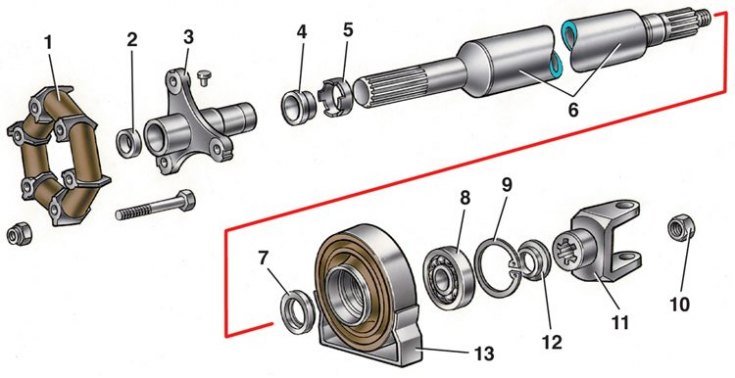
1 – elastic coupling; 2 – centering sleeve; 3 – elastic coupling flange; 4 – oil seal; 5 – oil seal cage; 6 – cardan shaft; 7 – dust deflector; 8 – bearing; 9 – retaining ring; 10 – nut; 11 – cardan joint fork; 12 – dust deflector; 13 – elastic support
Assembling the cardan joint
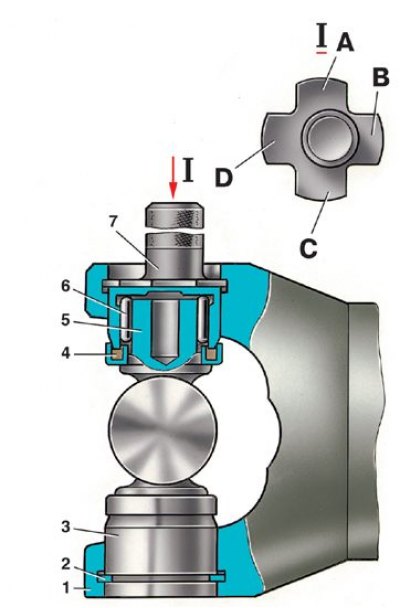
1 – cardan joint fork; 2 – retaining ring; 3 – bearing housing; 4 – oil seal; 5 – crosspiece tenon; 6 – bearing needle; 7 – caliber 41.8734.4092; A, B, C, D – feeler gauge petals
1. Assemble the cardan shafts in the reverse order of disassembly.
2. Apply FIOL-1 grease to the splined connections.
3. When connecting parts, align the marks applied to the detachable parts before disassembling.
4. After assembling the splined connection, pressing the seal by 0.3–0.5 mm with an axial load, squeeze the collar onto the fork groove.
5. Tighten the front propeller shaft fork mounting nut with a torque wrench and secure it in place.
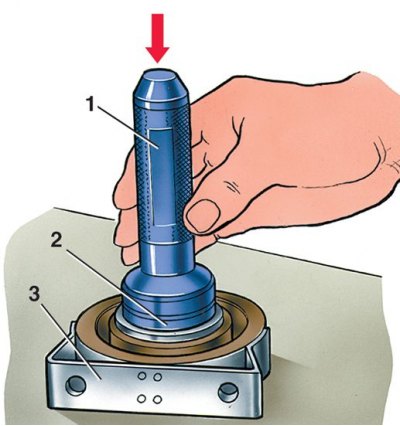
6. When assembling intermediate support 3, press in bearing 2 with tool 1 (with mandrel A.70045) and install a retaining spring ring in the groove of the support.
7. Place the dust deflector 7 on the rear end of the front propeller shaft (see fig. Front propeller shaft parts).
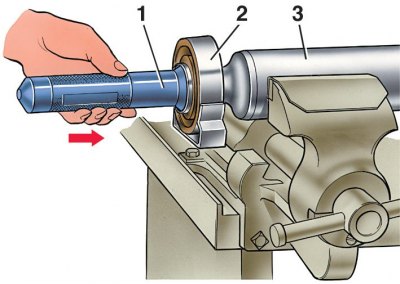
8. Then with device 1 (with mandrel A.4035) press in support 2 with the bearing (3 – rear part of the front propeller shaft).
9. Put on the second dust deflector 12 (see fig. Front propeller shaft parts), press the fork 11 of the front propeller shaft onto the shaft and secure it with a nut.
10. Assemble the old design cardan joint in the following order.
11. After removing the old thickened grease, fill the cavities in the crosspiece pins and lubricate the inner surface of the bearing housings with FIOL-2U grease (0.4–0.6 g for each bearing).
12. Lubricate the crosspiece pins with a thin layer of grease to prevent an air cushion from forming during assembly. Insert the crosspiece pins into the fork.
13. Place the bearing housings with needles on the crosspiece pins and press into the fork holes with a force of 7840 N (800 kgf).
14. Install the retaining rings in the fork grooves in their original places according to the marks.
15. Then check the axial free play of the crosspiece, which should be 0.01–0.04 mm.
16. If the free play is greater than specified, replace one thinner retaining ring with a thicker one.
17. When replacing cardan joint parts, select retaining rings with a gauge of 41.8734.4092, which has four petals of different thicknesses (1.53 mm; 1.56 mm; 1.59 mm; 1.62 mm).
18. To do this, install the retaining ring 2 (see Fig. Assembling the cardan joint) 1.56 mm thick.
19. When pressing in bearings, when the crosspiece rests against the bearing housing (in this case there are no gaps), using a 4187.34.409 feeler gauge, determine the distance between the bearing housing and the end face of the annular groove.
20. Depending on the measured distance, taking into account the axial clearance of 0.01–0.04 mm, insert the second retaining ring of the corresponding thickness. For example, if the petal passes 1.56 mm, then a 1.53 mm ring should be installed.
Attention! Retaining rings are supplied as spare parts in five (seven*) sizes (by thickness, mm), each of which has a specific color: 1.50 (1.45)* – natural;1.53 (1.52)* – dark brown; 1.56 (1.56)* – blue; 1.59 (1.60)* – black; 1.62 (1.48)* – yellow; (1,64; 1.67)* – colors are not indicated and their thickness is determined by measurement.
21. If the smallest thickness feeler gauge (1.53 mm) does not fit into the groove, replace ring 2 with another 1.50 mm one.
22. If the thickest feeler gauge (1.62 mm) enters the groove with a gap, then replace ring 2 with another one, 1.62 mm thick.
23. Having installed the retaining rings, hit the forks with a hammer with a plastic striker. Under the action of the impact and the elastically compressed seals, the gap between the bearing bottom and the retaining ring is eliminated and gaps appear between the bearing housings and the ends of the crosspiece pins.
24. After assembly, check the ease of rotation of the hinge forks and the balance of the cardan transmission.
25. The assembly of a cardan joint with stamped housings of needle bearings made of sheet steel has its own peculiarities. The gap between the bearing housing and the end face of the annular groove is measured with two calipers, one of which has a set of feeler blades with a thickness of 1.45; 1,48; 1,52; 1.56 mm, and the other is 1.60; 1,64; 1.67 mm.
26. If the feeler gauge petal of the smallest thickness (1.45 mm) does not enter the gap between the bearing housing and the end of the annular groove, then ring 2 (see fig. Cardan joint assembly) replace the 1.56 mm thick one with another one, 1.45 mm thick.
27. If the feeler gauge petal of the greatest thickness (1.67 mm) does not fit tightly into the gap, then install a ring of thickness 1.67 mm into this gap, remove ring 2 and repeat the operations for selecting the thickness of the ring again.
28. If the feeler gauge petal fits tightly into the gap, then install a ring into the groove, the thickness of which is equal to the size of the feeler gauge.
29. The force for pressing needle bearings into the fork holes must not exceed 10,000 N (1000 kgf).
30. Measure the gap with a feeler gauge from the cardan shaft side.
* For new design hinge.