




Contents: Disassembly and assembly of the…↓ Replacing the brush holder ↓ Replacing rotor bearings ↓ Replacing additional diodes ↓
Disassembly and assembly of the generator
Disconnect the wire from the "B" plug of the voltage regulator. Disconnect the wires of the regulator and the capacitor from the "30" terminal of the generator and unscrew the screws securing the voltage regulator. To avoid breaking the brushes when removing the brush holder, insert a screwdriver blade between the regulator body 1 (figure 132) and brush holder 2 and partially pull the regulator out of the generator, leaving the brush holder in place. After this, tilt and remove the regulator together with the brush holder from the generator. Remove capacitor 20 by unscrewing the screw holding it.
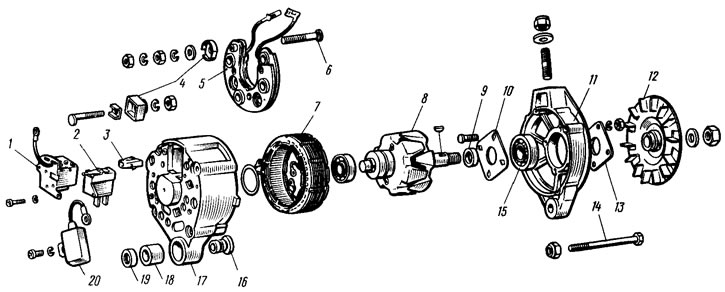
Figure 132. Generator parts: 1 - voltage regulator; 2 - brush holder; 3 - additional diode output block; 4 - insulating bushings; 5 - rectifier block; 6 - contact bolt; 7 - stator; 8 - rotor; 9 - spacer sleeve; 10 - inner bearing mounting washer; 11 - drive side cover; 12 - pulley; 13 - outer bearing mounting washer; 14 - tension bolt; 15 - Front rotor ball bearing; 16 - bushing; 17 - cover from the contact ring side; 18 - buffer bushing; 19 - pressure sleeve; 20 - capacitor
Loosen the nuts of the tie bolts 14 and remove the generator cover 11 together with the rotor and pulley. Clamp the rotor in a vice, loosen the pulley nut and remove the pulley from the rotor shaft using puller 02.7823.9504. Remove the segment key from the groove on the shaft and remove the cover 11.
The 02.7823.9504 puller consists of two steel half rings that are inserted into the pulley groove and a regular puller. The puller jaws grip the half rings and the bolt rests against the end of the generator shaft. The half rings have the same cross-section as the generator drive belt. On one side they are connected by a hinge, and on the other they are equipped with levers that are squeezed by hand when removing the pulley.
Loosen the nuts of the screws connecting the valve tips to the stator winding terminals and remove the stator 7 from the generator cover 17. Loosen the nut of the contact bolt 6, disconnect the plug of the additional diode wire from the block 3 and remove the rectifier unit 5.
The generator is assembled in the reverse order. The misalignment of the holes in the generator cover legs should not exceed 0.4 mm. Therefore, during assembly, it is necessary to insert a stepped cylindrical control mandrel into these holes, having a diameter of 12 mm on one side and 22 mm on the other. The conical spring washer of the pulley with its convex side should touch the nut. The pulley nut is tightened with a torque of 3.9-9.0 kgf·m.
To avoid breakage of the brushes, before installing the regulator with the brush holder in place, do not insert the brush holder completely into the regulator, but only partially push it in and insert it into the generator in this form. After installing the brush holder in place in the generator cover, gently press on the regulator to push it into the generator.
Replacing the brush holder
If the brushes are worn out and protrude from the brush holder by less than 5 mm, then replace the brush holder with brushes. To replace, pull the brush holder out of the voltage regulator housing by pressing the "B" terminal. Before installing the voltage regulator with a new brush holder in place, blow out the socket in the generator from carbon dust and wipe off oil mixed with carbon dust.
Replacing rotor bearings
To remove a faulty bearing from the drive-side cover, unscrew the nuts of the screws that tighten the bearing mounting washers, remove the washers with the screws, and press out the bearing using a hand press. If the nuts do not unscrew, (the ends of the screws are pierced), then these ends are cut off.
The information can be read on the website: VAZbook.ru
A new bearing can be installed in the generator cover only if the bearing hole is not deformed. The diameter of the hole should not be more than 42 mm. If the hole has a larger diameter or is deformed, replace the cover with a new one.
The bearing is pressed into the cover using a press and then clamped between two washers, tightened with screws and nuts. After tightening the nuts, the ends of the screws are marked.
When replacing the rotor bearing on the slip ring side, it is necessary to replace the cover at the same time, since if the bearing is damaged, the socket in the cover is also damaged.
Replacing additional diodes
To replace, unsolder the leads of the damaged diode and carefully remove it from the plastic holder, avoiding sharp blows to the rectifier unit. Then clean the diode installation site from the remains of epoxy resin, install and solder the new diode. The diode lead with the color mark is soldered to the valve leads. After soldering, glue the diode body to the holder with epoxy resin.