




In the case (figure 133) four poles 17 with excitation windings are secured, three of which are series and one is shunt. The housing together with covers 6 and 14 is tightened with two bolts. The anchor has an end collector. The rear end of the anchor shaft rotates in a metal-ceramic sleeve pressed into cover 14, and the front end in a sleeve pressed into the clutch housing.
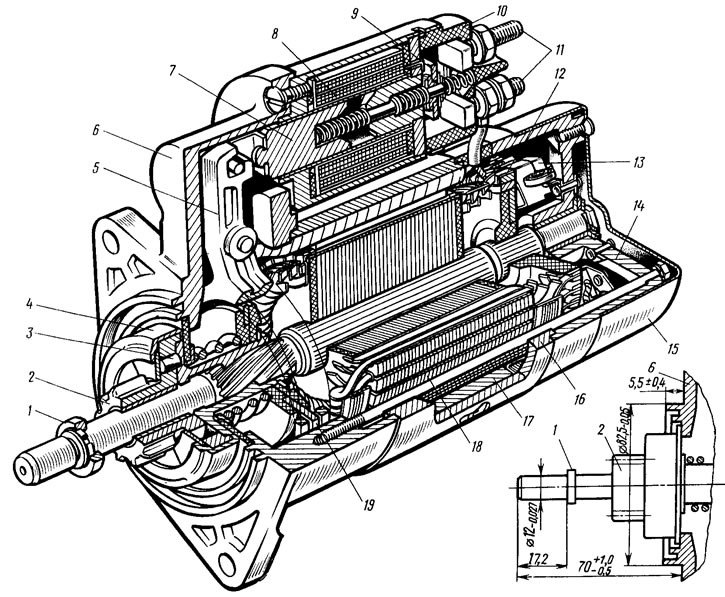
Figure 133. Starter 29.3708: 1 - limiting ring; 2 - drive gear: 3 - clutch roller; 4 - freewheel clutch; 5 - drive lever; 6 - drive side cover; 7 - relay anchor; 8 - relay winding; 9 - contact plate; 10 - relay cover; 11 - contact bolts; 12 - collector; 13 - brush; 14 - cover from the collector side; 15 casing; 16 - body; 17 - stator pole; 18 - anchor; 19 - leash ring
The starter connection diagram is shown in Figure 134. When the starter is turned on, voltage from the battery is supplied to both relay windings via auxiliary relay 6 type 113.3747-10 (retractor II and retainer I). After the relay contacts are closed, the pull-in winding is switched off. (On the first batches of VAZ-2108 cars, relay 6 was not installed.)
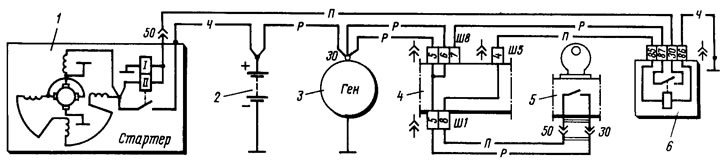
Figure 134. Starter connection diagram: 1 - starter; 2 - battery; 3 - generator; 4 - mounting block (fragment); 5 - ignition switch; 6 - additional starter relay
The original can be viewed on the portal: VAZbook
Brief technical characteristics of the starter:
- Nominal power, kW — 1.3
- Current consumption, A:
- at maximum power, no more than - 260
- in a inhibited state, no more than 500
- at idle, no more than 60
Possible starter malfunctions, their causes and methods of elimination are given in Table 20.