




Contents: Cylinder head ↓ Cylinder head gasket ↓ Valve guide bushings ↓ Valves ↓ Bearing housings ↓ Camshaft drive ↓
The valve timing mechanism admits fresh portions of the combustible mixture into the cylinders and releases combustion products from them — exhaust gases. These processes must occur in accordance with the cylinder operating order and valve timing phases adopted for a given engine.
The valve timing mechanism includes: camshaft belt drive, camshaft 5 (figure 19), exhaust and intake valves 2, valve springs with fastening parts and tappets 3 with adjusting washers 6. The camshaft cam acts on the valve through the tappet 3. This design of the mechanism ensures a rigid and reliable kinematic connection between the cam and the valve, due to which the vibration level of the parts is reduced.
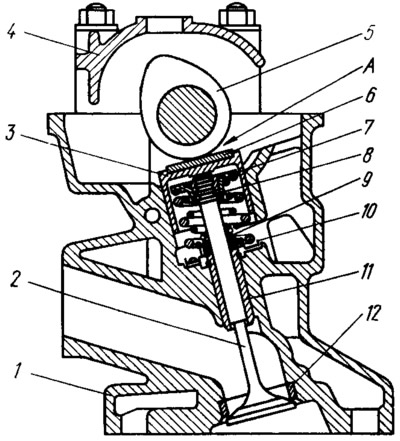
Figure 19. Section of the cylinder head at the intake valve:
1 - cylinder head: 2 - valve; 3 - pusher; 4 - camshaft bearing housing; 5 - camshaft; 6 - adjusting washer; 7 - spring plate; 8 - valve cracker; 9 - oil deflector cap; 10 - spring support washer; 11 - guide bushing; 12 - valve seat; A - the gap between the adjusting washer and the camshaft cam.
The working cycle in the engine cylinder occurs during two revolutions of the crankshaft, i.e. for four consecutive strokes (stroke) of the piston: the intake of the fuel mixture into the cylinder; compression; the working stroke during which combustion and expansion of the mixture occurs; exhaust gas release. The processes of intake of the combustible mixture and exhaust gas release (valve timing) are ensured by timely opening and closing of the corresponding valves (figure 20).
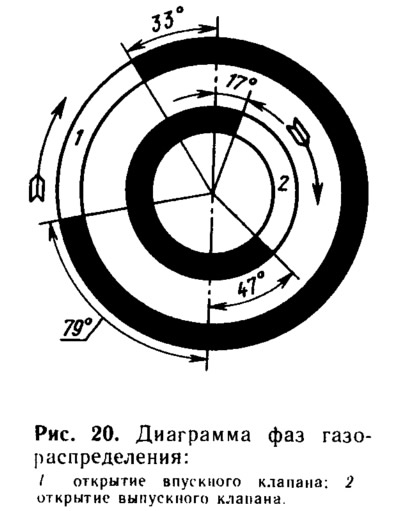
The intake valve begins to open even before the intake stroke, i.e. before the piston approaches TDC at a distance corresponding to 33° of crankshaft rotation. This is necessary so that the valve is fully open by the time the piston goes down. Then more fresh combustible mixture will enter through the intake port.
The intake valve closes with a delay, i.e. after the piston has passed BDC at a distance corresponding to 79° of crankshaft rotation. Due to the inertial pressure of the jet, the combustible mixture continues to enter the cylinder when the piston has already begun to move upward.
The exhaust valve begins to open before the working stroke is completely finished, i.e. before approaching BDC, at a distance corresponding to 47° of crankshaft rotation. At this point, the pressure in the cylinder is still quite high, and gases begin to exit the cylinder intensively, causing their pressure and temperature to drop rapidly. This significantly improves the cleaning of the cylinder from exhaust gases and protects the engine from overheating. Exhaust is completed after the piston passes TDC, i.e. after the crankshaft has turned another 17°.
From the valve timing diagram it is clear that there is a period (during a 50° crankshaft rotation) when both valves are open simultaneously - the intake and exhaust valves. Due to the short period of time, the overlap of the valves does not lead to the penetration of exhaust gases into the intake manifold; on the contrary, the inertia of the outgoing flow of exhaust gases causes the combustible mixture to be sucked into the cylinder and thereby improves its filling.
Cylinder head
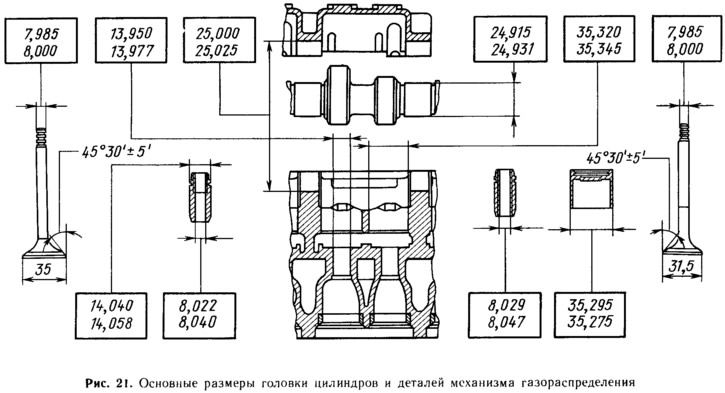
The valve timing mechanism parts are mounted on the cylinder head. The main dimensions of the cylinder head and valve timing mechanism parts are shown in Figure 21.
The head, common to all four cylinders, is cast from an aluminum alloy. It is exposed to high temperatures and gas pressure. Therefore, it has a rigid lower support part, which is intensively cooled by liquid. The wall thickness is made as uniform as possible to reduce internal stresses from thermal expansion.
The cylinder head contains wedge-shaped combustion chambers with inlet and outlet channels, which are brought out to the right side and connected to the corresponding pipelines through gaskets. Each combustion chamber has threaded holes for spark plugs, which come out to the left side of the cylinder head. On the left side there are also two channels for draining oil into the oil sump.
The free space inside the cylinder head forms a cooling jacket, which has an outlet to the outlet pipe on the rear side. The coolant temperature gauge sensor is screwed in on this side. Through the openings on the bottom side, the cooling jacket of the cylinder head communicates with the cooling jacket of the cylinder block. On the right side, through two openings, the coolant passes into the jacket of the intake manifold to heat the combustible mixture.
In the upper right part along the entire cylinder head there is a channel drilled for the oil line, from which oil is supplied to the camshaft supports through inclined channels, and through a horizontal channel to the right side to the oil pressure indicator lamp sensor.
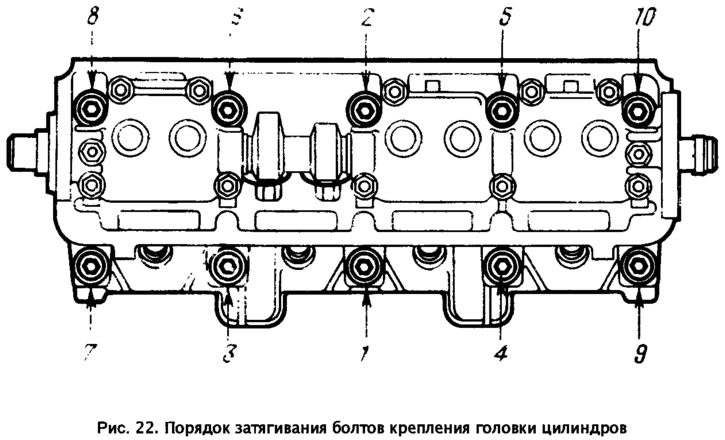
The head is attached to the cylinder block with ten bolts. To ensure uniform and tight fit, the bolts must be tightened on a cold engine in a specific sequence (figure 22) and in four steps: 1st - pre-tighten the bolts with a torque of 2 kgf·m; 2nd - tighten the bolts to a torque of 7.1... 8.7 kgf·m, 3rd - turn the bolts by 90°; 4th - tighten all the bolts again by 90 Since the bolts are tightened to the yield point, they stretch. Therefore, the bolts can only be reused if they have stretched to a length of no more than 135.5 mm (excluding bolt head). Two centering bushings around bolts 8 and 9 (see figure 22) ensure precise mutual arrangement of the cylinder head and block.
In the upper part of the cylinder head there are five bearings for the camshaft journals. The bearings are detachable. The upper half is in the bearing housings (front and back), and the lower one in the cylinder head. The holes in the supports are machined together with the bearing housings, so they are not interchangeable and the cylinder head can only be replaced together with the bearing housings.
The valve drive mechanism mounted on the cylinder head is covered with an aluminum cast cover. Along the entire perimeter of the lower surface of the cover there is a groove into which a sealing rubber gasket is inserted. The mounting studs are also isolated from the cover by rubber bushings. Thus, the cover does not directly contact the cylinder head. Therefore, vibration from the cylinder head is not transmitted to the cover and noise from the valve timing mechanism is reduced.
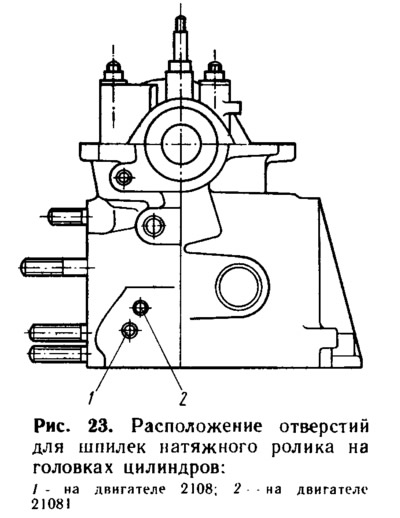
The same cylinder heads are installed on the 21081 and 2108 engines. But they have a difference in the installation location of the tension roller stud. On the 2108 engines, the stud is screwed into the lower hole 1 (figure 23), and on 21081 engines - into the upper hole 2.
The cylinder head of the 21083 engine differs from the 2108 head by increased diameters of the intake valves - 37 mm instead of 35 mm. Accordingly, the diameters of the intake valve seats and the diameters of the intake channels of the cylinder head are increased. The cylinder head number is cast on its left side, which is the front side due to the transverse arrangement of the engine on the car.
Cylinder head gasket
The cylinder head gasket is designed to provide a seal between the block and the cylinder head. It has a steel frame lined with asbestos on both sides. The frame keeps the asbestos from spreading. The edges of the cylinder holes are edged with aluminized steel, the hole for the oil passage to the camshaft is edged with copper tape, and the holes for draining oil into the crankcase have an additional sealing coating in the form of a roller of natural rubber 2 mm wide and 0.035 mm high.
When assembling the engine, always install a new gasket. Using a used gasket is not allowed, as it will not provide a seal. When installing the gasket, pay attention to the fact that the hole for the passage of oil (copper-banded) was located in the area of the 5th cylinder head mounting bolt (bolt number see figure 22).
The 2108 and 21081 engines use the same gaskets, while the 21083 uses a different one, with larger holes for the cylinders. They are easy to distinguish by their appearance. Thus, the 21083 gasket has a bridge between the holes for the cylinders of only 5 mm, and the holes themselves are circular. The 2108 gasket has a complex configuration of the holes for the cylinders, and the bridge between them is 7.9 mm.
Valve seats are made of special cast iron to ensure high strength under impact loads. Inlet valve seats are pressed into the cylinder head with an interference fit of 0.081...0.121 mm, and outlet valve seats - 0.071...0.111 mm.
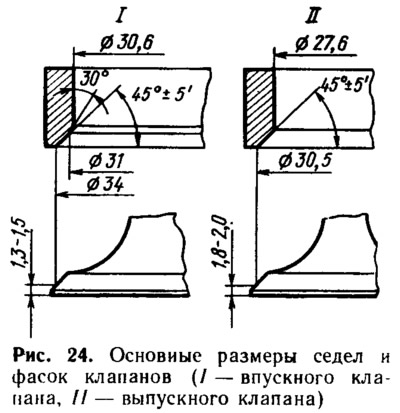
This tension is necessary to ensure that the seats are securely held in the cylinder head under high temperatures and impact loads. To facilitate the installation of the seats, they are either cooled in liquid nitrogen to -175°C before pressing, or the cylinder head is heated to 80°C. Working chamfers of valve seats (figure 24) after pressing, they are machined together with the cylinder head to ensure precise alignment of the chamfers and holes of the guide bushings.
Valve guide bushings
Valve guide bushings are made of cast iron and pressed into the cylinder head with an interference fit of 0.063...0.108 mm. Their outer surface has a groove into which a steel retaining ring is inserted. It ensures the accuracy of the bushings' position during pressing and prevents them from falling out.
The holes in the bushings are machined after they are pressed into the cylinder head. This ensures a narrow tolerance on the diameter of the hole and the accuracy of its location in relation to the working chamfers of the valve seat. Spiral grooves for lubrication are made in the holes of the guide bushings. The grooves are cut to half the length of the hole in the inlet valve bushings, and along the entire length of the hole in the outlet valve bushings.
On top of the guide bushings, caps made of heat- and oil-resistant rubber with a steel reinforcement ring are placed, which cover the valve stem and serve to reduce the penetration of oil into the combustion chamber through the gaps between the guide bushing and the valve stem.
Valves
The inlet valve is made of chromium-nickel-molybdenum steel. For better filling of the cylinder, its plate has a slightly larger diameter than the outlet valve plate.
The exhaust valve operates at high temperatures in an aggressive exhaust environment. Therefore, it is welded from two parts. The valve stem is made of chromium-nickel-molybdenum steel, which has high wear resistance and thermal conductivity for effective heat removal from the valve plate to its guide bushing. Heat-resistant chromium-nickel-manganese steel is used for the valve plate. In addition, a special heat-resistant alloy is fused onto the valve working chamfer to reduce wear.
To increase the wear resistance of the rods, both valves are nitrided, and the upper part of the rod is hardened with high-frequency currents.
The springs press the valve to the seat and prevent it from coming off the pusher. To avoid resonant vibrations, two springs are installed - an external and an internal one (see figure 19) with winding in one direction. The lower ends of the springs rest on the support washer. The upper support plate of the springs is held on the valve stem by two crackers, which have the shape of a truncated cone when folded.
Pushers 3 (see figure 19) valves transmit the force from the camshaft cam to the valve. They are steel cylindrical. The surface in contact with the valve is nitrocarburized to a depth of 0.2 mm to increase wear resistance. There is a socket for an adjusting washer in the upper part of the tappets.
Adjusting washers b (see figure 19) — flat steel nitrocarburized to a depth of 0.6 mm. The gap A between the cam and the washer is adjusted by selecting their thickness. Washers with a thickness of 3 to 4.5 mm with an interval of every 0.05 mm are supplied as spare parts. The thickness of the washer (numbers) is marked electrochemically on its lower surface.
The camshaft is a rod with cams and bearing journals. The shape and arrangement of the cams ensures the opening and closing of the valves in accordance with the order of cylinder operation (1-3-4-2) and the valve timing (see figure 20).
The camshaft is a cast iron five-bearing. On its rear side there is an eccentric for the fuel pump drive, and on the tailstock there is a groove for connection with the ignition distributor sensor coupling. The working surfaces of the cams, eccentric and the surface under the oil seal are bleached to increase wear resistance. This process consists of electric arc melting of the surfaces, as a result of which a layer of so-called "white" cast iron is formed, which has high hardness.
To prevent axial movement of the camshaft, a flange is provided at its rear end, which is fixed between the cylinder head (with bearing housing) and the auxiliary unit housing. The front end of the camshaft is sealed with a self-moving rubber seal.
Bearing housings
Bearing housings of the camshaft. The bearing journals of the camshaft rotate in holes that are half made in the cylinder head and half in the bearing housings (front and back). Bearing housings are cast aluminum. The first and second bearings are located in the front housing, and the third, fourth, and fifth bearings are located in the rear housing. The gap between the bearing holes and the camshaft journals is within 0.069...0.11 mm. The maximum allowable gap (wear) is 0.2 mm.
Each bearing housing is centered relative to the cylinder head by two mounting bushings placed on the mounting studs. To prevent oil leakage from under the bearing housings, a liquid self-hardening sealant such as SUPER THREE BOND No.50 or a similar domestically produced sealant KLT-75T is used. It is available in tubes and is applied with a tourniquet to the surface of the cylinder head in the area of the outer camshaft supports during engine assembly.
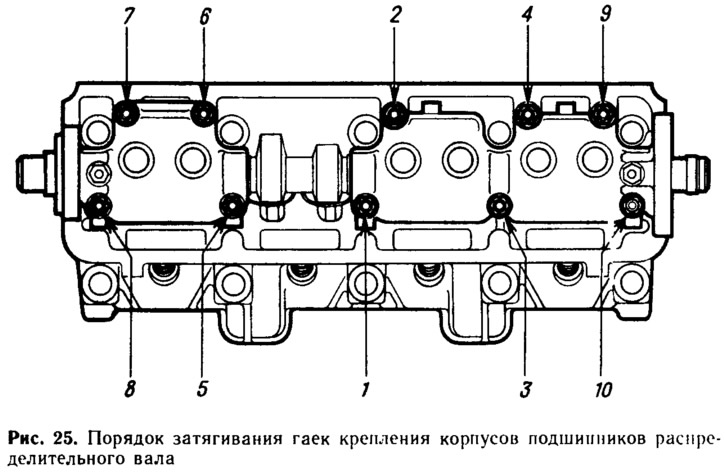
To avoid breakage or warping of the bearing housings, the camshaft should be placed in the supports with the cams of the first cylinder facing up, and the fastening nuts should be tightened in a certain sequence (figure 25) and in two stages. First, pre-tighten the nuts until the bearing housing surfaces are flush with the cylinder head. In this case, the housing mounting bushings should freely enter their sockets. Then finally tighten the fastening nuts with a torque of 2.2 kgf·m, observing the same sequence.
Camshaft drive
The camshaft drive consists of a toothed drive pulley 1 (figure 26) on the crankshaft, driven toothed pulley 5 on the camshaft, tension roller 3 and toothed belt 6. The same belt also drives pulley 2 of the coolant pump. The belt drive operates in a dry environment, without lubrication. It is protected from dust and dirt by front plastic and rear steel protective covers.
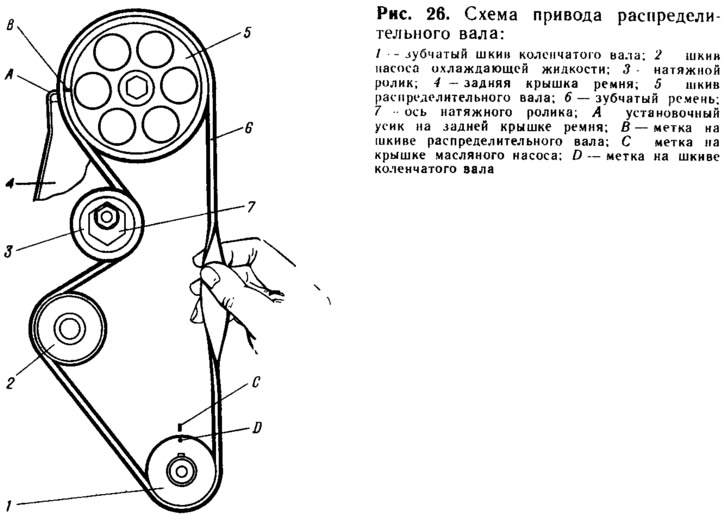
Figure 26. Camshaft drive diagram:
1 - crankshaft spongy pulley; 2 - coolant pump pulley; 3 - tension roller; 4 - rear belt cover; 5 - camshaft pulley; 6 - toothed belt; 7 - tension roller axis; A - mounting tab on the back cover of the belt; B - mark on the camshaft pulley; C - mark on the oil pump cover; D - mark on the crankshaft pulley.
The drive's special feature is a toothed elastic belt with semicircular teeth. It is made of oil-resistant rubber reinforced with fiberglass cord. The teeth are covered with elastic fabric to increase wear resistance. The cord and fabric shell are bonded to the rubber during vulcanization and give the belt high strength. Two branches of the belt together can withstand a breaking force of up to 1200 kgf.
The belt is tensioned by tension roller 3, which rotates on eccentric axis 7. By turning the axis relative to the fastening pin, the position of the roller's rotation center can be changed.
To coordinate the opening and closing moments of the valves with the crankshaft rotation angles (i.e. to ensure the correct installation of the valve timing), the crankshaft and camshaft pulleys are marked "B" and "D". The rear cover of the timing belt has a mark "A" (bent antennae), and on the oil pump cover there is a mark "C". If the valve timing is set correctly, then when the piston of the first cylinder is at TDC at the end of the compression stroke, the mark "B" on the camshaft pulley should coincide with the mark "A" on the rear cover, and the mark "B" on the toothed pulley of the crankshaft should coincide with the mark "C" on the oil pump cover.
The engine is located in the car so that the "C" marks are in a poorly visible area. Therefore, it is also possible to check the position of the crankshaft using the mark on the flywheel and the scale in the clutch housing hatch (see figure 30).