These gaps are necessary to ensure normal operation of the valve timing mechanism during thermal expansion of parts.
When the engine is running, the valves are heated up by hot gases, their rods are lengthened and the clearances are reduced almost to zero. If there are no clearances on a cold engine or they are smaller than the norm, then when the engine is running, the valves will remain slightly open. This will lead to overheating and a sharp reduction in the service life of the valves and seats, as well as to a decrease in compression in the cylinders, and therefore, engine power. If the clearances are too large, then impact loads and wear in the valve timing mechanism will increase. The engine will be accompanied by knocking. Therefore, very serious attention should be paid to adjusting the clearances.
To perform the adjustment, remove the air filter with the thermostat, disconnect the crankcase ventilation hose from the cylinder head cover, and the corrugated warm air supply hose from the warm air intake. Close the carburetor neck with a technological plug. Then disconnect the air and throttle valve drive cables from the carburetor and cylinder head cover.
Remove the cylinder head cover, disconnecting the crankcase ventilation hoses from it. Remove the front toothed belt cover, unscrew the spark plugs and remove the oil from the cylinder head oil baths. Inspect the camshaft cam surfaces: they should not have any scoring or damage.
The gap must be adjusted in the following order:
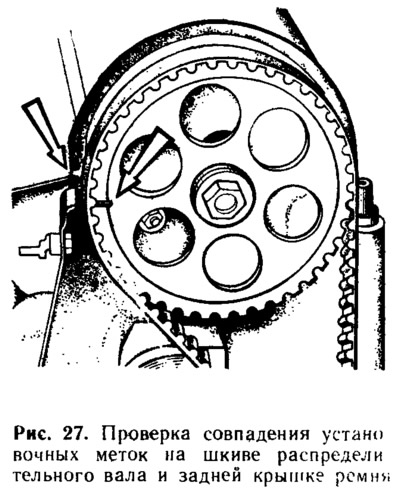
- turn the crankshaft until the timing marks on the pulley and the rear cover of the timing belt are aligned (figure 27), and then turn it another 40...50° (2.5...3 teeth on the camshaft pulley); in this case, the first cylinder will have a working stroke;
- check the clearances at the 1st and 3rd camshaft cams using a set of feeler gauges (cam numbers are counted in order from the camshaft pulley);
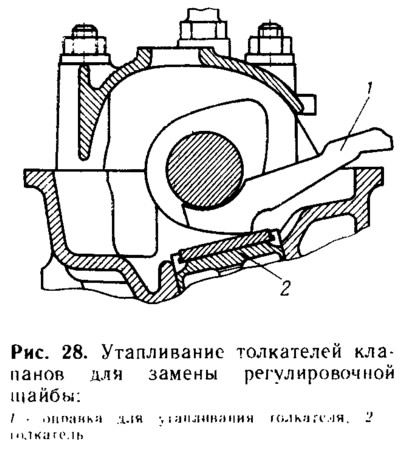
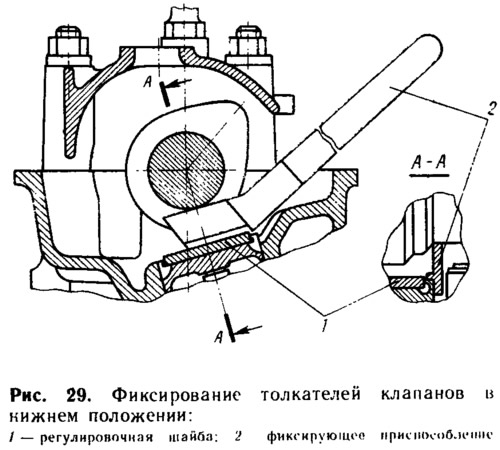
- if the gap differs from the norm, then turn the pusher with the slot towards you (the slots are located at the top of the pusher) and sink the pusher with mandrel 1 (figure 28), inserting it between the camshaft journal and the adjusting washer. Fix the tappet in the lower position with device 2 (figure 29), by installing it between the edge of the pushrod and the camshaft;
- remove the adjusting washer from the pusher using some device in the form of pliers with narrow jaws and a micrometer to measure its thickness;
- determine the thickness of the new washer using the formula:
H = B + (A - C),
where H is the thickness of the new washer; B — thickness of the removed washer; A - measured gap; C — nominal clearance.
Example. Let's say A = 0.26 mm; B = 3.75 mm; C = 0.2 mm (for intake valve), then:
H = 3.75 + (0.26 - 0.2) = 3.81 mm.
Within the clearance tolerance of ±0.05 mm, we take the thickness of the new washer to be equal to 3.8 mm.
- install a new adjusting washer into the pusher and remove the locking device; check the gap again. If it is adjusted correctly, then a 0.2 or 0.35 mm thick feeler gauge should enter with a slight pinch;
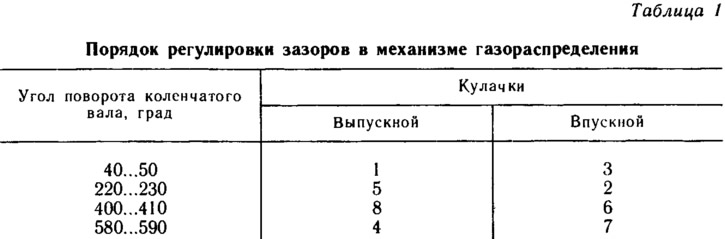
- successively turning the crankshaft by half a turn, which corresponds to turning the mark on the camshaft pulley by 90°, adjust the clearances of the remaining valves, observing the sequence indicated in Table 1.
After completing the adjustment, pour oil into the cylinder head oil baths, install the cylinder head cover and the front toothed belt cover. Install and adjust the air and throttle valve drive of the carburetor (see "Maintenance of the fuel system"). Install the air filter.
When adjusting, the crankshaft should only be turned clockwise, either by the crankshaft bolt or by the camshaft pulley using a lever-shaped device with two grips that fit into the pulley holes. Do not turn the crankshaft by the camshaft pulley mounting bolt, as this can damage the bolt.
(The original is posted on Internet resource: VAZBOOK)