




The car is equipped with a dry, single-disc clutch, permanently closed type, with a central pressure spring and a torsional vibration damper (damper) on the driven disk.
The clutch is located on the flywheel 7 (figure 56) and is closed by an aluminum housing, which is attached to the engine block. On the engine side, the upper and lower covers lean against the end surface of the clutch housing, and on the reverse side - the gearbox housing. On the inside of the upper cover, a scale 9 with divisions is welded, and a mark is made on the flywheel. The ignition timing is set and checked by mim. For this purpose, there is an inspection hatch in the upper part of the clutch housing. In addition to it, at the top of the housing 1, there is a hole for a plastic sleeve 14 of the clutch release fork. The lower end of the fork rests on a metal sleeve 2 pressed into the hole of the clutch housing lug.
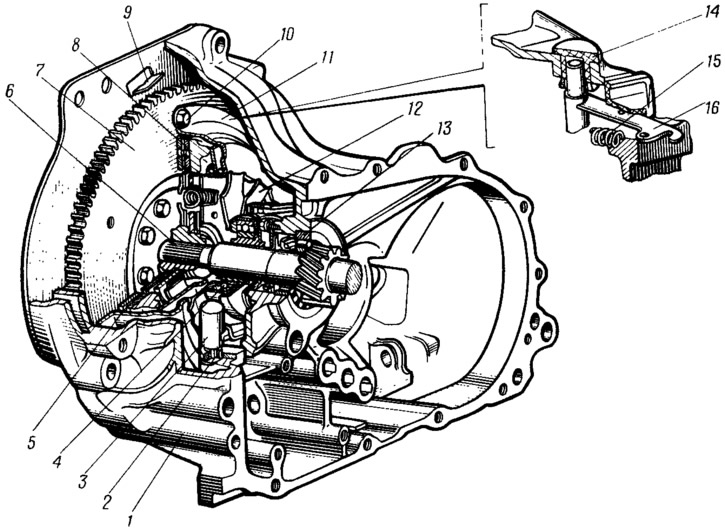
Figure 56. Clutch assembly:
1 - clutch housing; 2 - clutch release fork support sleeve; 3 - clutch release fork; 4 - clutch release bearing; 5 - driven disk; 6 - primary shaft of the gearbox; 7 - flywheel; 8 - pressure plate; 9 scale for checking ignition timing; 10 - bolt securing the clutch to the flywheel; 11 - clutch housing; 12 - clutch pressure spring; 13 - gearbox primary shaft bearing; 14 - clutch release fork bushing; 15 - clutch release fork lever release spring; 16 - clutch release fork lever.
The leading part of the clutch is a non-separable unit consisting of a casing 11, a pressure plate 8, a pressure spring 12 and a number of other parts. This unit is attached to the flywheel with six bolts 10. The accuracy of the unit's installation on the flywheel is ensured by three pins.
Pressure plate 11 (figure 57) is connected by three pairs of elastic plates 12 to the clutch housing 13. Such an elastic connection ensures the transmission of torque from the clutch housing to the pressure plate, as well as the axial movement of the pressure plate in the housing when the clutch is disengaged. In addition, the connecting plates, due to their elasticity, move the pressure plate away from the driven disk when the clutch is disengaged.
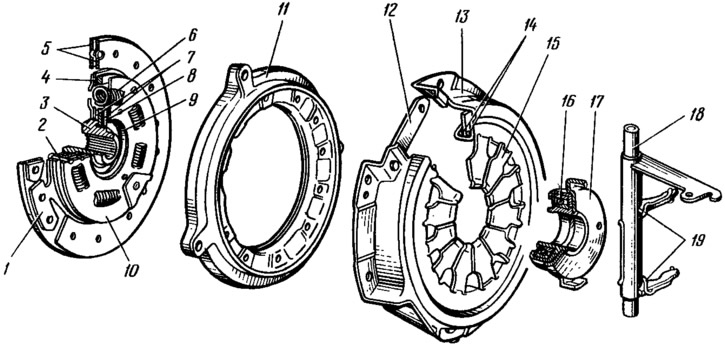
Figure 57. Clutch (detailing):
1 - slave disk; 2 thrust finger; 3 - driven disk hub; 4 - front plate of the torsional vibration damper (damper); 5 - friction linings; 6 - damper spring; 7 - friction ring; 8 - support ring; 9 - spring washer; 10 - rear damper plate; 11 - pressure plate; 12 plate connecting the clutch housing and the pressure plate; 13 - clutch housing; 14 - support rings of the pressure spring; 15 - pressure spring; 16 - clutch release bearing; 17 - clutch release bearing sleeve; 18 - clutch release fork; 19 - connecting spring of the clutch release bearing fork and sleeve.
Due to the rigid connection of the leading part of the clutch with the flywheel, the torque from it is transmitted directly to the parts of the leading part of the clutch both when engaged and when disengaged.
The clutch housing 13 is steel and stamped. The outer flange of the housing has holes for bolts and pins that attach it to the flywheel, and the inner flange has twelve projections, the ends of which are bent inward into the housing by 100...110°. This forms nests for support rings 14, which are welded to the clutch housing. These rings are supports for the pressure spring 15, relative to which it bends when the clutch is released.
The pressure spring is stamped from sheet spring steel in the shape of a truncated cone. The inner part of the pressure spring has radial slots that end in rectangular holes. The projections of the clutch housing enter these holes, which are then bent back. The slots form petals on the surface of the spring, which act as clutch release levers. The ends of the petals at the point of contact with the clutch release bearing are bent back to a rounded shape.
The pressure disk 11 is cast from cast iron. It has three bosses with holes for rivets, which are used to fasten the elastic plates 12. There are twelve ventilation slots on the annular projection of the disk.
(The material is posted on the website: «vazbook»)
The driven part of the clutch consists of a driven disk 1 assembled with friction linings 5 and a torsional vibration damper (damper). The driven disk is steel, with shaped slots dividing it into eight petals. Each petal has a flat section and two bends (bulges), due to which the surface of the steel disk has a wave-like shape. In order to preserve this shape, the friction linings 5 are riveted to each petal independently of each other, one to the convex part of the petal, the other (opposite) — to the flat section. The heads of the rivets are recessed into the holes of the linings, and their rods are riveted from the side of the disk. For access to the rivets, holes are made in the opposite lining.
The convex part of the petals creates uneven specific pressure on the surface of the linings and the surfaces of the flywheel and pressure plate that contact them: it is greater under the convex part of the petal, and less in the spaces between them. Only after the driven disk is fully compressed does the specific pressure on these surfaces equalize, which ensures smooth engagement of the clutch. At the same time, the driven disk initially slips relative to the surfaces of the flywheel and pressure plate, and the transmitted torque increases gradually. This protects the transmission parts from overloads and facilitates smooth starting of the car.
The driven disk is connected to the hub 3 through the parts of the torsional vibration damper, which creates an elastic connection between them. The need for a vibration damper is caused by the following. When the vehicle speed changes abruptly, when driving over uneven roads, when the clutch is abruptly engaged, and also due to uneven torque during the four-stroke cycle of the engine, dynamic loads arise in the vehicle transmission, causing twisting (unwinding) transmission shafts. Uneven engine torque can cause significant overloads in the transmission due to the occurrence of torsional vibrations and resonance when the frequencies of the transmitted loads coincide with the frequencies of the natural vibrations of the transmission. Elastic vibrations of the transmission lead not only to the occurrence of noise in the mechanisms and units, but also to dangerous vibrations, sometimes to breakdowns of parts when the amplitude of vibrations reaches a large value. The energy of torsional vibrations is absorbed by a damper.
It includes: front 4 and rear 10 plates, springs 6, thrust pins 2, friction rings 7, support ring 8 and spring washer 9. The listed parts connect the hub 3 with the driven disk 1. Flange 3 is clamped between friction rings 7 plates 4 and 10, which are connected to each other and to the driven disk by thrust pins 2 (with rivets). These pins pass freely through three horseshoe-shaped cutouts in the hub flange and limit the angle of rotation of the driven disk (together with damper plates) relative to the hub. Friction rings 7 (one is steel, the other is made of friction material) are pressed against the hub flange by a conical spring washer 9 through a support ring 8 with a force that ensures the movement of the driven disk relative to the hub (to the limit of the fingers) at a torque of 12 kgf·m. Additional resistance to rotation of disk 1 relative to the hub is created by three pairs of springs 6 of different elasticity and coloring (coating), laid in rectangular windows of the hub, disk and plates 4 and 10. Springs of the same color are located opposite each other. From falling out of the windows of the hub and disk, the springs are fixed by windows in plates 4 and 10, the size of which is smaller than the diameter of the springs.
The damping of torsional vibrations occurs due to the friction forces that arise when the disk 1 and plates move relative to the hub 3 and due to the elasticity of the springs. The amplitude of the elastic element of the damper of torsional vibrations is limited by three pins 2, which rest against the horseshoe-shaped cutouts of the hub.
The clutch is disengaged using a cable drive, the force from which is applied through lever 16 (see figure 56) is transmitted to the clutch release bearing 4.
The clutch assembly with the clutch release bearing is located on the guide sleeve, which is tilted with its flange toward the clutch housing. To the clutch projections with spring 19 (see figure 57) clutch release fork 18 is pressed. It rotates on bushings 2 (see figure 56) and 14. The place where the lever exits the crankcase is sealed with a protective cover.