




Open large image in new tab »
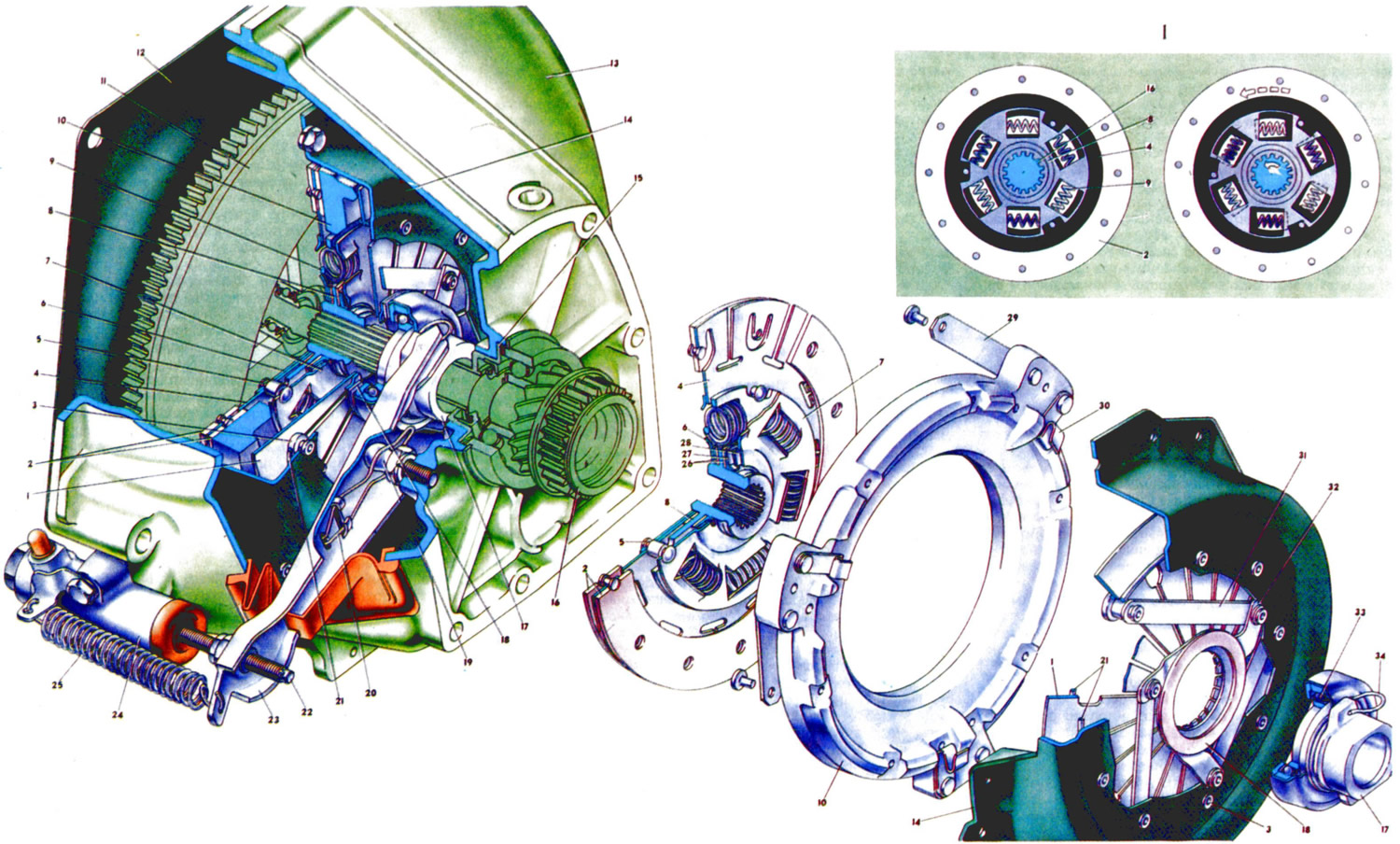
Fig. 14: 1. Pressure spring. 2. Friction linings of the driven disk. 3. Rivet for fastening the pressure spring to the clutch housing. 4. Driven disk. 5. Damper thrust pin. 6. Front plate of the damper. 7. Rear plate of the damper. 8. Driven disk hub. 9. Damper spring. 10. Pressure plate. 11. Flywheel. 12. Clutch housing cover. 13. Clutch housing. 14. Clutch housing. 15. Front cover of the gearbox. 16. Primary (drive) shaft of the gearbox. 17. Clutch release bearing sleeve. 18. Friction ring of the thrust flange. 19. Ball joint of the clutch release fork. 20. Spring of the clutch release fork. 21. Pressure spring support ring. 22. Clutch release fork plunger. 23. Clutch release fork. 24. Slave cylinder. 25. Clutch release fork return spring. 26. Damper friction ring. 27. Damper support ring. 28. Damper disc spring. 29. Plate connecting the pressure plate to the clutch housing. 30. Pressure spring retainer. 31. Plate connecting the thrust flange to the clutch housing. 32. Thrust flange. 33. Clutch release bearing. 34. Spring connecting the fork to the clutch release bearing sleeve. I - Damper action diagram.
The car has a classic layout with the front engine parallel to the longitudinal axis of the car and rear drive wheels. With this layout, the torque from the engine is transmitted to the drive wheels through the following transmission units: clutch, gearbox, cardan transmission and rear axle mechanisms (main gear, differential, axle shafts).
The transmission of the cars is characterized by a high degree of unification of parts, mechanisms and units with other models of cars of the Volga Automobile Plant, low labor intensity of technical maintenance, reliability and durability, consistent with the service life of the car before major repairs.
The clutch ensures a smooth connection of the flywheel 11 with the primary (drive) shaft 16 of the gearbox when the car starts moving. In this case, the torque from the crankshaft is smoothly transmitted through the transmission elements to the drive wheels of the car, which ensures a smooth start of the car. At the moment of gear shifting, as well as during braking, the clutch disconnects the engine crankshaft from the transmission, stopping the transmission of torque to the drive wheels, due to which conditions are created for shock-free gear shifting, wear of the brake mechanisms of the wheels and transmission parts is reduced and more effective braking occurs. VAZ cars use two types of clutch: 2103 and 2121. The first type of clutch is used on cars equipped with engines with a working volume of 1.2; 1,3; 1.5 l, the second type on cars with engines with a working volume of 1.6 l. To distinguish the leading parts of the clutch (clutch housing with pressure plate and spring) on the 2121 clutch, there is a mark in the form of a hole with a diameter of 6 mm in one of the slots of the petal of the pressure spring. The driven disks also differ in both shape and width of the friction linings. The 2103 clutch has a friction lining width of 29 mm, while the 2121 clutch has a width of 35 mm, and they are riveted with a large number of rivets.
The clutch is single-disk, dry, of a permanently closed type. The principle of operation is based on the transmission of torque from the flywheel to the primary shaft of the gearbox due to the friction forces that arise between the surfaces of the flywheel 11, driven 4 and pressure 10 disks when they are compressed. The driven disk, located on the splines of the primary shaft of the gearbox, is clamped between the flywheel and the pressure disk by the force of spring 1. The force must be such as to prevent slippage of the driven disk, otherwise the torque will not be fully transmitted to the drive wheels, and the disks will wear out intensively due to slippage.
[Information taken from the website vazbook.ru]
If the driven disk is connected to the primary shaft of the gearbox, then the pressure disk 10 together with the clutch housing 14 is bolted to the flywheel. Thus, some parts have a permanent connection with the flywheel, others are temporary, due to friction forces when the clutch is engaged. The first parts make up the leading part of the clutch, the second - the driven part. The pressure disk is removed from the driven part, i.e. the clutch is disengaged, via a hydraulic drive.
The parts that make up the leading and driven parts of the clutch are mounted on the flywheel and covered by the housing 13, which is attached to the end of the engine block. Between the engine block and the clutch housing, a stamped cover 12 is installed, closing the cavity of the clutch housing.
The leading part of the clutch is made as a separate non-separable unit, which includes the clutch housing 14, the pressure plate 10, the central pressure spring 1 and a number of other minor parts. This unit is attached to the flywheel with six bolts with spring washers. Precise installation of the leading part of the clutch on the flywheel is ensured by three installation pins pressed into the flywheel.
The clutch housing is stamped from steel. It has a concave shape, forming a cavity in which the pressure spring and pressure plate are located. The flanged part of the housing has holes for the pins and fastening bolts. One support ring 21 is welded inside the housing, on which one side of the pressure spring rests. The pressure spring 1 is fastened to the clutch housing with rivets 3. The rivets pass through the oval holes of the pressure spring. Another support ring 21 of the pressure spring rests against the heads of these rivets. Such a hinge joint allows the spring to sag relative to the support rings.
The pressure spring is stamped from spring steel. Radial slots divide its surface into separate petals, which act as clutch release levers. These petals are affected by the thrust flange 32, which is pressed against them by# due to the elasticity of the connecting plates 31. The friction ring 18 is glued to the outer surface of the thrust flange.
The outer edge of the pressure spring enters the grooves of the clamps 30, which are riveted to the pressure disk. Through the clamps, when the pressure spring deflects relative to the support rings 21, the pressure disk is moved away from the driven one.
The pressure plate 10 is cast iron. It has the shape of a ring with three lugs. The pressure plate is connected to the clutch housing by three pairs of elastic plates 29, which are riveted at one end to the lugs of the pressure plate, and at the other end to the clutch housing. Such a connection ensures the transmission of torque from the housing 14 to the pressure plate and, at the same time, the axial movement of the pressure plate inside the clutch housing.
The working surface of the pressure plate is ground. Its annular projection has 12 ventilation slots, which improve the cooling of the disk. The clamps 30 are fastened with rivets in three slots.
The leading part of the clutch is balanced. The permissible imbalance should not exceed 250 gf mm. Balancing is achieved by drilling out the metal in the lugs of the pressure plate.
The driven part of the clutch consists of a driven disk 4 with friction pads 2 and a torsional vibration damper (damper).
Driven disk - steel; T-shaped radial slots divide it into twelve petals. Each petal has a flat section and two bends (bulges), due to which the surface of the disk has a wave-like shape. In order to preserve this shape, friction linings 2 are riveted to each petal independently of each other, one to the convex part of the petal, the other (opposite) to a flat section. The rivet heads are recessed into the lining holes, and their rods are riveted on the disk side. Holes are made in the opposite lining to access the rivets. This type of lining fastening preserves the wave-like shape of the driven disk surface, which is necessary for smooth clutch engagement, since the driven disk gradually becomes flat as the pressure on its surface increases. At the same time, the driven disk initially slips relative to the surfaces of the flywheel and pressure plate, and the transmitted torque increases gradually. This ensures smooth starting of the car and protects the transmission parts from overloads.
The driven disk is connected to the hub 8 not rigidly, but elastically through the damper parts. Such an elastic connection ensures the damping of torsional vibrations that occur in the transmission due to uneven engine operation and transmitted dynamic loads.
The hub bore has splines for connection with the splines of the primary shaft 16 of the gearbox. Six windows and three horseshoe-shaped cutouts are made in the hub flange. Thrust pins 5 pass through these cutouts, which connect the front 6 and rear 7 plates of the damper and the driven disk 4. The ends of the thrust pins are riveted. The same windows are made in the front and rear plates of the damper and in the driven disk as in the flange of the hub 8. Springs 9 are located in these windows, which are kept from falling out by the flanging of the windows in both plates of the damper. The springs have different elasticity, which expands the area of action of the damper. Stiffer springs are painted light. They are installed between springs of less elasticity.
Friction rings 26 are installed on both sides of the hub flange. The disc spring 28, through the support ring 27, creates a constant friction moment between the surfaces of the friction rings and the hub flange.
When torsional vibrations occur, with a sharp change in the vehicle speed or with a sharp engagement of the clutch, the driven disk moves together with the damper plates relative to the hub 8. In this case, the friction element of the damper and the springs are triggered. The resistance they create dampens impact loads and torsional vibrations, protecting transmission parts from breakage and intensive wear. The action of the elastic element of the damper is limited by three stop pins 5, which rest against the horseshoe-shaped cutouts of the hub.
The clutch is released, i.e. the pressure plate is moved away from the driven plate, via a hydraulic drive controlled by the clutch pedal. The force from the clutch pedal is transmitted via the hydraulic drive to the clutch release fork 23, and from it to the clutch release bearing sleeve 17.
The fork 23 rests on the ball joint 19 and is held on it by a flat or round figured spring 20. The spring is attached to the fork, and the ball joint is screwed into a threaded hole in the clutch housing. A pusher 22 passes through the outer end of the fork, onto which an adjusting nut and a lock nut are screwed. The fork is pressed against the hemispherical surface of the adjusting nut by spring 25. To prevent the fork from flying off the pusher when disconnecting the spring, a cotter pin is installed on its end. The hatch through which the end of the fork exits the housing is sealed with a protective cover. The adjusting nut changes the working length of the pusher 22. In this case, the gap between the clutch release bearing and the friction ring 18 of the thrust flange changes, which should be 1.5-2 mm, which corresponds to a free travel of the clutch release fork pusher of 4-5 mm. To hold the pusher when turning the adjusting nut and lock nut, it has two flats for a key.
The coupling 17 of the clutch release bearing is located on the guide sleeve of the front cover 15 of the gearbox. The bearing 33 of the clutch release is pressed onto the coupling. The inner end of the clutch release fork is pressed against the coupling lugs by the spring 34.