




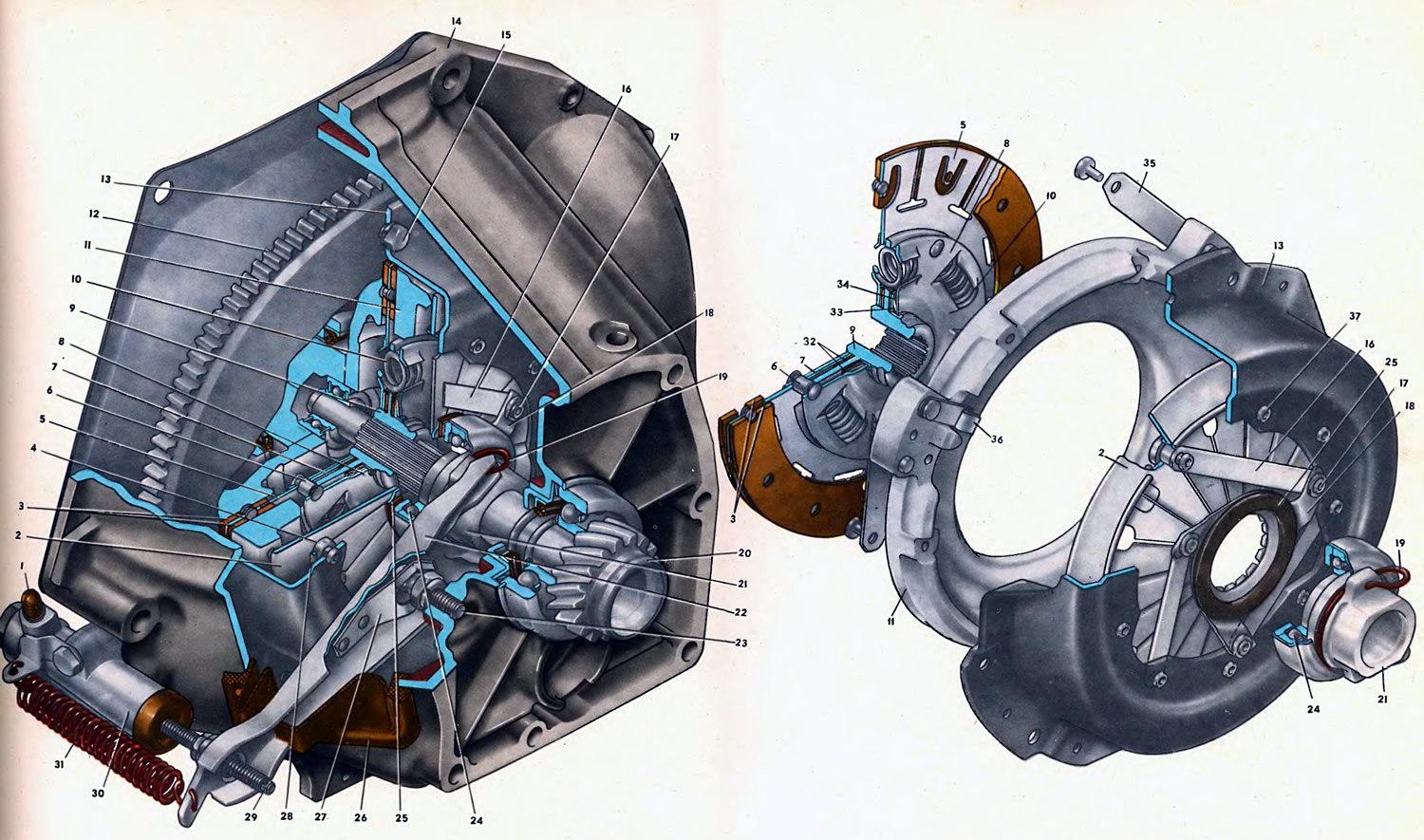
Open large image in new tab »
1. Clutch hydraulic air bleed nipple. 2. Diaphragm clutch pressure spring. 3. Clutch slave disk friction linings. 4. Clutch pressure spring rivet. 5. Slave clutch disk. 6. Thrust pin. 7. Front damper plate. 8. Rear damper plate. 9. Slave clutch disk hub. 10. Damper spring. 11. Clutch pressure plate. 12. Engine crankshaft flywheel. 13. Clutch housing. 14. Clutch housing. 15. Clutch housing fastening bolt. 16. Connecting plate of thrust flange to clutch housing. 17. Rivet for fastening connecting plate to thrust flange. 18. Thrust flange of pressure spring. 19. Connecting spring of clutch release fork and sleeve. 20. Gearbox input shaft. 21. Clutch release sleeve. 22. Clutch release fork. 23. Ball joint of fork. 24. Clutch release sleeve bearing. 25. Thrust flange friction ring. 26. Clutch release fork boot. 27. Clutch release fork retaining plate. 28. Support ring of pressure spring. 29. Clutch release fork plunger. 30. Clutch release drive slave cylinder. 31. Clutch release fork return spring. 32. Damper friction ring. 33. Support ring of Belleville spring. 34. Belleville spring of friction ring. 35. Connecting plate of pressure plate with clutch housing. 36. Clutch pressure spring retainer. 37. Rivet for fastening the pressure spring and the connecting plate of the thrust flange.
The clutch is one of the transmission mechanisms that transmits torque from the engine to the driving rear wheels. The clutch is designed to temporarily disconnect the engine from the transmission and smoothly connect them when shifting gears and starting the car from a standstill, and the damper built into the clutch is also designed to reduce torsional vibrations of the engine and transmission.
The operating principle of such a mechanism is based on the use of friction forces between the engine flywheel with the pressure plate and the driven clutch disc.
On VAZ-2101, 2102 and 2103 cars, the clutches are not much different from each other and will gradually be unified on all models.
The clutch used is highly reliable, simple and technologically advanced, durable, consistent with the service life of other transmission mechanisms, requires little labor for maintenance during operation, and is easy to operate.
The clutch drive from the pedal to the release fork is hydraulic.
The clutch is dry, single-disc, with a diaphragm pressure spring. It is called dry because for normal transmission of engine torque, the surfaces of the driven and pressure plates must be dry. The driven disk assembly and the pressure plate with a casing, a diaphragm spring and a thrust flange of the release drive are the main parts of the clutch. In addition, the clutch includes a release sleeve with a bearing, a release fork with a support, the main and working cylinders of the drive with hoses for supplying fluid, a feed tank and a drive pedal with an amplifier (servo spring) and tension springs.
The clutch is located together with the engine flywheel inside the aluminum crankcase 14, to the rear end of which the gearbox is attached with seven studs and nuts. The clutch cavity is closed in front by a stamped steel cover.
The pressure plate and diaphragm spring of the clutch are placed in a stamped steel casing 13, secured to the flywheel 12 with six bolts 15 with spring washers.
The accuracy of the mutual arrangement of the clutch housing and flywheel is ensured by three installation pins. To ensure that the mutual arrangement of the parts does not change after disassembling the clutch for repair and checking the technical condition, marks should be applied to the housing and flywheel before disassembling.
The diaphragm spring 2 creates the necessary force pressing the driven disk, and at the same time does not require a large force to engage the clutch. The spring is placed between the pressure disk 11 and the casing 13 and is pivotally connected to it by means of support rings 28. The inner part of the spring has petals formed by radial slots ending in oval holes. The petals work as clutch release levers, interacting with the thrust flange 18 moving in the axial direction under the action of the clutch release sleeve 21. The thrust flange 18 with the friction ring 25 is constantly pressed against the petals of the diaphragm spring by plates 16. The spring is connected to the pressure disk by three locks 36. Through the locks 36, the pressure disk is moved away from the driven one when the outer edge of the diaphragm spring moves back at the moment of clutch release. The pressure plate 11 of the clutch is connected to the casing 13 of the clutch by three tangentially arranged connecting plates 35. In this case, the ends of the plates 35, attached to the pressure plate with rivets, lie in the same plane with the contact surface of the pressure plate with the driven one, which eliminates the occurrence of vibrations. The uniform tangential arrangement of the three plates 35 ensures the centering of the pressure plate 11, as well as the transmission of rotation to it from the casing 13, maintaining the possibility of axial movement of the pressure plate when disengaging the clutch.
It should be noted that the connecting plates 35, due to their location, work in tension during normal clutch operation, which reduces the possibility of breakage.
The annular stop of the pressure plate has 12 ventilation slots, in three of which the clamps 36 of the pressure spring are installed.
The pressure plate with the casing and spring assembly are statically balanced; the imbalance is no more than 20 gf cm. Balancing is performed by drilling out the metal in the pressure plate lugs.
The driven disk 5 of the clutch, transmitting rotation from the engine to the drive shaft of the gearbox, is clamped between the flywheel and the pressure plate by a diaphragm spring 2. The torque of the engine shaft is transmitted from the friction linings to the hub of the driven disk through a torsional vibration damper (damper), which prevents the transmission of torsional vibrations. Torsional vibrations are caused by the actions of variable torques created by the pressure of gases in the working cylinders and the inertial forces of the translationally moving masses.
The damper dampens torsional vibrations due to friction of friction rings 32, arising during movement of disk 5 and plate 8 relative to hub 9. Movements occur due to elasticity of six springs 10, installed in windows of hub 9, disk 5 and plates 7 and 8. Cutouts on plates 7 and 8 are made with flanges, holding springs from falling out. In this way dangerous influence of torsional vibrations on engine and transmission within operating modes is excluded, and also stresses in transmission elements are reduced during occurrence of instantaneous dynamic loads during sharp change of speed mode.
The hub 9 of the driven disk is installed on the splines of the drive shaft of the gearbox with the protruding part towards the gearbox.
The hub flange has six rectangular windows for installing pre-compressed springs 10 of the damper and three U-shaped cutouts measured around the circumference for the passage of the damper thrust pins.
The springs 10 of the damper have different rigidity; the stiffer springs are painted with light paint. The installation of two types of springs expands the damper's characteristics as an absorber of system vibrations, increases the working area of the elastic element (springs) of the damper.
The fingers 6 of the damper, connecting the disk 5 with the front 7 and rear 8 plates of the damper, act as limiters of the action of the elastic element, thereby maintaining its strength. When the fingers 6 reach the edge of the U-shaped cutouts of the hub, the compression of the springs in the windows between the hub and the disk 5 with the damper plates stops, and the movement of the disk and plates relative to the hub also stops.
Friction rings 32, installed on both sides of the hub flange 9, are an element of the torsional vibration damper. From the front side of the hub flange 9, disk 5 is pressed against ring 32, from the rear - to the second such ring, support ring 33, on which the inner edge of the disk spring 34 presses. The outer edge of the disk spring 34 rests against the plate 8 of the damper. In a free state, the disk spring 34 has a conical shape, and after the assembly of the driven disk it becomes flat.
The nonlinear characteristic of the disc spring ensures an almost constant axial force within the limits of its significant deformation, and therefore the wear of the rubbing surfaces of the friction rings 32 that occurs during the operation of the vehicle has little effect on the magnitude of the damping moment, and consequently, its ability to dampen torsional vibrations that arise in the engine and transmission.
The driven disk 5, hub 9, plates 7 and 8 with springs 10 placed between them, two friction rings 32, support ring 33 and disc spring of the friction element of the damper after riveting the ends of three pins 6 make up one non-separable unit.
The magnitude of the friction moment of the friction element of the damper, absorbing the energy of torsional vibrations of the engine crankshaft, depends on the material of the friction rings and the tension between the parts, which is determined by the height of the middle part of the thrust pins, the thickness of the rings 32, 33, the flange of the hub 9 and the force of the disc spring 34.
Friction linings 3, independently of one another, are riveted with six aluminum or copper rivets to the petals of the driven disk. The rivets, holding their lining, are sunk into it with their heads, and holes are made in these places in the opposite friction lining.
When engaging the clutch with such a design of fastening the friction linings, the driven clutch disc becomes flat gradually, as the pressure on it increases, and the clutch engages smoothly, since due to the slippage of the disc until the moment of its complete pressing, the transmitted torque increases gradually.
The clutch is disengaged when the clutch 21, moving along the fixed guide sleeve, presses through the thrust flange 18 and the friction ring 25 onto the petals of the diaphragm spring 2.
The clutch release fork 22, which swings on the ball joint 23 and is held on it by the plate 27, rests on the thrust projections of the coupling 21 and is pressed against them by the spring 19. To prevent turning, the clutch release coupling has chamfers.
To prevent dust and dirt from entering the clutch housing, the window in the housing used for the passage of the fork is covered with a rubber boot 26.