




The clutch is mounted on the flywheel and is covered by an aluminum housing, which is bolted to the cylinder block. On the other side, the clutch housing is connected to the gearbox housing.
The driven clutch disc is freely mounted on the splines of the primary shaft of the gearbox, divided by radial slots into twelve sectors. Friction linings made of a special material are riveted to the driven clutch disc on both sides. Torque from the driven clutch disc to its hub is transmitted through a spring damper (torsional vibration damper).
The leading part of the clutch (basket) is attached to the flywheel with six bolts. The clutch basket includes a pressure plate, a casing and a diaphragm pressure spring. The pressure plate is movably fixed on elastic plates inside the casing. Under the action of the diaphragm spring, the driven clutch disk is clamped between the pressure plate and the flywheel.
The clutch is released by pressing the clutch pedal. The upper end of the cable is pivotally attached to the clutch pedal. The lower end of the cable is pivotally connected to the clutch release fork, the axle of which is mounted on two plastic bushings in the clutch housing.
The clutch release bearing is a ball, radial thrust bearing. The clutch release bearing sleeve is placed on the guide sleeve and is pressed against the clutch release fork by a spring. When the clutch fork is turned, the release bearing moves longitudinally along the guide sleeve.
The clutch release bearing is constantly pressed against the petals of the diaphragm pressure spring and rotates with it.
When the clutch is engaged, its leading and driven parts rotate as a single unit, transmitting torque from the engine crankshaft to the primary shaft of the gearbox. When the clutch pedal is pressed, the clutch release fork, turning, moves the release bearing with its sleeve along the guide sleeve. The clutch release bearing acts on the diaphragm spring, which, bending, moves the pressure plate away from the driven one and the transmission of torque stops. When the pedal is released, all clutch parts return to their original position under the action of the springs.
Adjusting the clutch drive (pedal stroke) is carried out by changing the position of the lower end of the cable sheath in its mounting bracket.
(The information is published on the website: «VazBook»)
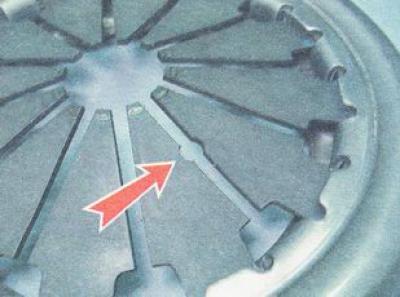
On cars with VAZ 2112 (1.5i) and VAZ 21124 (1.6i) engines, the leading and pressure plates of the clutch are installed, which are not interchangeable with other front-wheel drive VAZ models. They can be distinguished by the hole between the petals of the diaphragm spring...
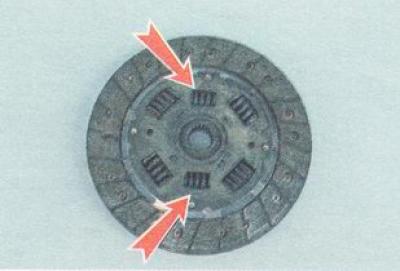
...and two damper springs offset to the center.
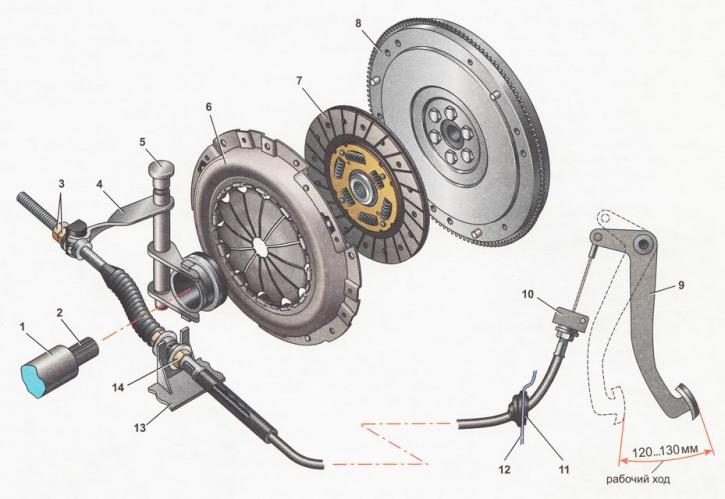
Device, diagram of the clutch on the VAZ 2110 car: 1 - Clutch release bearing guide sleeve; 2 - primary shaft of the gearbox; 3 - cable adjusting nuts; 4 - clutch release fork; 5 - clutch release fork axle bushing; 6 - pressure plate assembly (clutch basket); 7 - driven clutch disc; 8 - engine flywheel; 9 - clutch pedal; 10 - cable sheath bracket; 11 - anther; 12 - Engine compartment partition; 13 - bracket on the gearbox housing; 14 - cable sheath fastening nuts