




Avoid excessive force or uncontrolled movement of doors, trunk lids and hood, which may cause damage and/or abrasions to the doors and bodywork, for which the manufacturer is not responsible.
To avoid scratches on the paintwork of the car body, do not remove dust and dirt with dry wiping material. In order to preserve the car, it is necessary to wash it before the dirt dries with a stream of water at low pressure using a soft sponge and using car shampoos that create protective films from environmental influences.
ATTENTION! Do not wash your car with soda or alkaline solutions, or with waste water or other products not intended for washing cars.
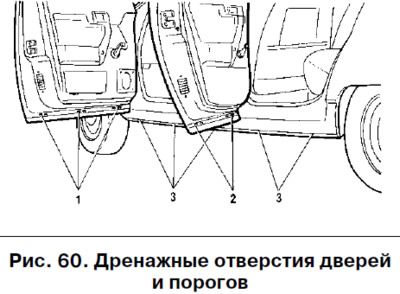
Before washing your car, clean the drainage holes in the doors and sills (Fig. 60).
ATTENTION! Due to the presence of car wash machines with different brush unit designs on the market, washing a car using brush wash machines may result in the loss of gloss of the paintwork and a decrease in its protective properties. Therefore, before washing, ask the car wash operator about the design, technical condition of the brushes and the degree of their impact on the paintwork of your car.
In summer, wash your car outdoors in the shade. If this is not possible, then immediately wipe the washed surfaces dry, as when water droplets dry in the sun, stains form on the painted surface. In winter, after washing your car in a warm room, wipe the body and door seals dry before driving out, as when the remaining drops freeze, cracks may form in the paintwork and the seals may freeze to the body.
ATTENTION! Do not wash your car with the ignition on.
When washing your car, avoid direct water jets on electrical equipment, electronic devices, sensors and detachable connections in the engine compartment. Monitor the condition of the protective covers of the detachable connections of electronic units and sensors. If moisture gets in, blow the detachable connections with compressed air and treat them with a water-repellent car preparation to protect the contacts from oxidation.
When washing, thoroughly wash the door flanges, hood, trunk lid, welded seams and joints of the engine compartment, trunk and door openings, since accumulated dirt in these areas will lead to the destruction of the protective and decorative coating and to metal corrosion.
ATTENTION! If signs of corrosion appear (including welded joints and butts), as well as damage to the paintwork (chips, scratches, abrasions) and other protective coatings (chipping and abrasion of mastic and primer) it is necessary to contact the PSSS authorized by the manufacturer to take measures to prevent further development of corrosion, restore and repair paint and protective coatings.
Timely measures taken to prevent the development of the corrosion process on the body and other parts of the car will extend its service life and preserve its marketable appearance for a long time. If you fail to take timely measures to eliminate corrosion processes on the body, the manufacturer is not responsible for the further condition of the body of your car.
To increase the corrosion resistance of the body, a special anti-corrosion compound is applied to the closed box-shaped cavities of the thresholds, side members, cross members and other elements of the body base. When operating a car, it is necessary to carry out anti-corrosion treatment of the body on the PSSS during the first year of operation and periodically once a year according to the technology developed by the manufacturer.
ATTENTION! After anti-corrosion treatment of the body with an anti-corrosion compound on the PSSS, it is necessary to check the exhaust system (neutralizer, main and additional muffler) to check for the absence of a composition on the specified parts to prevent possible combustion.
During vehicle operation, the coating on the underbody, as well as the paintwork on the lower parts of the front and rear fenders, are subject to abrasive wear from exposure to gravel, sand, and salt. As a result of this exposure, the mastic and primer wear out, and the exposed metal rusts. Therefore, regularly monitor the condition of these coatings and promptly restore damaged areas.
To maintain the shine of painted surfaces of the car (especially for vehicles stored outdoors) polish them regularly using polishing pastes. These pastes close microcracks and pores that have appeared in the paint coating during use, which prevents corrosion from occurring under the paint layer.
To ensure that the car body surface retains its shine for a long time, do not leave the car in the sun for a long time, and do not allow acids, soda solutions, brake fluid and gasoline to come into contact with the car body surface.
To prevent stains on the paintwork under the fuel filler flap from gasoline, wipe the surface with a clean cloth before and after refueling.
[The original can be viewed on the portal VAZbook.ru]
Due to the unfavorable environmental conditions in some areas, there are cases of aggressive impact of individual components from the environment on the protective and decorative coatings of the car. These impacts are manifested in the form of a red rash, local color change of the external paint coating, local destruction of the enamel coating of the body.
The cause of the appearance of the red rash is the deposition of tiny particles of airborne metal dust on the horizontal surfaces of the body, which is glued to the body by corrosion products during wetting with dew. The red rash can be removed with a 5% solution of oxalic acid with the addition of a detergent and abundant subsequent rinsing with clean water by specialists authorized by the PSSS.
Local changes in colour (spots) of the external paintwork and local destruction of the enamel coating of the body are the result of exposure to acidic industrial emissions after their combination with air moisture. Such effects, depending on the severity, are eliminated by polishing or repainting the body.
Wipe plastic parts with a damp cloth. Do not use gasoline or solvents, as the plastic parts will lose their shine.