




Each drive consists of two constant velocity joints (CV joints) and shafts connecting the joints. The short shaft of the left drive is made of a steel rod, the long shaft of the right drive is made of a steel pipe. The tail of the inner joint housing is connected to the differential axle gear using a splined connection. The joint transmits torque to the drive shaft regardless of the angle between the joint housing and the shaft. The inner joint is designed so that it not only transmits torque at different angles, but also allows for mutual axial movement of the joint housing and the suspension drive shaft while the vehicle is moving. The outer joint transmits torque from the drive shaft to the drive wheel hub, to which it is connected using a splined connection. The splined end of the outer joint housing is attached to the hub with a nut.
The hinges are protected from dirt and moisture by dust covers (protective rubber covers), secured with steel band clamps.
Note: The following describes the work on removing, repairing and installing the left drive. All work on the right drive is performed similarly.
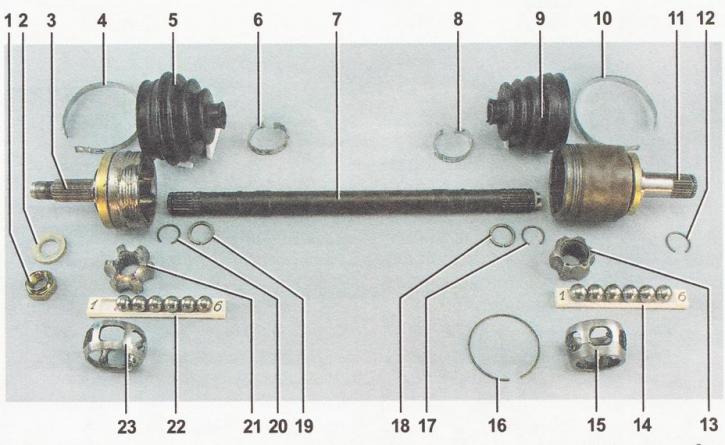
Front wheel drive car parts: 1 - special hub nut; 2 - nut thrust washer; 3 - outer hinge housing; 4 - large clamp of the outer joint boot; 5 - CV joint boot (external hinge); 6 - small clamp of the outer joint boot; 7 - left drive shaft; 8 - small clamp of the inner joint boot; 9 - CV joint boot (internal hinge); 10 - large clamp of the inner joint boot; 11 - inner hinge housing; 12 - retaining ring of the inner hinge shank; 13 - inner race of the inner joint; 14 - inner joint balls; 15 - inner joint separator; 16 - inner hinge lock; 17 - inner joint cage retaining ring; 18 - thrust ring of the inner joint cage; 19 - thrust ring of outer joint cage; 20 - outer joint cage retaining ring; 21 - inner race of the outer joint; 22 - outer joint balls; 23 - outer joint separator.
Note: The right drive shaft is longer and made of pipe.