




Contents: Removal the CV joint ↓ Installing CV joints ↓
Recommendation. During each vehicle maintenance, the condition of the CV joint boots should be checked. If the boot is torn, dirt that gets into the inner cavity of the joint will completely disable the CV joint after several hundred kilometers of vehicle travel. A faulty CV joint must be replaced as an assembly. If the boot rupture was detected before the CV joint failed, the joint can be disassembled and washed, replacing the CV joint boot and grease.
To carry out repair work you will need:
- special pliers for installing clamps for fixing the anther joints (see point 9 "Special tools and devices") or sliding pliers;
- sliding circlip pliers;
- cV joint grease 40 cc.;
- new CV joint boot;
- new hinge locking and retaining rings.
Removal the CV joint
1. Remove the front wheel drive assembly (see "Drive wheel - removal and installation").
2. The ends of all four inner and outer joint clamps on both shafts point in the direction opposite to the drives' forward rotation. To ensure proper assembly, if the clamps are to be reused, use a marker to mark them to indicate the direction of rotation.
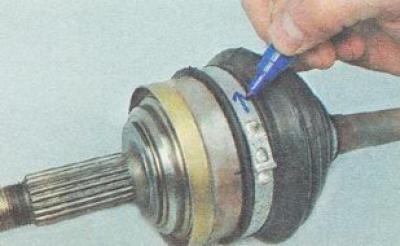
3. Using large sliding pliers or special tongs, squeeze the large clamp and, using a slotted screwdriver, disconnect the clamp lock holding the CV joint boot.
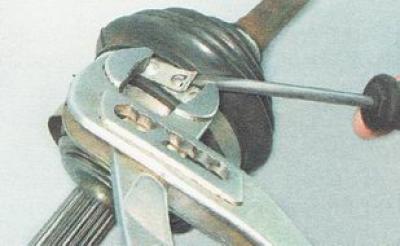
4. In the same way, remove the small clamp of the outer joint boot.
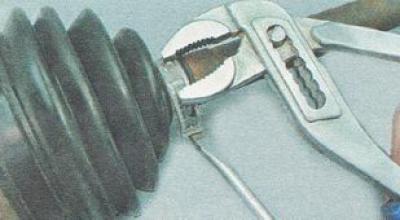
5. Secure the drive shaft in a vice. Use a slotted screwdriver to pry up and remove the CV joint boot from the outer joint housing.
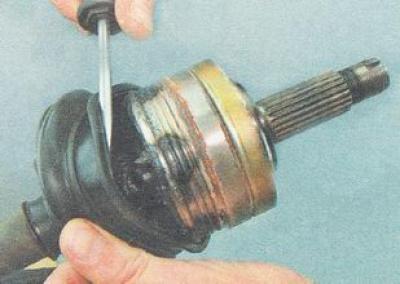
6. Cut off the CV joint boot with a knife.
Warning: If the CV joint is to be reused, do not strike the separator or the joint housing.
7. By striking the inner CV joint race with a soft metal punch, we press the outer joint off the drive shaft.
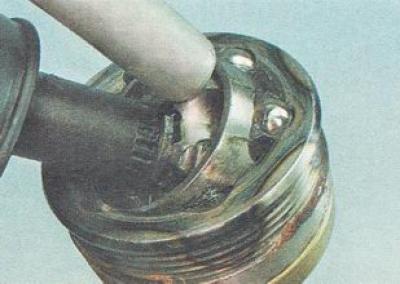
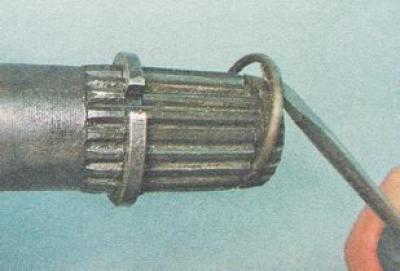
8. Using a slotted screwdriver, pry up and remove the retaining ring from the drive shaft splines.
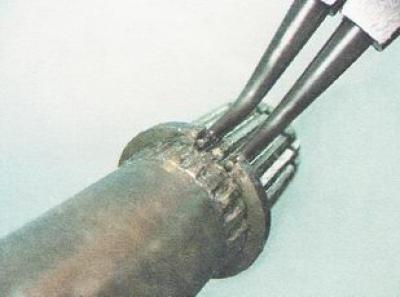
9. Using expansion pliers, remove the thrust ring.
10. Wash the joint in kerosene, wipe with a clean cloth and let dry.
Installing CV joints
1. To avoid damaging the new CV joint boot during installation, wrap the shaft splines with tape or electrical tape.
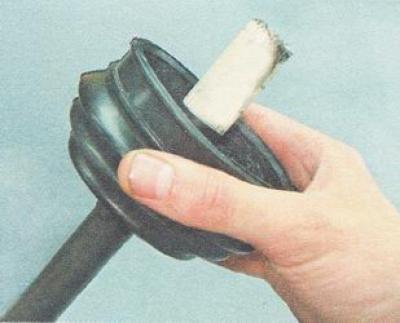
2. Put a new CV joint boot on the shaft, move the boot to the center of the shaft and remove the adhesive tape.
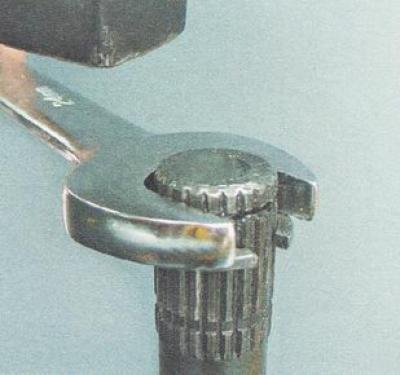
Helpful Hint: Do not use a socket head to install the thrust washer. The internal chamfer found on almost all sockets will compress the washer, preventing it from being installed on the shaft.
3. Secure the drive shaft in a vice in a vertical position. Using a 24 mm open-end wrench as a mandrel, install a thrust ring on the splined end of the shaft.
The text is on the website VazBook.ru
4. Install the retaining ring in the same way.
5. Lubricate the shaft splines with CV joint grease.
6. Install the hinge on the splined end of the shaft. Using a wooden spacer, press the hinge onto the shaft until it is secured with a locking ring.
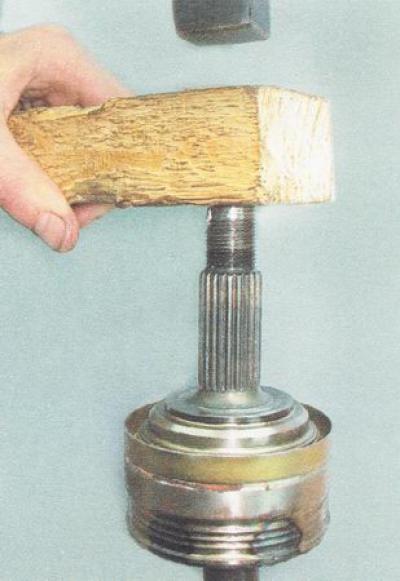
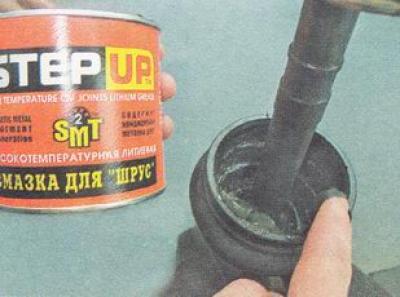
Warning: The outer joint requires 40 cc of grease.
7. Fill the joint with constant velocity joint grease. The remaining 40 cm³ of grease is placed in the CV joint boot.
8. Move the CV joint boot towards the joint so that the large sealing belt of the boot is completely placed on the joint housing, and the small sealing belt fits into the groove of the shaft.
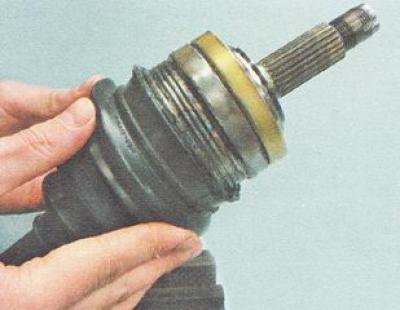
9. By lifting the small diameter sealing belt with a slotted screwdriver, we release excess air from the inner cavity of the boot.
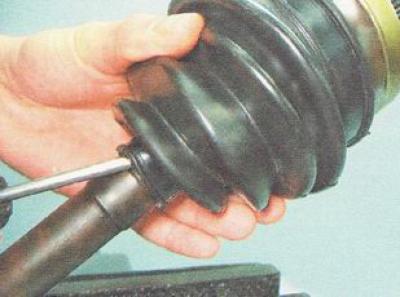
10. Using sliding pliers or special clamp installation pliers and a slotted screwdriver, install the large and small boot clamps. Install the CV joint boot clamps taking into account the direction of drive rotation. The outer end of the clamps should be directed in the direction opposite to the drive rotation when moving forward.
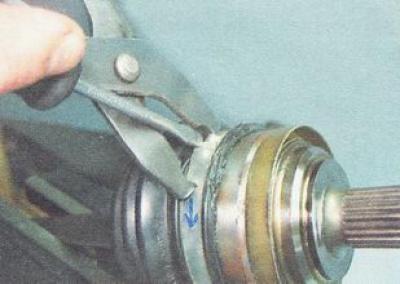
Recommendation: Before installing the assembled drive, be sure to install a new retaining ring on the splined tailpiece of the inner joint.
11. Install the front wheel drive on the vehicle (see "Installation", p. 1-5 "Drive wheel - removal and installation").