




The five-speed gearbox is designed on the basis of the four-speed gearbox previously installed on the Sputnik family of vehicles (Fig. 1).
The main difference of the five-speed gearbox is the additional fifth gear, the gears of which are installed in a larger rear cover. Otherwise, the designs of the gearboxes are identical, so the features of the general design are considered using the example of a four-speed gearbox; the features of the five-stage are shown separately in Fig. 2.
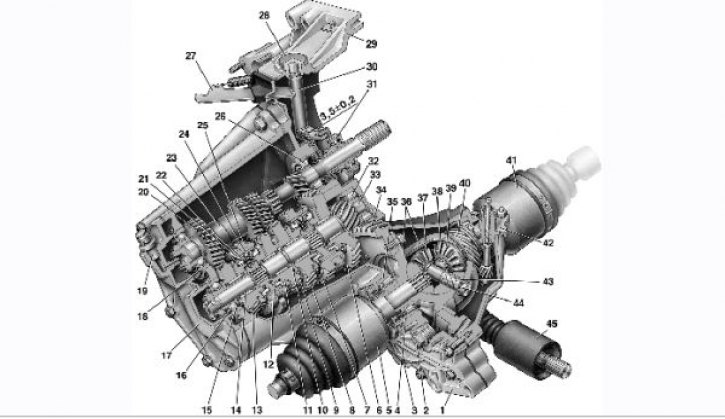
Four-speed gearbox: 1 – box housing; 2 – filler and inspection hole plug; 3 – drain plug; 4 – adjusting ring; 5 – left front wheel drive; 6 – driven gear of the 1st gear of the secondary shaft; 7 – synchronizer clutch of 1st, 2nd gears with reverse gear ring; 8 – driven gear of the 2nd gear of the secondary shaft; 9 – retaining ring; 10 – thrust half ring; 11 – driven gear of the 3rd gear of the secondary shaft; 12 – hub of synchronizer clutch of III and IV gears; 13 – driven gear of the IV gear of the secondary shaft; 14 – secondary shaft gear needle bearing; 15 – thrust washer of the fourth gear; 16 – secondary shaft ball bearing; 17 – rear cover of the gearbox; 18 – primary shaft ball bearing; 19 – breather; 20 – synchronizer locking ring; 21 – sliding clutch of synchronizer III and IV gears; 22 – retainer cracker; 23 – primary shaft; 24 – retainer ball; 25 – fork of sliding clutch of synchronizer of III and IV gears; 26 – primary shaft roller bearing; 27 – clutch release fork lever; 28 – clutch release fork bushing; 29 – clutch housing; 30 – clutch release fork; 31 – clutch release bearing; 32 – secondary shaft roller bearing; 33 – secondary shaft; 34 – driven gear of the main transmission; 35 – differential tapered roller bearing; 36 – differential box; 37 – satellite; 38 – axle gear retaining ring; 39 – axle gear; 40 – speedometer drive pinion; 41 – right front wheel drive; 42 – speedometer drive; 43 – satellite axis; 44 – satellite axle retaining ring; 45 – protective cover of the gear shift drive hinge
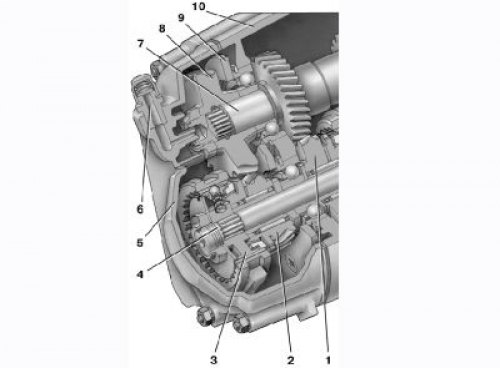
Rear of the five-speed gearbox: 1 – driven gear of the IV gear of the secondary shaft; 2 – driven gear of the V gear of the secondary shaft; 3 – V gear synchronizer; 4 – secondary shaft; 5 – rear cover of the gearbox housing; 6 – breather; 7 – primary shaft; 8 – leading gear of the 5th gear; 9 – thrust plate for bearing mounting; 10 – gearbox housing
Note: In later production gearboxes, the oil filler and inspection hole plugs have been eliminated and replaced with a dipstick installed in the upper part of the crankcase.
The primary shaft 23 (see Fig. 1) is made in the form of a block of driving gears, which are in constant engagement with the driven gears of all forward gears. They are located on needle bearings on the secondary shaft 33.
In addition to them, two synchronizers are installed on the shaft. The main gear drive pinion is manufactured together with the secondary shaft. The differential is double-satellite. The preliminary tension in the differential bearings is adjusted by selecting the thickness of ring 4.
The driven gear 34 of the main transmission is attached to the differential box flange. The five-speed gearbox has extended primary and secondary shafts at the output of the crankcase.
On this part of the shafts are located the leading 8 (see fig. 2) and the driven 2 gears of the 5th gear and its synchronizer 3. In this box, the sleeve 12 (see Fig. 3) is not installed in the gear selection mechanism.
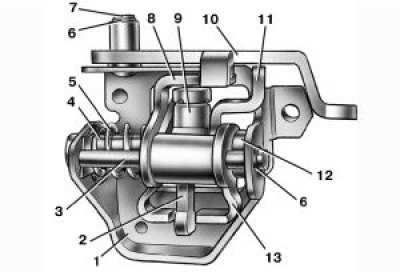
Gear selection mechanism: 1 – gear selection mechanism housing; 2 – gear selection lever (forward running); 3 – guide axis of the locking brackets; 4 – gear selector lever axis; 5 – spring; 6 – retaining ring; 7 – reverse fork axle; 8, 13 – locking brackets; 9 – gear selector lever lock; 10 – reverse gear fork; 11 – gear selection lever (reverse); 12 – thrust sleeve
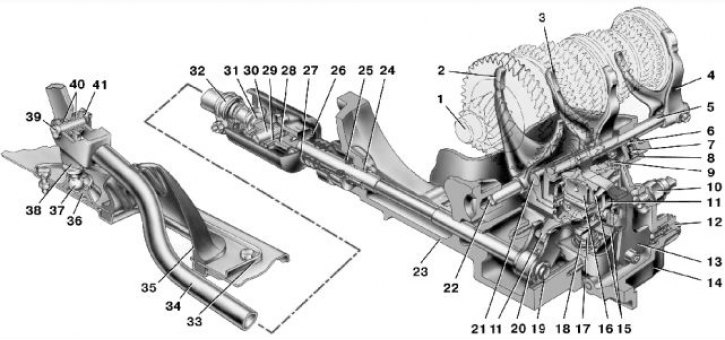
Gearbox control drive: 1 – secondary shaft; 2 – fork for shifting 1st and 2nd gears; 3 – fork for shifting III and IV gears; 4 – V gear engagement fork; 5 – V gear engagement fork rod; 6 – retainer ball; 7 – retainer spring; 8 – retainer cover; 9 – guide axis of locking brackets; 10 – Reversing light switch; 11 – three-arm gear selector lever; 12 – Reverse gear fork retainer plug; 13 – reverse gear fork; 14 – gearbox housing; 15 – locking brackets; 16 – gear selection mechanism housing; 17 – gear selector lever axis; 18 – gear selector lever spring; 19 – gear selection rod; 20 – gear selection rod lever; 21 – fork rod for shifting III and IV gears; 22 – fork rod for shifting 1st and 2nd gears; 23 – clutch housing; 24 – bushing; 25 – rod seal; 26 – conical screw for fastening the hinge; 27 – hinge protective cover; 28 – gear shift drive rod hinge housing; 29 – hinge bushing; 30 – hinge axis; 31 – hinge tip; 32 – gear shift drive rod clamp; 33 – gear shift lever housing; 34 – gear shift drive rod; 35 – protective cover of the traction; 36 – ball joint of the lever; 37 – spherical lever pin; 38 – gear shift lever; 39 – lever axis; 40 – lever axle bushing; 41 – locking bracket.
The gearbox control drive consists of a gear shift lever 38 (Fig. 4), a ball joint 36, a rod 34, a gear selection rod 19 and gear selection and shifting mechanisms. A lever 20 is fixed to the inner end of the rod 19, which acts on the three-arm lever 11 of the gear selection mechanism.
This mechanism is made as a separate unit and is attached to the plane of the clutch housing 23. In the housing 1 (Fig. 3) of the gear selection mechanism, two axles are fixed. On the axle 4, a three-arm gear selection lever, two locking brackets 8 and 13, and also a bushing 12 are installed.
The other axis 3 passes through the hole in the hub of the locking brackets, fixing them from turning. The arm of the gear selection lever 2 serves to engage forward gears, the arm 11 - to engage reverse gear, and the third arm is acted upon by the lever 20 (see Fig. 4) of the gear selection rod 19.
A locking device 9 is mounted in the hub of the gear selector lever (see fig. 3). A fork 10 for engaging reverse gear is installed on the axis 7. Gearboxes are produced with different final drive ratios.
To distinguish the secondary shaft, grooves are machined on its toothed rim: two on the left (the crown of the shaft is located to the right of the observer) for 17-tooth crown, one on the left for 16-tooth crown, one on the right for 15-tooth crown.
The driven gears of the main transmission are marked with the gear ratio (for example, "65/15").
To distinguish gearboxes by final drive ratios, they are marked with paint. The marking is applied to the upper part of the gearbox housing: "01" for a gear ratio of 3.9; "02" for gear ratio 4.1; "03" for gear ratio 3.7; "00" for gear ratio 4.1 of a five-speed gearbox.
Helpful Hints: The manufacturer does not provide clear recommendations on oils used for the gearbox. Either motor oil or various transmission oils are recommended. Therefore, decide which oil to use depending on the operating conditions of the vehicle.
If the car is used mainly in big city conditions with frequent gear shifting, use motor oil, as this ensures a relatively long service life of the synchronizers.
If you have to drive mainly on highways at high speeds, but with relatively rare gear changes, it is better to use transmission oil that provides an increase in the service life of gears and bearings with a slight decrease in the durability of synchronizers.
When filling the gearbox, try to pour a little more oil into it (approximately 100 ml), than recommended by the manufacturer. This will ensure better operating conditions for the bearing of the V gear, located high in the crankcase and lubricated only by splash.