




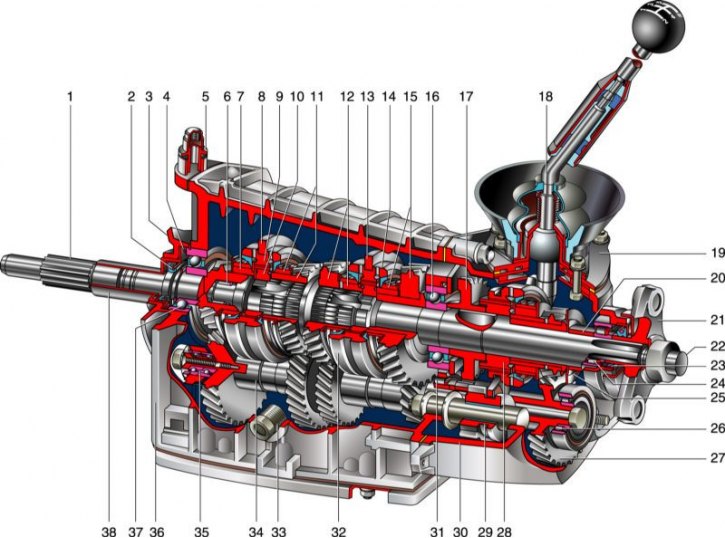
1 – primary shaft; 2 – primary shaft seal; 3 – clutch housing; 4 – spring washer; 5 – breather; 6 – secondary shaft needle bearing; 7 – toothed ring of the 4th gear synchronizer; 8 – fork for shifting III and IV gears; 9 – sliding clutch of synchronizer III and IV gears; 10 – hub of synchronizer clutch of III and IV gears; 11 – gear and ring gear of the synchronizer of the third gear; 12 – gear and toothed ring of the 2nd gear synchronizer; 13 – fork for shifting 1st and 2nd gears; 14 – clutch for switching 1st and 2nd gears; 15 – gear and toothed ring of the 1st gear synchronizer; 16 – secondary shaft intermediate bearing; 17 – V gear; 18 – gear shift lever; 19 – gear shift lever housing; 20 – spacer sleeve; 21 – elastic coupling flange; 22 – secondary shaft; 23 – secondary shaft rear bearing seal; 24 – secondary shaft rear bearing; 25 – oil deflector washer; 26 – bearing of the gear block of the 5th gear and reverse gear; 27 – block of gears of the 5th gear and reverse gear; 28 – 5th gear synchronizer hub; 29 – intermediate reverse gear; 30 – back cover; 31 – intermediate shaft rear bearing; 32 – sliding clutch of synchronizer of 1st and 2nd gears; 33 – filler plug; 34 – intermediate shaft; 35 – front bearing of intermediate shaft; 36 – gearbox housing; 37 – rear bearing of the primary shaft; 38 – guide sleeve.
Gearbox - mechanical, with manual shifting, has five forward gears and one reverse, all forward gears are synchronized. It is unified with the 2107 gearbox; only the rear cover is slightly different: the hole for the speedometer drive is closed with a plug, since the Niva speedometer is driven from the transfer case. Currently, the 2105 gearbox is used for all gearboxes.
The gearbox housing parts – the clutch housing, the gearbox housing itself and the rear cover – are cast from an aluminum alloy and are pulled together with studs and nuts. The connections are sealed with cardboard gaskets (you can use sealant during repairs). To improve heat dissipation, the gearbox housing surface is ribbed. The bottom of the housing is covered with a stamped steel cover with a gasket (fastened with studs). The clutch housing is bolted to the engine cylinder block. To ensure the alignment of the crankshaft and the primary shaft of the gearbox, the housing is centered on two bushings (grooves are made for them in the mounting holes of the block and crankcase). The third support of the power unit is installed on the rear cover of the gearbox. It is attached to the crossbar, and the latter is attached to the floor of the body (on welded bolts).
There is a filler hole on the left side of the gearbox housing (control) hole, in its lower cover - drain. The holes are closed with plugs with a conical thread. There is a magnet in the drain plug. It holds back steel particles that get into the oil when parts wear out. A breather is screwed into the upper part of the clutch housing. It prevents the pressure in the gearbox from increasing when it heats up. If the breather is faulty, (jamming of the cap) there may be a strong oil leak through the seals.
The gearbox has three shafts: primary, secondary and intermediate. The primary shaft rests on two ball bearings - at the rear end of the crankshaft and in the front wall of the gearbox housing (the latter bears the brunt of the load). A needle bearing is installed in the rear end of the primary shaft, which is the front support of the secondary shaft and ensures the alignment of the shafts. The secondary shaft also rests on a ball bearing in the rear wall of the gearbox housing and a roller bearing in its rear cover. The intermediate shaft rotates in two bearings: the front one is a double-row ball bearing located in the front wall of the gearbox housing, and the rear one is a roller bearing located in its rear wall. Through the reverse gear block and 5th gear, the intermediate shaft also rests on a roller bearing in the rear cover of the gearbox. The axis of the reverse intermediate gear is also fixed on the rear wall of the gearbox housing.
The primary shaft has two gear rims. The helical gear rim, located closer to the front wall of the crankcase, is in constant engagement with the front gear of the intermediate shaft (thus, these shafts always rotate together). The straight-toothed ring gear of the primary shaft is the ring gear of the 4th gear synchronizer (when it is engaged, the torque is transmitted directly from the primary shaft to the secondary shaft, bypassing the intermediate shaft, which is why this gear is often called "direct").
The intermediate shaft is a block of four helical gears. When any gear except IV is engaged, torque is transmitted to the secondary shaft through the intermediate shaft. The intermediate shaft gears are arranged in the following order (from its front end): gear of constant engagement with the primary shaft, gears of III, II, I gears. A block of two gears is attached to the rear end of the shaft with a bolt: reverse (straight-toothed) and V gear (helical). It is additionally supported by a roller bearing in the rear cover of the gearbox.
The secondary shaft contains driven gears for III, II, I gears, reverse gear and V gear (in order, counting from the front end of the shaft) and synchronizers. The driven gears of the forward gears are in constant engagement with the corresponding gears of the intermediate shaft. The gears of the III and II gears rotate on the hardened journals of the secondary shaft, the gears of the I and V gears - on the bushings. The driven gear of the reverse gear is rigidly fixed to the shaft with a key. The crowns of their synchronizers - spur gears of a smaller diameter - are made at the same time as the helical gears of the forward gears. They are directed towards the corresponding synchronizer (III, I, V - forward, II - backward). At the rear end of the secondary shaft, the flange of the elastic coupling is fixed with a nut. Previously, the nut was fixed from unscrewing by placing a lock washer under it - its edges were bent to the edge of the nut. Now, an anaerobic sealant is applied to the thread, and the washer is not installed.
The synchronizer consists of a hub rigidly fixed to the secondary shaft, a sliding clutch, a retaining ring, a blocking ring, and a spring with a washer. The hubs of the synchronizers of III-IV and I-II gears enter the grooves on the secondary shaft with their internal projections, and the hub of the synchronizer of the V gear is held by the same key as the driven reverse gear pinion. On the outer surface of the hubs there are splines along which the sliding clutches move. On the clutches there are recesses into which the forks of the gearshift rods enter. The blocking rings are connected with their internal rims to the rims of the synchronizers of the corresponding gears and are pressed by springs towards the sliding clutches. The springs rest on the side surface of the driven gears through washers.
The reverse gear does not have a synchronizer. To engage it, you need to engage the intermediate gear with the driven gear of the secondary shaft and with the leading reverse gear in the rear gear block on the intermediate shaft.
The gearbox control drive consists of three rods connected to forks. The forks for engaging forward gears enter the grooves of the synchronizer sliding clutches, and the fork for engaging reverse gear enters the groove on the intermediate gear.
The gear selector mechanism consists of a guide plate with eight rectangular cutouts in the center, upper and lower washers, the gearshift lever and its housing, and a reverse locking bracket. These parts are pulled together by three bolts, which secure the gear selector mechanism to the rear cover of the gearbox. The "neutral" position of the lever between III and IV gears is set by two pairs of spring-loaded guide strips installed in the grooves of the guide plate and acting on the lower end of the lever. Accidental engagement of reverse instead of V gear is impossible due to the bent petal of the locking bracket, which rests on the protrusion on the lever. To engage reverse gear, you need to press the lever down - in this case, its protrusion falls below the petal of the bracket.
The gearbox parts are lubricated by splashing. The primary and secondary shafts are sealed with oil seals, and on the secondary shaft behind the driven gear of the 5th gear there is an oil deflector washer. The gearbox is filled with transmission oil with a viscosity of 75W80 to 85W90 and a quality class of at least GL-4. Its level should be at the lower edge of the filler hole (first make sure that the car is level).