




Most often, the engine stops due to the cessation of gasoline flow into the carburetor mixing chambers or failure of the ignition system. In most cases, such reasons can be eliminated on the spot without much time expenditure, after which you can continue driving. However, this can only be done with a rational sequence of actions in the process of finding a specific malfunction and knowledge of the techniques necessary for checking the serviceability of the relevant devices.
Once you have made sure that there is gasoline in the fuel tank, you need to check whether it is entering the carburetor mixing chambers. To do this, remove the carburetor air filter cover and, looking into the primary (right in the direction of vehicle movement) mixing chamber, open the throttle valves fully by sharply pressing the end of their drive rod with your hand; at the same time, a stream of gasoline should appear from the accelerator pump sprayer, which, when the engine is hot, can immediately turn into clearly visible steam (at night, a portable lamp or flashlight should be used to illuminate the mixing chamber). If a trickle of gasoline appears, you can assume that the fuel system is in order (this same check, in particular, indicates the serviceability of the accelerator pump); in this case, you need to put the air filter cover back in place and start checking the ignition system, which will be discussed below.
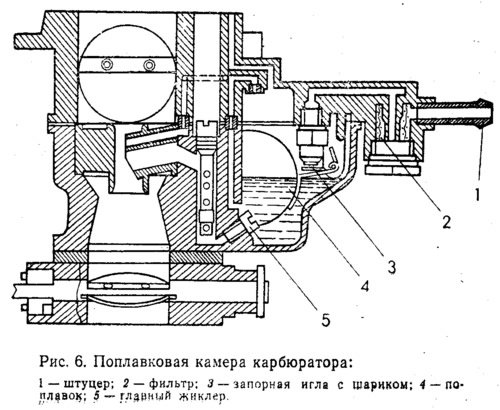
If there is no stream of gasoline, check whether it is supplied to the float chamber of the carburetor. To do this, remove the air filter housing and disconnect the gasoline line from the carburetor; then, having first put the gearshift lever into neutral and applied the handbrake, remove the high-voltage central wire from the induction coil cover and, directing it forward (in the direction of the car) and down the end of the removed fuel line, ask an assistant to turn on the starter for 5-10 seconds. Check whether gasoline comes out of the fuel line in the form of a strong pulsating stream (it is not advisable to use the manual fuel pump lever instead of the starter, since it may turn out that the fuel pump supplies gasoline when pumped manually, but does not do so when normally driven by a running engine). If gasoline comes from the fuel pump, it should be assumed that the fuel filter is clogged with dirt (2 in Fig. 6) in front of the float chamber, the fuel channel in the needle valve seat or the main jet is clogged (5 in Fig. 6) primary chamber. In this case, you need to remove the carburetor fuel filter, clean it from dirt and blow it out; after this, you need to blow out the needle valve with a pump with a conical tip screwed into the end of its hose, directing the air stream into the fitting (1 in Fig. 6), onto which the fuel line from the fuel pump is put on. Then put on the fuel line, put the central high-voltage wire in place, turn on the starter for 5-10 seconds, and then (if the engine has not started working during this time) check again whether a stream of gasoline comes from the accelerator pump sprayer. If so, you need to try again to start the engine, which will most likely start working (if the engine is still not cool, it should be started with the accelerator pedal fully depressed). If the fuel stream from the accelerator pump sprayer does not appear again, it is necessary to remove the cover of the carburetor float chamber, disassemble and thoroughly blow out the needle valve, and also blow out the primary and secondary chamber jets with a pump; after assembling the carburetor, repeat the "fuel trickle" test and, after making sure that gasoline is entering the primary mixing chamber, start the engine.
Let's assume that, as we established at the beginning of the test, gasoline does not flow from the fuel pump or flows very weakly. In this case, check the condition of the fuel pump filter and clean it if necessary. If this does not help, disconnect the fuel line from the fuel pump that connects it to the tank and blow it in the direction of the tank (with a "clean" fuel line, when pumping with an air pump, you should hear a "gurgling" sound in the fuel tank - to hear it better, unscrew the plug from the filler neck). Install the fuel line in place and, having made several dozen "pumps" with the manual fuel pumping lever, make sure that gasoline has started flowing from the fuel pump. Then, having turned on the starter, see if gasoline continues to flow when the fuel pump is driven by the engine; in a positive case, the malfunction can be considered eliminated. If gasoline has stopped flowing or has not flowed even when pumping manually, it remains to assume that the fuel pump is faulty, most likely due to the failure of the diaphragms; the latter must be replaced by new ones from the spare parts kit carried.
Let's assume now that at the very beginning of the check you have made sure that the power supply system is in good working order. Then proceed to check the ignition system. Remove the central high-voltage wire from the distributor cap and, holding it by the rubber tip, bring it to a distance of 5-7 mm to the octane corrector adjustment nut ("ground"); then open the window of the left front door, put your hand in it and, looking at the tip of the removed high-voltage wire, turn on the starter for 2-3 seconds (do not forget to set the gearshift lever to neutral and apply the handbrake before doing this). Check to see if a blue spark jumps between the wire and the adjusting nut. If so, insert the center wire into the distributor cap, remove the high-tension wire from any of the four spark plugs, unscrew that spark plug and put the tip of the removed wire on it (it is even better to use a perfectly serviceable spare spark plug for the test, without unscrewing the working one). Press the spark plug body to the engine oil filler cap or to the octane corrector adjusting nut and, acting as described above, turn on the starter for 10 seconds; a spark should periodically jump between the spark plug electrodes. If there is no spark, the fault most likely lies in the rotor or distributor cap. To check the rotor, remove the distributor cap (at the same time, make sure that the sliding graphite contact inserted into it from the inside is present and in good condition, that it is not worn out and moves freely in the guide), bring the central high-voltage wire to the central contact of the rotor (Fig. 4), leaving a gap of 5-7 mm, and turn on the starter; there should be no spark between the wire and the rotor, otherwise the rotor insulation is broken and it must be replaced. When checking the rotor, be careful, keeping in mind that after the starter is turned on, the rotor will begin to rotate and therefore you must not touch it with your hand.
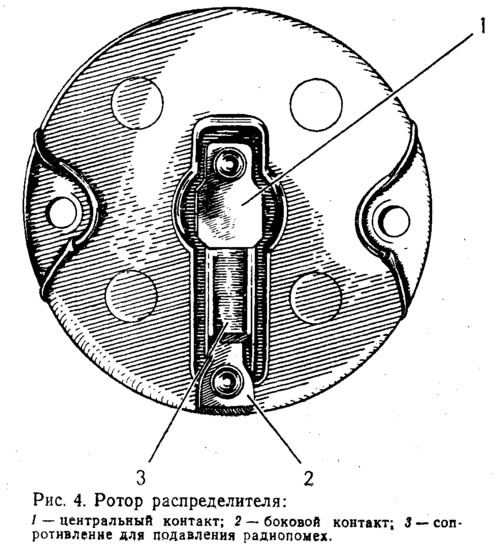
If the spark did not jump, this does not mean that the rotor is in good condition; perhaps the resistance for suppressing radio interference, connecting the central and side contacts of the rotor, has failed (see fig. 4). In this case, as a temporary solution, you need to clamp a piece of foil or bare copper wire between the plastic and the brass plates of the central and side contacts (it should be borne in mind that this will increase the level of interference to radio reception both in the car itself and in the surrounding area), then replace the distributor cap, insert the central wire and check again for a spark in the spark plug. If there is still no spark, remove and carefully inspect the distributor cap from the outside and inside for cracks and thread-like traces of soot, the presence of which indicates that the insulation is broken and the cap needs to be replaced. If there is no spare cap, the existing one must be carefully wiped, clean the cracks with a knife and, having installed the cap in place, check whether a spark has appeared in the spark plug electrodes; however, the above does not always help and can be considered a temporary measure at best. In addition, if the cover is faulty, there may be cases when sparks in the spark plug electrodes will jump, but the engine will not be able to work, since the moments of sparks will not correspond to the required ones. In this situation, attempts to start the engine will be accompanied by "sneezing" in the carburetor and "shooting" from the muffler.
Let us further assume that at the beginning of the ignition system check there was no spark between the high-voltage central wire and the "ground". Then the low-voltage circuit should be checked. To do this, insert the starting handle into the crankshaft ratchet, prepare a tester, i.e. a portable lamp, the wires of which have spring clamps at the ends (it is advisable to always have such a lamp with you), connect one wire to the low voltage terminal of the distributor (i.e. to the terminal connected by a thin wire to the ignition coil), and the second one to the "ground" and turn on the ignition. When slowly rotating the engine crankshaft with the handle and the system is in good working order, the test lamp should light up alternately (when the distributor contacts open) and fade away (when they close).
Continuous lighting of the test lamp means that the contacts are not conducting current; in this case, you need to check their condition and adjust the gap (see section "Starting the engine").
(The material is posted on the website VAZbook)
If the probe lamp does not light up at all when the contacts are open, check whether there is any current in the low voltage circuit at all. To do this, inspect the wire running from the ignition coil to the distributor, then, if it is serviceable, disconnect it from the low voltage terminal of the distributor, connect it to one probe clip, and attach the second clip to the "ground"; when the ignition is turned on, the light bulb should light up. If yes, there is current in the circuit and it remains to assume that there was a short circuit to "ground" between the low voltage terminal of the distributor and the moving contact. The short circuit must be found and eliminated.
Let's assume that the test lamp does not light up again during the described check. This most likely indicates a fault in the low voltage circuit between the battery's "plus" terminal and the ignition coil's input terminal. As a temporary solution, directly connect the battery's "plus" terminal to the ignition coil's "+B" terminal with an additional wire and the engine will start, but it will only be possible to turn it off by disconnecting the additional wire. Upon arrival at the parking place, you must immediately find and fix the fault in the low voltage circuit.
Let's assume that, despite the additional wire, the lamp does not light up again. Then it remains to assume a break in the primary winding of the ignition coil, which in this case must be replaced. Such a malfunction is rare. For replacement, you can use the ignition coil of any domestic passenger car or truck with an electrical system voltage of 12 V; such a coil will also fit in the mounting locations. It is important to keep in mind that ignition coils of other domestic cars have not two, but three terminals - VK, VK-B and a third terminal without a designation; in this case, the terminal without a designation should be connected to the distributor, the second wire should be connected to the VK-B terminal, and the VK terminal should be left free. In addition, in this case, it will not be possible to directly use the standard high-voltage wire connecting the ignition coil to the distributor; it will have to be adapted or, even better, replaced with a spare wire that does not have a tip on one end.
If at the beginning of the ignition system check it turns out that the spark between the central high-voltage wire and the octane corrector adjusting nut (ground) is weak and has a reddish tint rather than a blue tint, it should be assumed that the capacitor is faulty (happens quite rarely). Any automotive capacitor can be used for replacement.
The procedure for checking the ignition system in the most unfavorable case was described above, when there are no known good contacts, rotor and distributor cap, capacitor and protective caps of high-voltage wires in stock; it is recommended to always carry these spare parts with you. If they are available, troubleshooting is significantly easier, since obviously serviceable parts can be installed one by one to replace parts whose serviceability is questionable. However, it should be borne in mind that incorrect (with an error of 180°) installation of the distributor rotor will not only exclude the possibility of starting the engine, but will also lead to breakage of the rotor being installed; to avoid this, you should remember (or better yet, draw it) the position of the lateral contact of the rotor being removed relative to the longitudinal axis of the vehicle.