




The designers have worked hard to make the Zhiguli as safe as possible. Indeed, in many cases, for the first time in domestic practice, VAZ cars have incorporated a number of elements aimed at increasing safety. Here, it is necessary to point out the front disc brakes, separate drive for the front and rear brakes, brake force distribution regulator, good controllability and stability of the car, good visibility. Such factors as the overall high reliability of the car, ease and convenience of control, low noise and vibration levels, effective heating and ventilation systems, and comfortable seating that reduce driver fatigue also contribute to increased safety. VAZ cars can be equipped with seat belts for the driver and all passengers. The controls for lighting and signaling devices, windshield wipers and other devices are conveniently located within easy reach of the driver. The body has variable rigidity along its length, which we have already discussed. The door locks are designed to prevent them from opening in the event of a rollover or other types of accidents.
Statistics from recent years, however, show that Zhiguli cars are often involved in road accidents, which can be explained by two main reasons: the large number of inexperienced motorists who begin their driving careers with a fast and dynamic car, and the fact that these same circumstances make Zhiguli unusual for experienced drivers who have previously driven other brands of domestic cars.
The high quality of the Zhiguli car determines not only the low level of interior noise in the cabin, but also a small increase in noise with increasing speed. In combination with good stability and controllability, this leads to the driver "not feeling the speed" and is overcome by a false sense of security and calm. Meanwhile, driving at a speed higher than that which corresponds to specific objective conditions is fraught with the same danger for the Zhiguli as for any other car - indeed, the driver in this case may not be able to cope with control, which will lead to an accident. Since at high speed the car has, regardless of the subjective feelings of the driver, a large reserve of kinetic energy (the value of the latter, as is known, is proportional to the square of the speed), the consequences of the accident can be very serious. Suffice it to say that at the automobile testing ground, the collisions of cars with a stationary obstacle reproduced for experimental purposes are carried out at a speed of only about 50 km/h; however, the cars suffer very serious damage, as do the dummies that replace the driver and passengers (especially if the dummies are not secured with seat belts).
Without retelling the provisions of the Road Traffic Regulations in this brochure, which, naturally, must be strictly observed, we consider it useful to give Zhiguli drivers a number of practical tips that, we hope, will help them protect themselves and their passengers from many troubles. These tips, however, also apply to drivers driving other cars; however, due to the reasons mentioned above, many of the recommendations are especially relevant when driving a Zhiguli.
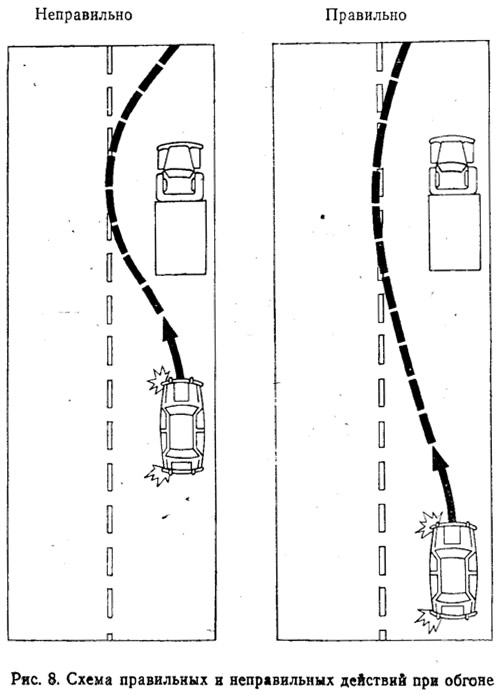
Don't drive abruptly! This thesis means that you should avoid abrupt changes in direction, excessively intense acceleration and braking, abrupt release of the accelerator and clutch pedals. This is especially important when driving in winter and on slippery roads in general. Passing and overtaking should be done along a smooth trajectory, and not by sharp turns (Fig. 8).
Always keep a sufficient distance from the car driving in front! Even in the most favorable conditions - when driving on a dry road - the distance in meters should be no less than half the speed expressed in kilometers per hour.
Don't rush through a green light that you feel is about to change to yellow and red! Statistics show that most accidents and pedestrian collisions are caused by drivers who do the opposite. When approaching a light that you feel is about to change from green to yellow and red, you need to slow down and be prepared to stop at the stop line.
If you see someone driving to the left or right of you (both nearby and especially a little ahead) the car suddenly and for no apparent reason (to you) starts to brake - brake too! Most likely, a pedestrian, whom you could not see before, will jump out from under the wheels of this car into your lane. For the same reason, do not try to break ahead in a free lane when the traffic light turns green, while cars in other lanes are at the "stop" line.
Develop the habit of glancing in the rearview mirror when braking! This will often save you from being hit from behind. After all, the situation often allows you to "roll" a little further forward and "get away" from being hit from behind. Remember that your car's brakes are more effective than most others!
At intersections, do not try to use your right-of-way unconditionally. Make sure that the car approaching from the left really intends to let you pass. Remember that it is better to give way to someone who should not have expected such kindness from you than to get into a traffic accident even with the proud consciousness of being right!
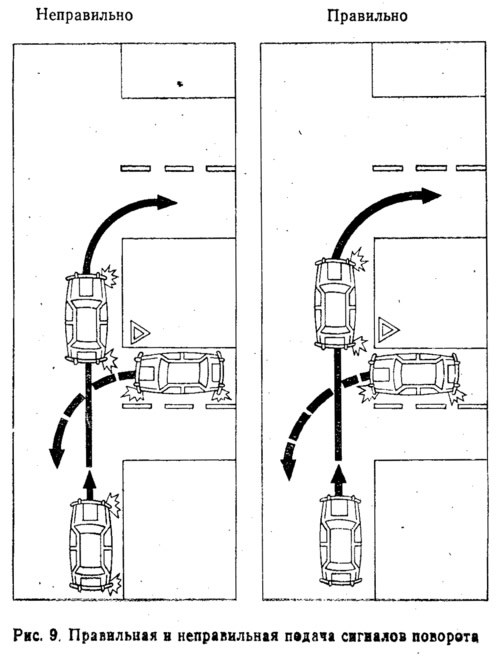
If at an intersection a car approaching you on a cross street gives a turn signal, do not rush to continue driving until you are sure that it has actually started to perform the intended maneuver. If you intend to turn left or right, give a signal about this in advance, but not before you pass the previous intersection (Fig. 9).
Do not overuse the coasting! Such driving on a slippery road threatens to skid. At the same time, on a dry road it does not provide significant advantages, however, leading to increased wear of transmission units.
If you need to quickly reduce speed on a slippery road, use intermittent braking.
Don't "hang" over the steering wheel or grip it with a death grip - this is not only tiring, but also makes it difficult to control the car, i.e. unsafe. Develop the habit of driving, leaning back freely on the seat and gripping the steering wheel without pressing hard.
Don't let drivers behind you influence your decisions by turning on their horn or headlights - don't react to such "rushing" actions! Remember that you see and know the situation in front of you better than those behind you.
Do not place any hard objects on the shelf behind the back of the rear seat. In the event of an accident, they may fly forward with force and cause additional serious injuries!
Transport children in the back seat. Remember that the safest place in the car is in the back on the right, and the least safe is next to the driver, especially when seat belts are not used. The back doors, unlike the front ones, cannot be opened from the inside when the lock button is pressed - this is also done to improve the safety of children sitting in the back seat.
When driving, do not block the front doors from the inside - in the event of an accident, this will make it difficult for others to quickly provide you with assistance.
If you feel that an accident is inevitable, do not lose your composure and turn off the ignition at the last moment. This will reduce the likelihood of a fire.
Remember that the worst kind of disaster is any collision, so anything but that (except, of course, running into people).
Particular mention should be made of seat belts, the use of which for the driver and the passenger sitting next to him has been mandatory in a number of areas since January 1, 1976. (it is advisable to equip the rear seat with belts as well).
As experience in countries where seat belts have been used for a number of years shows, these belts greatly reduce the severity of injuries in accidents, primarily in the case of rollovers and various types of impacts on the front of the car. Therefore, remember that seat belts in your car are not installed for traffic police officers, but for you and the people riding with you, and do not neglect them!
It is useful to equip your car seat with head restraints, which help prevent potentially serious injuries in the event of a strong impact to the rear of the car.
Now about night driving. Despite the fact that at night the traffic intensity decreases many times compared to daylight hours, statistics show that the probability of a traffic accident in the dark increases sharply. It is especially difficult to drive at night on unlit highways, as well as in the city in rainy weather, since the wet road surface reflects the light of street lamps and creates glare, making it difficult to navigate. From the above it follows that it is better to avoid long drives in the dark; if such driving is nevertheless necessary, we recommend that, in addition to the generally known provisions, you keep in mind some additional points.
When driving on an unlit highway, do not look at the headlights of oncoming cars, but look to the right at your lane and at the right shoulder. Remember that you need to pass oncoming cars with low beam headlights, not with sidelights (i.e. practically blindly). Unfortunately, there are drivers who do not understand this and, violating the requirements of the Road Traffic Regulations, try to drive with the headlights on, and demand the same from you. Since you continue to drive with low beam headlights, such drivers "in protest" turn on the high beam; in this situation, also turn on the high beam for a moment, showing that you were driving with the low beam before, and immediately turn it on again. After this, the oncoming driver usually calms down, also switches to the low beam, and then the passing proceeds normally.
When driving for a long time at night in rainy weather, do not forget to periodically wipe the headlights to avoid deterioration of visibility of the road in front of the car, the side lights, tail lights and turn signal glasses so that others can see you and your signals to change the direction of movement.
Special mention should be made of the circumstances that arise after driving through fords and deep puddles. The wetting of the wheel brakes that occurs in such cases leads to a decrease in the friction coefficient between the brake pads and discs (brake drums), which causes a temporary but sharp decrease in the effectiveness of the brakes. You need to remember this and immediately after leaving the water "dry" the brakes by braking several times from a speed of 30-40 to 15-20 km/h (in this case, it is necessary to ensure that there is no car behind you).
Some accidents involving cars of all makes and types occur not because of driving errors, but as a result of technical faults; however, these faults usually do not occur suddenly and can therefore be prevented by systematically monitoring the condition of the relevant vehicle components. Zhiguli vehicles are distinguished by their high operational reliability; however, what has been said also applies to them.
From a safety standpoint, the main areas of concern should be the tires, brakes, tie rod ends, upper and lower ball joints of the front wheel steering knuckles.
When it comes to tires, the biggest danger is a sudden loss of internal air pressure (especially in the front tire) and "skidding" of the vehicle, associated with the loss of traction of the tires with the road surface.
When hitting nails and other small sharp objects, the air from a damaged tire usually does not come out immediately, which is why this type of damage does not pose a particular danger. It is only important to promptly sense the malfunction that has arisen by the car pulling to the left or right and deteriorating roll and control, as soon as possible (however, without sudden braking and turns) pull off the road and stop, keeping in mind that otherwise the tire will inevitably fail, irreparably. A much more dangerous situation occurs when the tire "bursts" spontaneously. Let's consider the reasons that can lead to this.
A tire can "burst" due to the development of cracks and tears in its sidewall or on the tread. Therefore, tires must be inspected regularly (including from the side facing the inside of the car); if cracks or tears are found, the tire should no longer be driven on.
It is dangerous to drive on tires with lower than normal internal air pressure, as this leads to overheating of the tire and a decrease in its reliability, as well as overloading the car and, accordingly, its tires. When driving for a long time at high speeds, especially in hot weather, it is advisable to additionally increase the internal air pressure by 0.2-0.3 atm compared to the recommended for normal conditions, as this will reduce tire deformation and their heating. If your car tires were purchased at different times and, in your opinion, differ in reliability (we are not yet talking about the degree of their wear), then you need to put new tires on the front wheels.
As for the possibility of "skidding", it should be remembered that it usually begins with lateral sliding of the rear tires, not the front ones. Therefore, it is better to put tires with less tread wear on the latter than on the front wheels.
It should be borne in mind that according to the current Road Traffic Regulations, the tread of a passenger car tire must have a tread depth in the center of the tread of at least 1 mm. However, to further reduce the likelihood of "skidding" and punctures, as well as to maintain the suitability of the tire for restoration by applying a new tread, it is better (and ultimately more profitable) remove the tire from service after the tread depth has decreased to 2.5–2 mm.
If it does happen that at high speed your front tire suddenly "bursts" and the car "pulls" to the left or right, keep it moving in a straight line using the steering wheel (which in this case will require a lot of effort), release the accelerator pedal smoothly and, without using the brakes, let the car roll with engine braking. Brake only after the speed drops to 10-15 km/h. The same action should be taken in the event of a sudden failure of the rear tire.
The brakes of the Zhiguli car are quite effective and reliable. However, it is necessary to replace the brake pads in a timely manner, primarily on the front wheels, since the service life of the brake pads of the front wheels is significantly shorter than that of the rear ones. In the event of failure of the brake drive of the front or rear wheels at the moment of braking, the pedal, despite the separate drive, will "fall" to a fairly large depth; however, despite this, it is necessary to quickly press it all the way down, and if this does not help, "pump" the pedal once or twice. As a result, braking, although not as effective as with a properly functioning brake drive on all wheels, will be ensured.
The condition of the steering rod ends and ball joints of the front wheel steering knuckles has a major impact on safety.
To check the upper ball joint, you need to set the wheels in the direction of straight-line movement by eye, grab the upper part of the tire with your hands while standing to the side of the car and, sharply pulling the wheel towards you and away from you, estimate the amount of play in the ball joint by the knock and movement of the parts. The play, when estimated by the movement of the upper part of the tire, should not exceed 1 mm. To acquire the skill, it is useful to estimate the clearance in the upper ball joints before doing this.
The wear of the lower ball joint is determined by placing the car on an inspection pit or overpass and measuring, with the plug of the lubrication hole located on the lower end of the support turned out, the distance from the lower edge of the housing to the surface of the ball joint pin. If this distance exceeds 11.8 mm, the ball joint must be replaced. The measurement is conveniently made using a template made from a nail in the form of a rod with a diameter of 4 mm with a flat end and a mark applied at a distance of 11.8 mm from its end.
Tie rod ends (there are six of them in total) should not have noticeable play when the steering wheel is sharply rocked from side to side. The check is carried out in an inspection pit or overpass with the initial position of the wheels corresponding to straight-line movement. In this case, the participation of two people is required (one, located below, checks the play in the tips, and the second, on his command, shakes the steering wheel). When swinging, there should be no knocking or noticeable play in the tip being tested.
Next, check the condition of the pendulum lever, for which it is enough to grab the adjacent transverse rod with your hand and sharply swing it forward (in the direction of the vehicle's movement), and then back; if there is noticeable play in the lever bearings, the two plastic bushings must be replaced, and if wear is detected on the pendulum lever axis, this part must also be replaced.