




First of all, the assessment of "agility", or, as experts say, traction and speed qualities, can be objective and subjective. The criteria for objective assessment are the maximum speed of the car and the intensity of its acceleration, measured with instruments, primarily the acceleration time from a standstill with gear shifting to a certain speed. The criteria for subjective assessment are much more complex; for example, in different cars we feel the same acceleration intensity differently depending on the noise and vibration level in the cabin, the nature of the change in engine noise with an increase in the rotation frequency of its shaft, the clarity of gear shifting and the travel of the gear shift lever, the travel of the accelerator pedal and the nature of its connection with the axes of the carburetor throttle valves. It can be immediately noted with satisfaction that Zhiguli cars have quite sufficient "agility" from an objective and subjective point of view. It is only necessary to keep in mind that the high-speed engine of the Zhiguli and the transmission designed for it "do not like" driving with a low number of revolutions, and this means that when accelerating the car, you should not rush to shift to the next, higher gear, and when the speed decreases during movement, promptly engage a lower gear, preventing the occurrence of jerks in the transmission. For example, in fourth gear you should not drive at a speed of less than 50 km/h on a VAZ-2101 car and less than 45 km/h on a VAZ-2103 car.
"Appetite", or fuel efficiency of a car, is characterized by fuel consumption per unit of distance traveled under various driving conditions; in general, it is estimated by operating fuel costs.
It should be borne in mind that the reference fuel consumption given in the technical characteristics of the vehicle refers to the case of a fully warmed-up vehicle with a full load in the summer on a straight horizontal road with an improved surface in the highest gear at a constant speed of 80 km/h. In everyday operation, the conditions are much more difficult even in the most favorable cases; thus, the road, as a rule, has climbs, descents and turns, obstacles arise on the way of movement, forcing to reduce speed, brake, accelerate again, engage downshifts, etc. Therefore, although in real conditions the car is usually operated not with a full, but with a partial payload, the operating fuel consumption always exceeds the control one, and the latter is used only to check the technical condition of the car (hence its name).
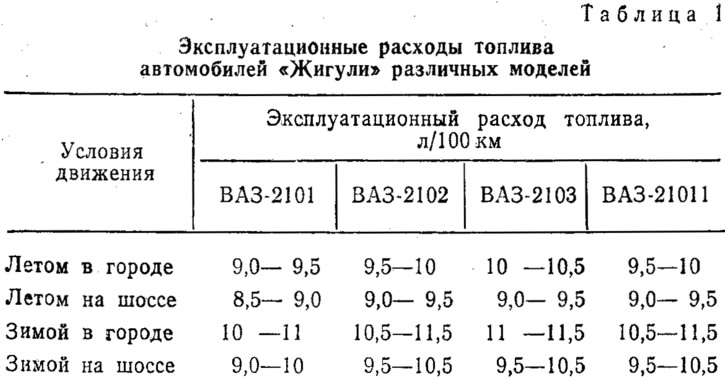
Operating fuel costs of various Zhiguli models are given in Table 1.
It is useful for car enthusiasts to know that the following fuel consumption standards are set for state-owned VAZ vehicles:
- on VAZ-2101 - 10.0 l/100 km;
- on VAZ-2102 - 10.3 l/100 km;
- on VAZ-2103 - 10.5 l/100 km.
Operating fuel costs depend largely on specific driving conditions and driving style; they should be constantly monitored using the vehicle's operation and maintenance diary.
Let us now consider what needs to be done to restore the high traction-speed qualities and fuel efficiency of the car if they have decreased during operation. Let us keep in mind that, since Zhiguli cars have a high durability, we can be sure that such phenomena, even with very significant mileage, are not a consequence of the "old age" of the car and engine, but a consequence of the occurrence of specific, usually easily eliminated faults. We can say with confidence that the traction-speed qualities and fuel efficiency can be maintained at a high level until the engine is sent for repair due to severe wear of the piston group, causing excessive oil burnout, which usually occurs only with mileage much exceeding 100 thousand km.
Let's consider the main reasons that can lead to a decrease in traction and speed qualities, keeping in mind a run-in vehicle without obvious signs of malfunctions (interruptions in engine operation, knocking sounds, etc.). In this case, the main reasons may be:
- incomplete opening of the throttle valves when the accelerator pedal is fully depressed;
- carburetor accelerator pump malfunction;
- incorrect fuel level in the carburetor float chamber;
- incorrect ignition timing;
- increased rolling resistance of the vehicle.
The last three reasons also lead to a deterioration in fuel economy.
The methods for ensuring full opening of the carburetor throttle valves are described below in the section "Features of maintenance and routine repairs", and the fuel level settings in the float chamber are described in the vehicle operating instructions. We will only add that it is convenient to check the distance between the float and the gasket, as well as the float stroke, using a homemade gauge in the form of a parallelepiped, one side of the cross-section of which is 7.5 mm, and the other is 15.5 mm. It is also necessary to keep in mind that the distance between the float and the gasket should in no case be more than 7.5 mm, since this will lead to sudden failures in engine operation due to exhaustion of the fuel supply in the float chamber during intensive acceleration, high speeds and overcoming long climbs. At the same time, during operation, the fuel level tends to constantly increase, so it must be periodically checked and adjusted.
The method for checking the accelerator pump was described above in the section "You are stuck on the road", but there it was an integral part of checking the fuel system in the event of the engine stopping while driving. In the case under consideration, when the engine is running but does not provide the required acceleration intensity, the absence of a stream of gasoline during the same check will indicate a failure of the accelerator pump itself; a common, easily remediable cause in this case is the roller of the lever 1 of the accelerator pump drive (Fig. 5) catching on the tray of the carburetor float chamber, which is why the lever remains in the pressed position. The second (less likely) the cause is a rupture of diaphragm 2, which in this case must be replaced.
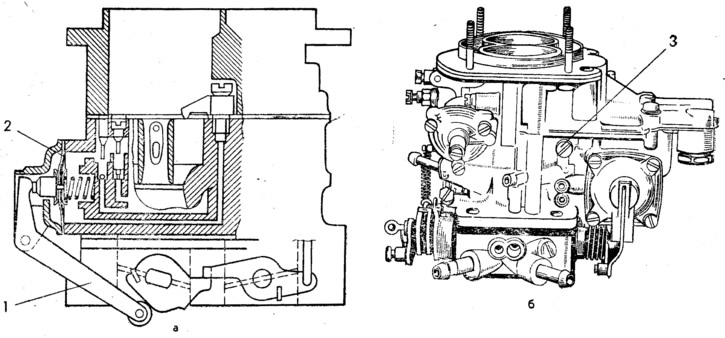
Fig. 5. Accelerator pump: a — diagram; b - view of the carburetor from the accelerator pump side:
1 — accelerator pump drive lever; 2 — accelerator pump diaphragm; 3 — housing of the idle system jet.
The ignition advance is determined by the position of the distributor breaker housing, its shaft and the octane corrector adjusting nut. The method for initially setting the ignition advance is described in the vehicle operating instructions. The position of the distributor breaker housing relative to its socket is fixed during installation at the factory by a paint spot, and there is no need to change it during operation; therefore, it is necessary to check whether the housing is installed "on the spot" and, if not, restore its correct position. Just in case, it is useful to know that turning the distributor-breaker housing counterclockwise leads to an increase in ignition timing, and vice versa. "Fine" adjustment is performed by turning the octane corrector adjusting nut; the normal position of the latter is in the interval between zero and the third division towards earlier ignition (towards "+").
Increased rolling resistance of a car is most often a consequence of low internal pressure in the tires, excessive tightening of the front wheel bearings, incomplete release of the foot brake or, more often, the hand brake, or incorrect toe-in of the front wheels. To make sure that there is no increased rolling resistance, you should first check the internal air pressure in the tires and, if necessary, bring it to the norm, eliminating this factor. Then you need to warm up the car's engine by driving it for at least 15 km, find a small horizontal area with asphalt or cement concrete pavement in good condition, stop on it, open the driver's door, drive off and immediately release the accelerator pedal, simultaneously disengaging the clutch and leaving it in this position until the car comes to a complete stop (it is enough if the latter rolls by inertia for only 2-3 m). In this case, you need to look through the open door at the road surface and make sure that the car has rolled back at least 3-5 m after coming to a complete stop. If this has not happened, you should find and eliminate one of the remaining causes of difficult rolling, which were discussed above.
Let us now consider the causes of various engine malfunctions.
The occurrence of vibration ("shaking") of the engine with a frequency proportional to the number of revolutions, accompanied by a noticeable deterioration in the dynamic qualities of the car, is usually associated with the high-voltage wire jumping off one of the spark plugs or with its failure. To find a defective spark plug, it is necessary to remove the high-voltage wire from each spark plug one by one while the engine is running at low idle speed (to avoid unpleasant electric shocks, it is better to remove and put on the wires with the engine turned off); the faulty spark plug will be the one whose disconnection did not result in an additional reduction in speed. A faulty spark plug can sometimes be found "by touch" by its lower temperature compared to serviceable spark plugs. You can also unscrew the spark plugs from the engine one by one and inspect their electrodes; the electrodes of a faulty spark plug will be covered with black soot, sometimes wet, unlike others. A faulty spark plug must be replaced. Sometimes, however, it stops working not completely, but partially (only under load, at high speeds or intermittently); in this case, detecting it using the signs described above becomes difficult, and the defect should be eliminated by replacing one of the working spark plugs with a known good spare one and checking the result of the replacement each time by driving in normal modes for several minutes.
If there are "uneven" interruptions in engine operation, it is necessary to check the ignition system in the same way as recommended above.
In cases of interruptions at high speeds, including in engine braking mode, the cause is usually a faulty distributor contacts.
In case of sudden failures at the end of a long intensive acceleration, when overcoming long climbs with a high engine load and when driving at high speeds, the cause is most often too low a fuel level in the carburetor float chamber. At the same time, an excessively high level is one of the most common causes of increased fuel consumption.
Traction and speed characteristics are noticeably impaired, and fuel consumption increases when the air filter cover position is not appropriate for the season, or more precisely, the ambient air temperature; it should be set to the "winter" position at temperatures below +5°C, and vice versa.
Often, despite the presence of a special control lamp, the reason for a sharp deterioration in the vehicle's dynamics is the handbrake, "forgotten" in a not fully released position.
If a fully warmed-up car starts to "pull" poorly, and this is accompanied by the appearance of a gasoline smell in the cabin and deterioration of engine operation at low idle speeds, the most likely cause is a spontaneous increase in the fuel level in the float chamber, which occurs regardless of the previously performed adjustment, which is associated with the jamming of the shut-off needle in the lowered position or, more often, the loss of tightness of the carbon valve. The latter, if it occurs even to a small extent, is also a difficult to diagnose cause of deterioration in the fuel economy of the car.
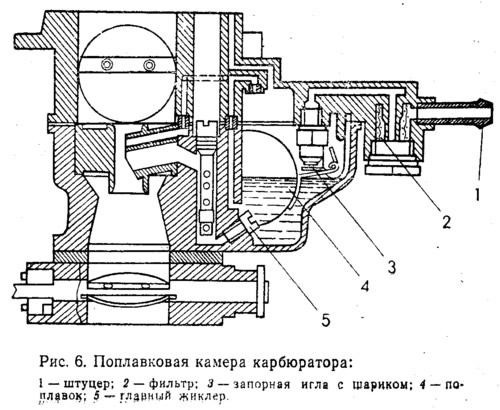
To check, remove the cover of the float chamber and float 4 (Fig. 6), take out the shut-off needle 3 and unscrew the needle valve. Then put a 15-20 cm long rubber hose on the valve thread, turn the valve upside down with the hole facing up, insert the shut-off needle and, putting the other end of the hose on the tip of a small squeezed rubber bulb, check whether the bulb will gradually fill with air. If this happens, the needle valve has lost its tightness and should be replaced together with the needle and the gasket underneath. If there is no replacement, the functionality of the previous valve can be restored for a while by "tapping" the shut-off needle. To do this, clamp the valve in a vice with the hole facing up, insert the needle and, without turning it, lightly tap through the wooden gasket on its end, into which the ball is inserted (you can't hit it too hard, as this will cause the ball to lose its mobility). Then you should check the tightness of the needle valve and, if it is restored, install it in place.
An important element of normal engine operation is its stable operation at low idle speed. The procedure for adjusting the idle system is described in the instructions supplied with the car, but sometimes the adjustment does not help and the engine immediately stalls when the accelerator pedal is released. Most often, the cause of this situation is clogging of the emulsion jet of the idle system. Therefore, in this case, you should unscrew the housing 3 of this jet (see fig. 5), what is more convenient to do after removing the air filter housing, take the jet out of the housing and blow it thoroughly with a pump. In the carburetor of the VAZ-2103 car, the jet must be unscrewed together with the electromagnetic valve into which it is inserted, take it out and blow it out.
Let us consider in particular the question of the rational time for warming up a car before starting off after a long period of parking. The conducted studies have shown that the amount of starting wear depends mainly on the number of piston strokes during the time it takes for the engine to warm up, and not on the load of the latter. Since the engine naturally warms up faster under load, it is more correct not to warm it up on the spot at idle, but to start off 20-30 seconds after starting and warm it up while driving. In this case, naturally, you need to drive slowly and not give the engine high revs. The above applies even more to Zhiguli cars, whose engines run on oils that retain fluidity at low temperatures, have an anti-drain valve in the oil filter that prevents oil from flowing into the sump after the engine is stopped, and a carburetor that provides the car with satisfactory traction qualities and the engine with stable operation at low idle speeds almost immediately after a cold start. Switching to a short warm-up time will not only reduce starting wear of the engine, but will also save your time, reduce fuel consumption and air pollution in the parking area.