




Although a number of units and components of the vehicles in question have an original, fairly advanced and complex design, their maintenance and, in many cases, routine repairs after the end of the warranty period (or mileage) can be performed by the car enthusiast himself, having some metalworking skills and equipped with a minimum of additional tools and accessories (see section "Spare parts").
Below is a series of useful recommendations for car enthusiasts, suggested by practice, on the operation, independent maintenance and repair of Zhiguli cars.
When disassembling threaded connections during work with the vehicle (except those subject to strong heat, such as spark plug threads) it is useful to lubricate the bolts with consistent grease before assembly (LITOLOM-24) in order to facilitate disassembly if it is required again in the future.
Periodically check the tightening of the nuts securing the exhaust pipe to the exhaust manifold and the bolts securing the main gear housing to the rear axle beam. A sign of loosening of the latter is high-frequency vibration of the car body when driving at a speed of 80 km/h and above, in particular, "small" shaking of the rear-view mirror.
After running in a new car, adjust the carburetor throttle drive to ensure that it opens fully when the accelerator pedal is pressed all the way down. When checking, one person sitting in the driver's seat presses the pedal all the way down (with the engine off) and holds it in this position, the second person checks the degree of opening of the throttle valves by pressing the end of the drive rod of the latter in the direction of further opening. If the throttle valves do not open completely, it is necessary to change the length of the adjustable drive rods; you can also bend up the end of the rod connected to the accelerator pedal.
After the throttle valves have begun to open fully, it is necessary to check and adjust the low idle speed. When starting the engine for this purpose, you must be ready to immediately turn off the ignition if the engine starts to "run away" despite the pedal being released; this situation may occur if the length of the adjustable drive rods is not set correctly.
The adjustment of the throttle valve drive should be checked periodically during operation, especially in the event of deterioration in the traction and speed qualities of the vehicle.
When adjusting valve clearances, it is important to remember that the worst type of error is to allow no clearance at all. In this case, the valves will not close tightly, which will lead to rapid burning of their working chamfers.
Each time you adjust the valve clearances, it is advisable to inspect the condition of the camshaft cams. This can be done by turning each cam in turn so that it is horizontal and its top is directed to the left (in the direction of the car). Then, using a portable lamp, without applying pressure, run the end of a screwdriver across the entire width of the cam and make sure that it is not worn out (no protrusions on the ends - Fig. 7). If wear has appeared, the camshaft must be replaced, but if necessary, you can drive the car for several thousand more kilometers before replacing it, although with a constantly increasing deterioration in traction and speed qualities. The condition of the camshaft cams must be especially checked in cases where a strong knock in the valves is not eliminated after adjusting the clearances.
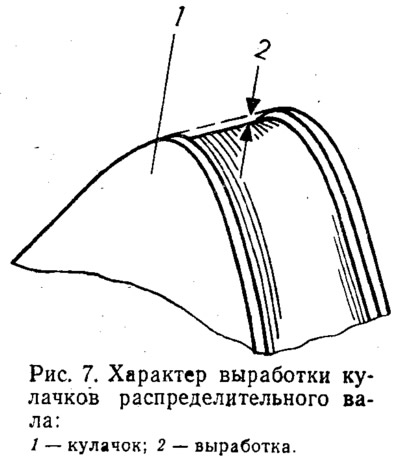
At the same time as replacing the camshaft, it is usually necessary to replace the valve levers, the working surfaces of which are damaged. When replacing the camshaft, it is necessary to change the engine oil (with mandatory flushing of the lubrication system of the latter) and an oil filter, otherwise metal particles remaining in the oil (cam wear products) can quickly damage a new camshaft.
The operating instructions indicate the need to change the coolant after two years of vehicle operation or after a mileage of 60 thousand km. This requirement is due to the fact that the TOSOL A-40 coolant gradually loses its oiliness (lubricating properties), and this worsens the operating conditions of the coolant pump seal and can ultimately lead to its failure. For the same reason, do not add any oil unless absolutely necessary (all the more so to pour) water or other types of coolant into the cooling system; if this had to be done, you need to switch back to TOSOL A-40 as soon as possible.
The splined joint of the front cardan shaft should be lubricated using a grease nipple screwed into place of the threaded plug. For this purpose, it is convenient to use a grease nipple for lubricating the ball joints of the front wheel pivot pins of Moskvich cars. After lubrication, the grease nipple must be replaced with a threaded plug again.
After a significant mileage of the car, the cardan bearings, especially the rear one, may fail. This malfunction is diagnosed by the appearance of characteristic metallic knocks when starting off, which constantly increase as the mileage increases. To check, you should disconnect the rear flange of the cardan transmission from the flange of the main gear drive pinion and shake the cardan in both planes; its malfunction is determined by easily perceptible play in the bearings. In this case, the crosspiece assembly with needle bearings is subject to replacement.
The thickness of the friction linings of the front brake shoes can be conveniently checked by removing the wheel, turning the steering wheel all the way to the left or right, and illuminating the ends of the shoes with a portable lamp.
When changing the brake pads of the front wheels, difficulties often arise with pressing out the pins. In this case, you should apply the ends or rags soaked in brake fluid (any) to the corresponding places and leave these "compresses" for several hours, after which the removal of the pins becomes much easier.
After removing the old pads, the new ones, naturally thicker, usually do not fit into the caliper. Therefore, before installing them, you need to "drown" the pistons; this can be done conveniently with the blunt end of a tire iron, but care must be taken not to damage the piston dust caps.
Often, after a significant mileage of the car, difficulties arise when removing the brake drums of the rear wheels. In such cases, you need to put stops under the front wheels, lift the rear wheel with a jack, remove it, unscrew the bolts securing the drum to the axle shaft, then engage third gear, "accelerate" the raised brake drum to a speed of 50-60 km / h (by the speedometer) and press the brake sharply; usually the drum can be easily removed after this, otherwise the attempt should be repeated. For safety reasons, no one should stand in the plane of rotation of the drum. Long-term (more than 30-40 s) rotation of the drum should not be allowed, as this can damage the differential.
The friction linings of the rear brake shoes wear unevenly; the linings of the "leading" pads facing the front of the car usually have greater wear. Therefore, after a run of 60-70 thousand km, it makes sense to swap the pads in order to extend the service life of the set.
If it is necessary to disassemble the steering rods (for example, to replace a broken hinge cover) you should unpin the nut, unscrew it to such an extent that it is flush with the pin, and then "tap" the side surface of the conical socket of the lever with a hammer until the hinge pin itself falls out of the socket. In no case should you hit the nut or, especially, the end of the pin, since this does not give any results and can only lead to damage to the parts.
To increase the service life of the ball joints of the front wheel pivot pins, it is useful to add grease to them after the first 4-5 thousand km. To do this, it is necessary to temporarily add grease to the lubricated joint (or constantly) insert a grease nipple instead of the plug (the grease nipple used in Moskvich models 403, 407 and 408 for lubricating the water pump is suitable) and inject SHRB-4 grease or, if unavailable, LITOL-24 into the cavity. During the lubrication process, it is necessary to monitor the protective cover and, after it noticeably swells, stop further lubrication to avoid its rupture.
The wear of the front tires is greatly influenced by their installation angles. It should be borne in mind that in terms of tire wear, the most important is the toe-in, while the camber has a relatively small effect on wear.
To check and adjust the toe-in at home, you can make a simple measuring ruler, which is a wooden block 1180 mm long with screws with semicircular heads screwed into its ends (when screwed in half the length of the thread, the screws should protrude 20 mm on each side).
An empty car is placed on an inspection pit or overpass; the front wheels are positioned (by eye) in the direction of straight-line movement.
The measuring ruler is first installed between the front wheels, ahead of their centers, at the maximum height permitted by the engine and front suspension components; the screw heads rest against the inner sidewalls of the tires close to the edges of the disks. The screws are screwed in or unscrewed so that the ruler is positioned "spread apart" and there is no transverse gap between the screw heads and the sidewalls of the tires. The sidewalls of the tires opposite the screw heads are marked with chalk. Then the ruler is removed and the car is rolled forward by about two-thirds of a wheel turn, after which the ruler is installed behind the centers of the front wheels opposite the chalk marks again at the maximum possible height (if necessary, the position of the marks is adjusted by additionally rolling the car forward or backward slightly so that the ruler takes the highest possible position). When the wheels are correctly aligned, the lateral clearance should be 0.5-1.5 mm. If this is not the case, the wheel alignment must be adjusted, following the instructions.
Despite the simplicity of the described measuring ruler and the small errors in measurements that occur when using it, experience has shown that the ruler provides the accuracy necessary for practice and allows for high tire mileage.
During operation, the following phenomenon sometimes occurs: the car pulls to the left or to the right. To eliminate this, you need to insert a 1-2 mm thick half-washer into the corresponding package of adjusting shims, which are clamped by the bolts that secure the lower arm axle to the front suspension crossmember between the axle and the crossmember. If the car pulls to the left, the half-washer should be inserted into the rear shim pack of the left lower arm, if to the right - into the rear shim pack of the right lower arm. If this is not enough, you can add another half-washer to the front shim pack of the right lower arm when pulling to the left, and to the front shim pack of the left lower arm when pulling to the right. It should be borne in mind that the results of installing half-washers do not appear immediately, but only after a run of 80-100 km. After you have made sure that the pull has been eliminated, immediately adjust the toe-in of the front wheels.
If knocking sounds appear in the front suspension, you should first check the condition of the lower shock absorber bushings. To do this, simply disconnect the lower shock absorber mount, pull the latter down and check the tightness of the connection of the lower shock absorber ear with the bracket. If there is play, the rubber bushings must be replaced (possible options for replacing the bushings are discussed below in the section "Spare parts"). Before installing new bushings, they should be soaked in brake fluid (any).
Knocking in the front suspension may also be a consequence of increased clearance between the spacer sleeve of the lower mount of the front shock absorber and the bolt inserted into it. In this case, the specified connection must be sealed.
When adjusting the front wheel bearings, remember that the main reason for their failure is overtightening. Therefore, they should be tightened in such a way that when you press your finger on the edge of the brake disc, you feel a small gap in the bearings.
The internal air pressure should be checked when the tires are cold.
Research has shown that contrary to common practice, it is not necessary to swap all the wheels of a car every 5-10 thousand kilometers. Such a practice masks suspension defects (especially the front), causing accelerated tire wear, and can lead to premature wear of not just one tire, but the entire set of tires. In addition, such a practice is associated with unnecessary labor and time. Instead, it is necessary to identify and eliminate the causes of wear of a particular tire, after which the most worn tire should be used as a spare.
Unexpected starter failure (when turned on, a weak click is heard, the starter does not turn the crankshaft) is often a consequence of oxidation of the battery terminals (first of all positive). In this case, you need to clean the terminals as recommended in the "Starting the Engine" section.
When the battery charge indicator light comes on while the engine is running, this indicates that the generator has stopped working, and this is often caused by minor problems that can be fixed immediately.
First check fuse #10 (far right) to contact with the clamps and to burn out (for example, you can try to install fuse No.4 in its place), and then the contact in the plug connectors of the charging indicator lamp relay, which is located under the hood on the right on the front wheel mudguard.
If this does not help, the problem is most likely in the contamination of the collector rings. However, there is no need to rush to remove and disassemble the generator. Most often, after a short time during movement, the defect disappears by itself and the generator starts working. By the way, with a non-working generator, you can drive several hundred kilometers on the highway during the day; in the dark and when using the starter, the distance that can be traveled without charging the battery is significantly reduced, but still remains quite large.
Let's assume that the generator has not started working. Then it is necessary to wipe the collector rings with a rag soaked in gasoline, turning the engine shaft with the handle. As for the wear of the brushes, their service life usually exceeds 100 thousand km.
Wiping the collector rings, removing and installing the brushes can be done without removing the generator from the car, although this is quite inconvenient. To remove the generator, you need to unscrew the bolt of the upper tension bar, move the generator towards the engine, remove the belt from the pulley, remove the engine protective panel and the lower mudguard, unscrew the generator bracket nut, remove the bolt and take out the generator from below. If the measures mentioned above do not give results, the generator must be sent to a repair shop for repair.