




We are talking about measures aimed at facilitating subsequent operation, maintenance and current repairs of the car, increasing its corrosion resistance and protecting it from attacks on the safety of your car.
Threaded connections are tightened at the factory quite conscientiously and, as a rule, do not require additional tightening. We recommend checking only the tightening of the four nuts that secure the exhaust pipe to the exhaust manifold and the bolts that secure the gearbox to the rear axle beam. The nuts that secure the exhaust pipe should be tightened smoothly, without jerking, to avoid breaking the studs.
On some vehicles, the spark plugs, chain tensioner lock nut, brake and clutch release cylinder bleed nipples, and valve adjusting bolt nuts are tightened too much. As a result, these threaded connections cannot be loosened with the tools supplied with the vehicle, which can put you in a difficult situation when performing maintenance and troubleshooting work yourself in the future (for example, if it is necessary to replace a faulty spark plug). Therefore, try to unscrew these threaded connections and if this fails, do it at the first visit to the service station (and to maintain the right to warranty repairs, you are required to undergo maintenance there after the first 2 thousand and 10 thousand km of your car's mileage) ask the station worker to do this (tighten the connections after they have been loosened using the tool supplied with the vehicle).
There are a number of connections in the car that will inevitably have to be disassembled during operation; if you do not take the necessary measures from the very beginning, this can be very difficult to do due to corrosion. Therefore, we recommend:
[The article is copied from the website: VAZBOOK]
- remove the front disc brake pads, sand the pins, wipe them clean and lubricate them with brake fluid before installing them - this will make subsequent replacement of the brake pads easier;
- remove the rear brake drums and lubricate their mounting surfaces that come into contact with the rear axle axle shaft stockings with a thin layer of LITSSh-24;
- disassemble a number of threaded connections and lubricate the bolts (screws) with LITOL-24 before assembly. Such connections include the studs of the lower fastenings of the front shock absorbers, fastenings of the optical elements of the headlights, sidelight lenses, front turn signals;
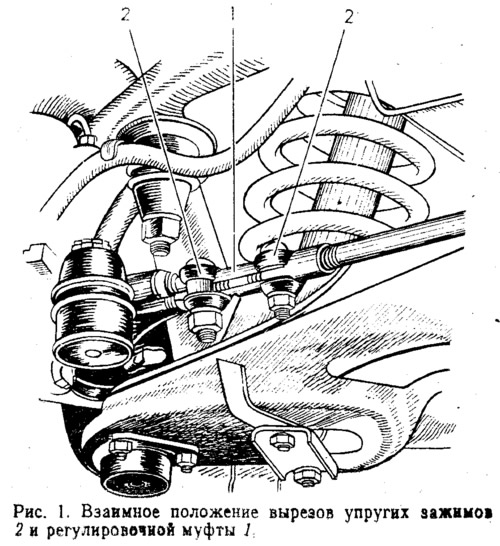
- check the position of the notches of the elastic clamps 2 (Fig. 1) securing the adjusting couplings 1 of the left and right side rods of the steering system relative to the slots of the adjusting couplings. If the notches of the clamps and the slots in the couplings do not match, loosen the clamp tightening bolts and turn them until they match the slot; then tighten the bolts again, but do not allow the ends of the clamps to touch after tightening. This operation must be done to ensure that the steering rod ends are securely clamped by the adjusting sleeves.
Remove the wire ends from the battery terminals and place rings cut from felt and soaked in engine oil on the terminals (before installing the tips, wipe the terminals with a rag slightly moistened with gasoline). These rings will protect the battery terminals from oxidation.
Keep a diary of your car's operation. For this, you can use a large notebook, which is best kept in the glove compartment along with a pencil. In the diary, briefly but systematically record all maintenance and repair work performed, as well as the amount of gasoline poured into the tank. Before each entry, indicate the date and speedometer readings.
Immediately equip the new car with front and rear mudguards, which will reduce corrosion and contamination of the corresponding body parts. To avoid engine failure due to impacts of the oil pan against hard objects, install a protective panel under the pan.
Zhiguli cars are generally satisfactorily protected from corrosion; so, the bottom of the car, the floor of the cabin, the doors resist it quite well. The most vulnerable to corrosion are:
- front fenders at the junction with the rear wall of the front wheel arch and opposite the cavity behind this wall;
- front panel between headlights and sidelights; longitudinal box-shaped side members of the body base ("thresholds");
- inner surfaces of the front fenders and rear wheel arches.
To enhance anti-corrosion resistance, it is useful to cover the front panel between the headlights and sidelights with an additional layer of protective mastic (from the inside), inner surfaces of the front wings (special attention should be paid to the area where the wings meet the rear wall of the front wheel arch) and the inner surfaces of the rear wheel arches.
It is useful to squirt oil into the cavities under the rear of the front fenders once or twice a year. It is advisable to put oiled rags into the gap between the upper edge of the rear wall of the front wheel arch and the inner surface of the fender. Oil should be poured into the box-shaped side members of the body base once or twice a year.
Having a steering lock combined with precision numbered keys makes it difficult to steal your car (if, of course, you have developed the habit of turning the key to the right position when leaving), however, it is advisable to equip the doors with an audible alarm to prevent unauthorized persons from entering the passenger compartment. It is also useful to do the same with the engine hood and trunk. It is useful to additionally secure the wheel caps and the spare wheel with some special devices. The same applies to the radiator grille (except for the VAZ-2103 model, in which it can be removed only by opening the hood). It is better to replace the standard fuel tank cap with a special one with a built-in lock. It is better to remove the outside rearview mirror at night, for which it is useful to equip it with a special detachable bracket.