




Contents: Suspension arms ↓ Ball joints ↓ Rubber-metal hinges ↓ Replacement ↓ Steering knuckles ↓ Suspension springs ↓ Stabilizer bar ↓ Front suspension cross member ↓
Suspension arms
The deformation of the upper and lower arms is determined using device A.95716.
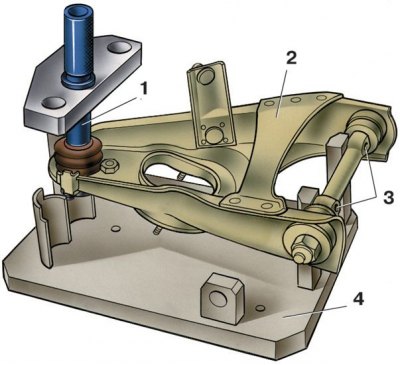
1. Install the lower arm so that the mandrel 1 for centering articulates with the cone of the ball joint pin of the arm, and the installation pins of the device 4 (a.95716 device for checking levers) entered the holes 3 of the lever axis 2.
2. The centering mandrel must fit into the right or center hole of the device, depending on which lever is being checked, right or left.
3. A sign of deformation of the lever is the impossibility of inserting the device into the holes 3 of the lever axis without force from the fingers, as well as poor articulation of the mandrel 1 with the cone of the ball joint pin.
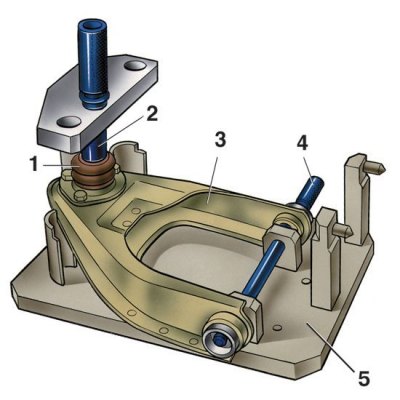
4. Upper arm 3 is installed on device 5 (device A.95716) in an inverted position so that the mandrel 2 for centering the ball joint exactly coincides with the tail of the ball joint pin 1, and the pin 4 passes through the holes of the rubber-metal hinges of the lever.
5. The amount of deformation of the lever is determined by the difficulty of inserting pin 4 into the holes of the levers and by the poor articulation of the conical socket of mandrel 2 with the conical surface of the pin of ball joint 1. Pin 4 should enter the holes of the joints without much effort.
6. If the deformation is minor, the levers are adjusted, and if it is major, they are replaced.
Ball joints
Checking the upper ball joint on the device 02.8701.9502
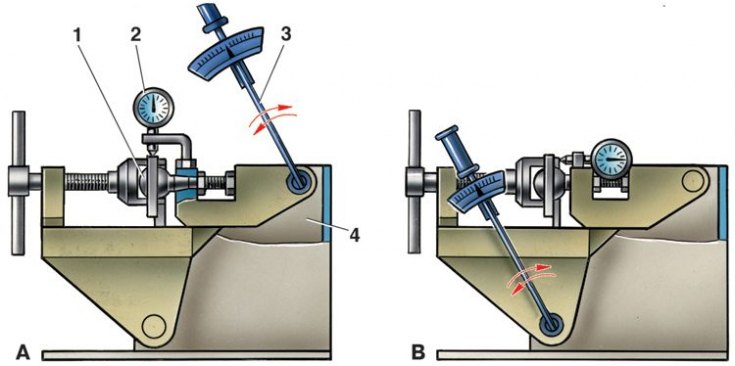
1 – ball joint; 2 – indicator; 3 – torque wrench; 4 – device 02.8701.9502; A – radial clearance check diagram; B – axial clearance check diagram
1. Make sure that the joint mudguards are intact. Tears, cracks, rubber peeling off the metal reinforcement, traces of grease leakage are unacceptable.
2. Check for wear on the working surfaces of the ball joints by turning the ball pin manually. Free movement of the pin or its jamming are unacceptable.
3. A more precise check of the condition of the upper ball joint by the value of the radial and axial clearance is carried out on the device 02.8701.9502. To do this, install the ball joint 1 (Figure A) in the socket of the device and tighten it with a screw. Install the indicator 2 in the bracket of the device so that its leg rests against the side surface of the joint housing, and the indicator arrow is at zero.
4. Install torque wrench 3 in the upper socket of the device and, applying a torque of 196 N·m (20 kgf·m) in both directions, determine the total radial clearance in the ball joint using indicator 2. If it exceeds 0.7 mm, replace the joint with a new one.
5. The axial clearance in the ball joint is checked in a similar manner, after first changing its fastening in the device, as shown in Figure B. The axial clearance in the joint is allowed to be no more than 0.7 mm.
Rubber-metal hinges
Signs that require replacement of rubber-metal hinges are described (see subsection 8.1.2).
The replacement procedure is as follows.
Replacement
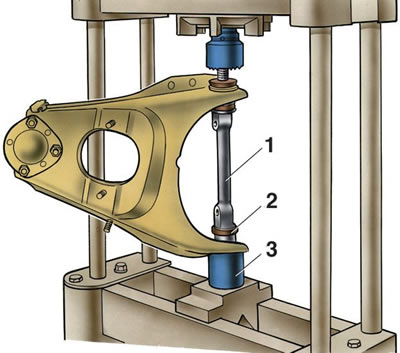
1. Place the lower lever on mandrel 3 and use the press punch to press on axis 1 of the lever until hinge 2 is pressed out of the hole. To press out the second hinge, turn the lever over and repeat the operation.
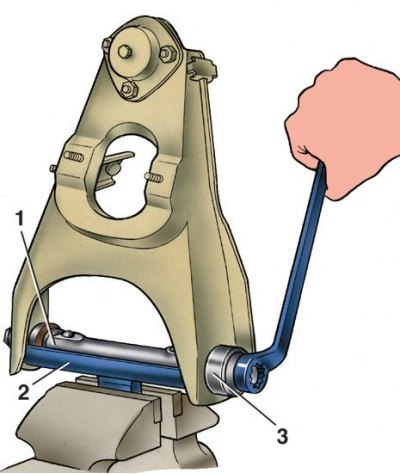
2. Pressing in the lower arm joints is done using the spacer sleeve A.74177/2, clamped in a vice, and the device A.74177/1. Mount the arm with the axle 1 on the device 2, put the joint on the axle and press it into the arm socket using the device 3 (A.74177/1). Then repeat the above operations to press in the second joint, on the other side of the arm.
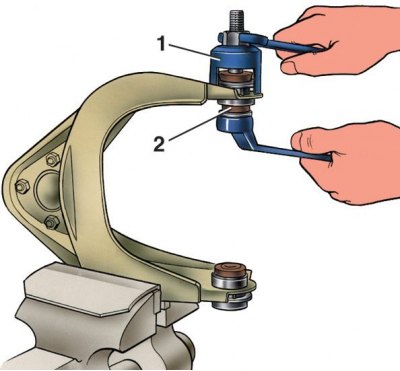
3. Upper arm. To press out the joints, install the A.47046 device on the arm so that the head of the screw of the device 1 is directed inward. By tightening the screw of the device, press out the joint 2.
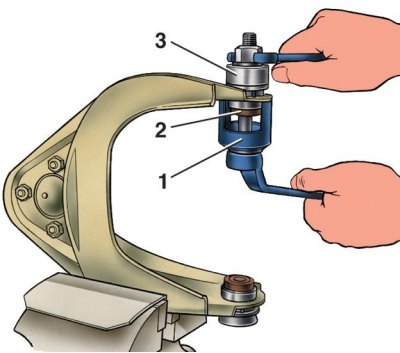
4. To press in, insert joint 2 into the lever socket and install tool A.47046, complete with cap 3. By tightening the screw of tool 1, press the joint into the lever socket.
Steering knuckles
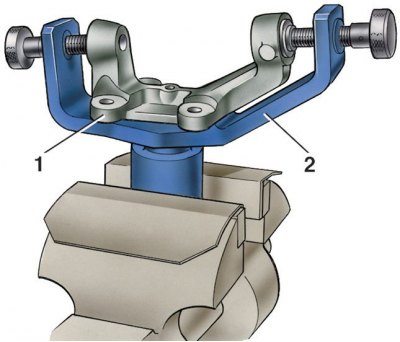
1. To check, install steering knuckle 1 on gauge 2 A.96008, clamped in a vice so that its surface under the wheel hub seal coincides with the gauge hole.
2. Insert the two side mounting pins of the gauge into the holes of the knuckle. If inserting the pins requires some effort, the knuckle is deformed and must be replaced with a new one.
Suspension springs
Basic data for checking front suspension springs
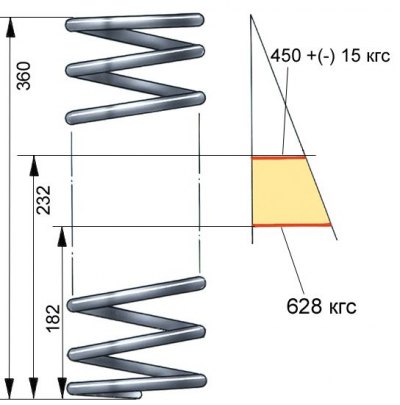
Carefully inspect the springs. If any deformations are found that may cause malfunction, replace the springs with new ones.
1. After compressing the spring three times until the coils touch, check its elastic characteristics at the control points.
2. Check the technical condition of the insulating gaskets and replace them if they are damaged.
Attention! According to the length, under a load of 4413 N (450 kgf), the springs are divided into two groups: group A - length greater than 232 mm and group B - length equal to or less than 232 mm. Group A springs are marked with yellow paint, and group B - with green, on the outer side of the coils. The marking must be clearly visible after installing the spring on the car.
Stabilizer bar
1. Check if the bar is deformed and if its ends are in the same plane; if the deformation is minor, straighten the barbell; if the deformation is significant, replace the rod.
2. Check the integrity of the cushions in the mounting brackets to the body and to the lower suspension arms; replace the cushions if worn.
Front suspension cross member
Checking the front suspension crossmember
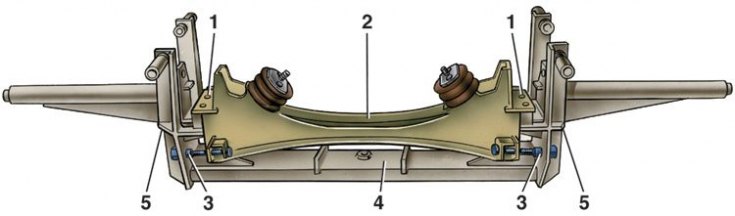
1 – hole on the crossbar for the mounting pins of the device; 2 – crossbar; 3 – control bushings of the device; 4 – device A.78124/R; 5 – control holes for installing bolts on the crossbar
1. To check, install the crossbar on device 4 so that the pins coincide with the holes 1 of the crossbar.
2. Screw the control bushings 3 of the device onto the ends of the two cross member bolts.
3. The holes 5 of the device and the crossbar bolts located opposite them must be coaxial.
4. Signs of crossbar deformation - impossibility of inserting the pins of the device into the crossbar holes without force, misalignment of the crossbar bolts with the bushings 3 of the device. If deformation is detected that cannot be eliminated by straightening, replace the crossbar.