




Contents: Deformation of the lower arm axle ↓ Deformation of the front suspension…↓ Condition of rubber-metal hinges ↓ Clearance in upper ball joints ↓ Condition of lower ball joints ↓
Checking the condition of the rubber-metal hinge of the front suspension arm
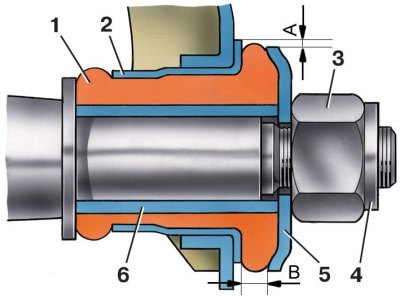
1 – rubber bushing of the hinge; 2 – outer sleeve of the hinge; 3 – suspension arm axle mounting nut; 4 – suspension arm axis; 5 – thrust washer of the hinge; 6 – inner sleeve of the hinge; A – radial displacement; B – distance between the thrust washer and the outer end of the outer sleeve
Measuring the gap in the upper ball joint with the device 02.8701.9500 (the brake is not shown)
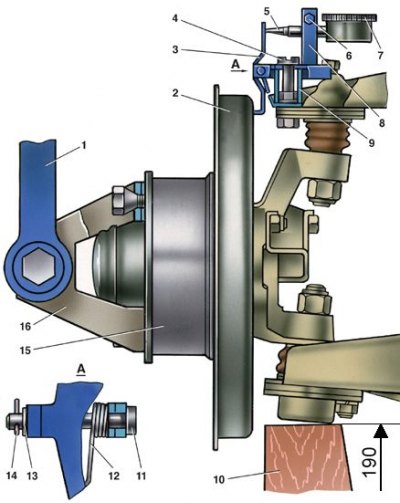
1 – torque wrench; 2 – brake protective cover; 3 – lever; 4 – screw; 5 – indicator extension; 6 – bolt; 7 – indicator; 8 – base; 9 – bushing; 10 – shoe; 11 – axis; 12 – spring; 13 – washer; 14 – cotter pin; 15 – wheel hub; 16 – bracket
Lower Ball Joint Test Diagram
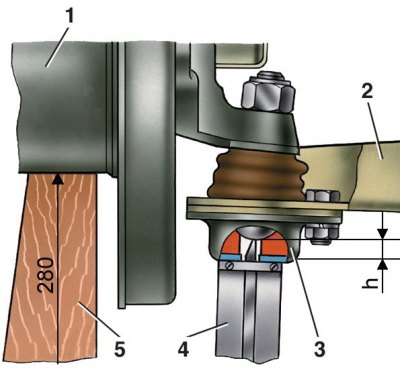
1 – wheel hub; 2 – lower arm; 3 – lower ball joint; 4 – caliper; 5 – wooden block
During each maintenance, as well as during repairs, it is necessary to check the condition of the protective covers of the suspension ball joints, paying special attention to the absence of mechanical damage to the covers. Find out if there are any cracks or traces of contact with road obstacles or the body on the suspension parts, deformations of the steering knuckle, the axis of the lower arm, suspension arms, crossmember and elements of the front of the body, and also check the gap in the upper ball joint and the condition of the lower ball joint.
Deformation of the lower arm axle
The text is copied from the online resource [www.VAZbook.ru]
1. The deformation of the lower arm axis is determined by inspection.
Deformation of the front suspension cross member
2. Loosen the nuts securing the lower arm axles so that the resulting gap between the spacer washer 28 (see Fig. Front suspension) and the mating surface of the cross member fits the caliper leg, close to the rod of the front bolt.
3. Measure the length of the cross member between the planes of the lower arm axles (left and right), in the area of the front bolts. The distance should be 611±1 mm.
4. If the cross member is deformed so that the wheel alignment angles cannot be adjusted, replace the cross member.
Condition of rubber-metal hinges
5. Make sure there is no deformation of the suspension arms, lower arm axle, cross member, and then hang up the front wheels of the car.
6. Measure the radial displacement A (see fig. Checking the condition of the rubber-metal hinge of the front suspension arm) outer sleeve 2, relative to inner sleeve 6, and distance B between thrust washer 5 and the outer end of outer sleeve 2.
7. Rubber-metal hinges are subject to replacement:
- if further adjustment of wheel alignment is not possible (when all washers are removed from under the lower arm axle);
- in case of ruptures and one-sided "bulging" of rubber;
- if the radial displacement A exceeds 2.5 mm;
- if dimension B does not fit within the range of 3–7.5 mm for the lower arm, 1.5–5 mm for the upper arm.
8. If dimension B is outside the specified limits, check that the rubber-metal hinge is pressed into the lever socket correctly.
Clearance in upper ball joints
9. The clearance in the upper ball joints is checked using the device 02.8701.9500. Place the car on a level horizontal surface with a hard surface, lift the right front part of the car and remove the wheel.
10. Place a wooden block 10 under the lower ball joint (see fig. Measuring the gap in the upper ball joint with device 02.8701.9500) 190 mm high and lower the car onto it.
11. Install sleeve 9 on the nut of the upper hinge mounting bolt closest to the casing, put base 8 on the sleeve and lightly secure it with screw 4.
12. By moving the device, set the lever 3 in a vertical position so that its lower end rests against the protective casing 2 of the brake, and tighten the screw 4.
13. Install indicator 7 into base stand 8 until its leg rests against lever 3, with a tension of 2–3 mm, and tighten bolt 6.
14. Attach bracket 16 to hub 15 with two wheel mounting bolts, put torque wrench 1 on the hex head of bracket axle 16 and, with a torque of 196 N·m (20 kgf·m), turn the key towards and away from the car, sum up both indicator readings.
15. The total indicator readings should not exceed 0.8 mm.
16. Repeat the operations for the left front wheel suspension.
Condition of lower ball joints
17. Place the vehicle on a level, horizontal surface with a hard surface and, lifting the right front part of the vehicle, remove the wheel.
18. Place a wooden block 5, 280 mm high, under hub 1 and lower the car onto it, clean the lower part of the joint from dust and dirt and unscrew the conical plug (see fig. Lower ball joint inspection diagram).
19. Measure the distance "h" with the depth gauge of the caliper 4 as shown in the diagram.
20. Repeat the operations for the left front wheel suspension.
21. If h = 11.3 mm, remove the joint from the car and inspect it carefully. There should be no cracks in the joint housing and no dirt in the grease. If there is dirt in the grease, cracks in the joint housing, or if h = 11.8 mm, replace the joint.