




Ignition switch
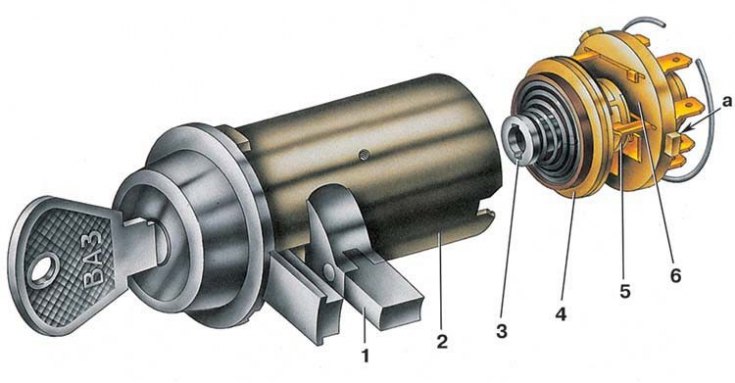
1 – locking rod; 2 – ignition switch housing; 3 – roller; 4 – contact disk; 5 – contact bushing; 6 – shoe; a – wide protrusion of the contact part
The ignition switch is checked for operation of the anti-theft device and correct contact closure in different key positions (see table. Ignition switch terminal connections). Voltage from the battery and generator is supplied to contacts "30" and "30/1". The free plug "INT" is used to connect the radio receiver.
The locking rod of the anti-theft device must extend when the key is set to position III (parking) and removed from the lock. The locking rod must retract after turning the key from position III to position 0 (off). The key must be removed from the lock only in position III.
When installing the contact part in the switch housing, it must be positioned so that the plugs "15" and "30" are on the side of the locking rod 1 (see fig. Ignition switch), in this case, the wide protrusion "a" of the contact part will enter the wide groove of the ignition switch housing.
Switching the ignition switch terminals
Key position | Contacts with voltage | Switched circuits |
0 (Disabled) | 30 and 30/1 | – |
I (Ignition) | 30–INT | Exterior lighting. Windscreen wiper and washer. Heater |
30/1–15 | Generator excitation winding. Ignition system. Direction indicators. Control instruments. Reversing light | |
II (Starter) | 30–INT | See position I |
30/1–15 | See position I | |
30–50 | Starter | |
III (Parking) | 30–INT | See position I |