

Open large image in new tab »
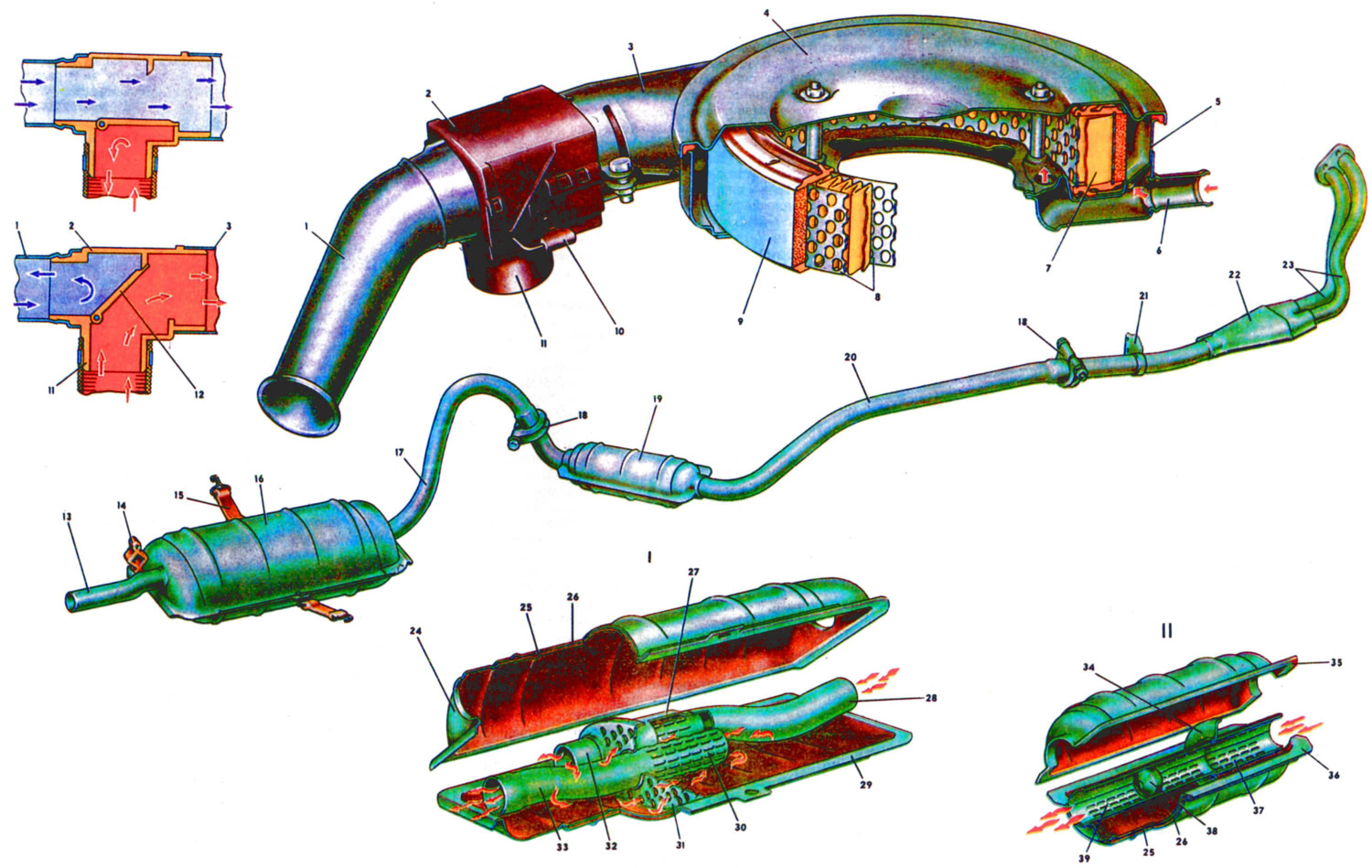
Pic. 13: 1. Cold air intake. 2. Temperature controller. 3. Filter nozzle. 4. Filter cover. 5. Filter housing. 6. Crankcase exhaust ventilation manifold. 7. Paper filter element. 8. Perforated shells of the filter element. 9. Filter element precleaner. 10. Damper handle. 11. Warm air intake pipe from the exhaust manifold area. 12. Damper. 13. Exhaust pipe. 14. Exhaust pipe suspension pad. 15. Silencer suspension belt. 16. Main muffler. 17. Front pipe of the main muffler. 18. Clamps. 19. Additional muffler. 20. Front pipe additional muffler. 21. A collar of fastening of a reception pipe to a transmission. 22. Gas receiver. 23. Receiving pipes. 24. The upper semi-body of the main muffler. 25. Thermal insulation of the main muffler. 26. The casing of the main muffler. 27. The casing of the left pipe. 28. Inlet pipe. 29. The lower half-case of the main muffler. 30. Perforation on pipes for extinguishing the energy of gases. 31. Perforated baffle. 32. Left pipe. 33. Outlet pipe. 34. Deaf partition. 35. The upper half-case of the additional muffler. 36. The lower half-case of the additional muffler. 37. Front perforated pipe. 38. Diaphragm. 39. Rear perforated pipe. I - Main silencer. II - Additional muffler.
Air filter
The air filter cleans the air entering the carburetor from mechanical impurities. The engine is equipped with a single-stage dry-type air filter with a replaceable filter element with a pre-cleaner. The air filter has seasonal adjustment of intake air temperature.
The air filter housing 5 is stamped from a steel sheet. The filter housing is mounted on the carburetor flange with four studs and fastened with self-locking nuts. On the carburetor, the filter is sealed with a rubber gasket. From above, the filter housing is closed with a cover 4 with a rubber seal. The cover is fastened with three nuts screwed onto the axles with remote ledges. The case and cover are painted with black enamel.
The filter element is made of a special filter cardboard 7 inserted into metal perforated shells 8. From the outside, a filter element 9 made of synthetic wool is put on for preliminary air purification (precleaner), increasing the dust capacity of the filter.
The filter element is installed in the body 5 and is pressed by the cover 4. The elastic rims of the filter element ensure the tightness of the connections of the element with the body and the cover.
From the bottom side, a collector 6 of the engine crankcase exhaust ventilation is welded to the filter housing, which is connected to the space behind the filter element.
The factory does not recommend cleaning and restoring the filter element, since this may damage the filter cardboard, and therefore, there is a possibility of abrasive wear of the engine cylinders.
Thermostat
The thermostat 2 consists of a plastic housing with a damper 12, the position of which can be changed with the handle 10. The thermostat is mounted on the air filter pipe 3 and fastened with a tie bolt. From the bottom, the thermostat housing has a branch pipe 11 for taking warm air from a deflector located on the exhaust manifold. Branch pipe 11 is connected to the deflector by a corrugated hose. A cold air intake 1 from the engine compartment is put on the thermostat housing. To reduce the noise of air intake, the intake 1 is made of polypropylene.
Depending on the ambient temperature, the damper 12 is set with the handle 10 to one of three positions: 1) HOT - warm air enters from the exhaust manifold zone through a corrugated hose and pipe 11; 2) COLD - cold air enters through intake 1; 3) intermediate position.
On some cars, a thermostat is installed with an automatic damper 12 drive from a thermal power element installed inside the thermostat and allowing you to automatically maintain the air temperature at the air filter inlet. On top of the specified thermostat there is an additional damper pneumatic actuator connected by a hose to the cavity of the inlet pipe. The operating range of the thermal power element is from +30 to +42°С. When the engine is idling, due to the increased vacuum in the intake pipe, the pneumatic actuator acts on the thermostatic valve and ensures that warm air enters the air filter, which results in a more complete combustion of the working mixture in the engine cylinders, and, consequently, a decrease in exhaust gas toxicity.
Under normal vehicle operating conditions, the filter element must be replaced every 20,000 km. When operating on very dusty roads, the replacement must be carried out every 10,000 km of the vehicle's run.
Intake pipe
The inlet pipe is cast iron, mounted on the cylinder head studs through two sealing metal-asbestos or ferronite gaskets common with the exhaust manifold.
The inlet pipe has a platform for installing a carburetor and four channels for supplying the working mixture to the engine cylinders. The pipe has a jacket for heating the working mixture, which is connected by channels to the jacket for cooling the cylinder head. The liquid is drained from the intake pipe heating jacket through a hose and tube to the engine cooling system pump.
Gasoline condensate formed on a cold engine drains out through a drain pipe pressed into the intake pipe and connected to the intake chamber of the pipe. To eliminate noticeable lean mixture at idle due to air leaks, the drain tube has an outlet with a diameter of (0,8±0,1) mm.
Exhaust gas outlet
Exhaust gases are released through the exhaust manifold, exhaust pipe 23, additional muffler 19 and main silencer 16. The exhaust pipe and mufflers are non-separable, they are connected to each other by pushing the pipes one into the other and are fixed with clamps 18. Moreover, one of the connected pipes has a flared end with two longitudinal diametrically spaced slots. When assembling, it is necessary to completely cover the said slots with the inserted pipe.
An exhaust manifold
The exhaust manifold is cast iron, has four pipes for exhaust gases from four cylinders. The manifold is fastened with studs to the cylinder head through sealing metal-asbestos or ferronite gaskets. The collector in the lower part has a flange to which the exhaust pipe of the mufflers is attached.
Downpipe
The downpipe consists of a flange, two pipes, a gas inlet 22, welded from two stamped halves, closed on both sides with asbestos heat-insulating gaskets and thin-walled protective casings. The exhaust pipe is studded to the exhaust manifold with four brass nuts, as well as to a bracket attached to the gearbox with a clamp 21. A sealing gasket made of asbestos sheet reinforced with steel tape is installed between the intake pipe and the manifold. Since 1988, the gasket has been made from elastomer. Gasket and nuts are disposable.
Silencers
Silencers consist of two stamped half-shells welded together. Perforated pipes and partitions are placed inside the mufflers, forming chambers, each of which suppresses the noise of a certain frequency range.
The main muffler 16 has two stamped half-shells 24 and 29, perforated pipes and a partition 31. Asbestos sheet or other insulating material is placed under the casings of the upper and lower half-shells for thermal insulation and noise reduction.
The main muffler shells and internal perforated pipes are made of stainless steel to improve corrosion resistance.
The outlet pipe 13 may have a decorative vent made of stainless steel.
The additional muffler 19, unlike the main one, has a blank partition 34, a throttling diaphragm 38. The perforated pipes of the muffler are arranged coaxially.
Mufflers with pipes assemblies are attached to the floor of the body with two rubber straps 15 for the body of the main muffler and a rubber cushion 14 for the exhaust pipe 13.