

Open large image in new tab »
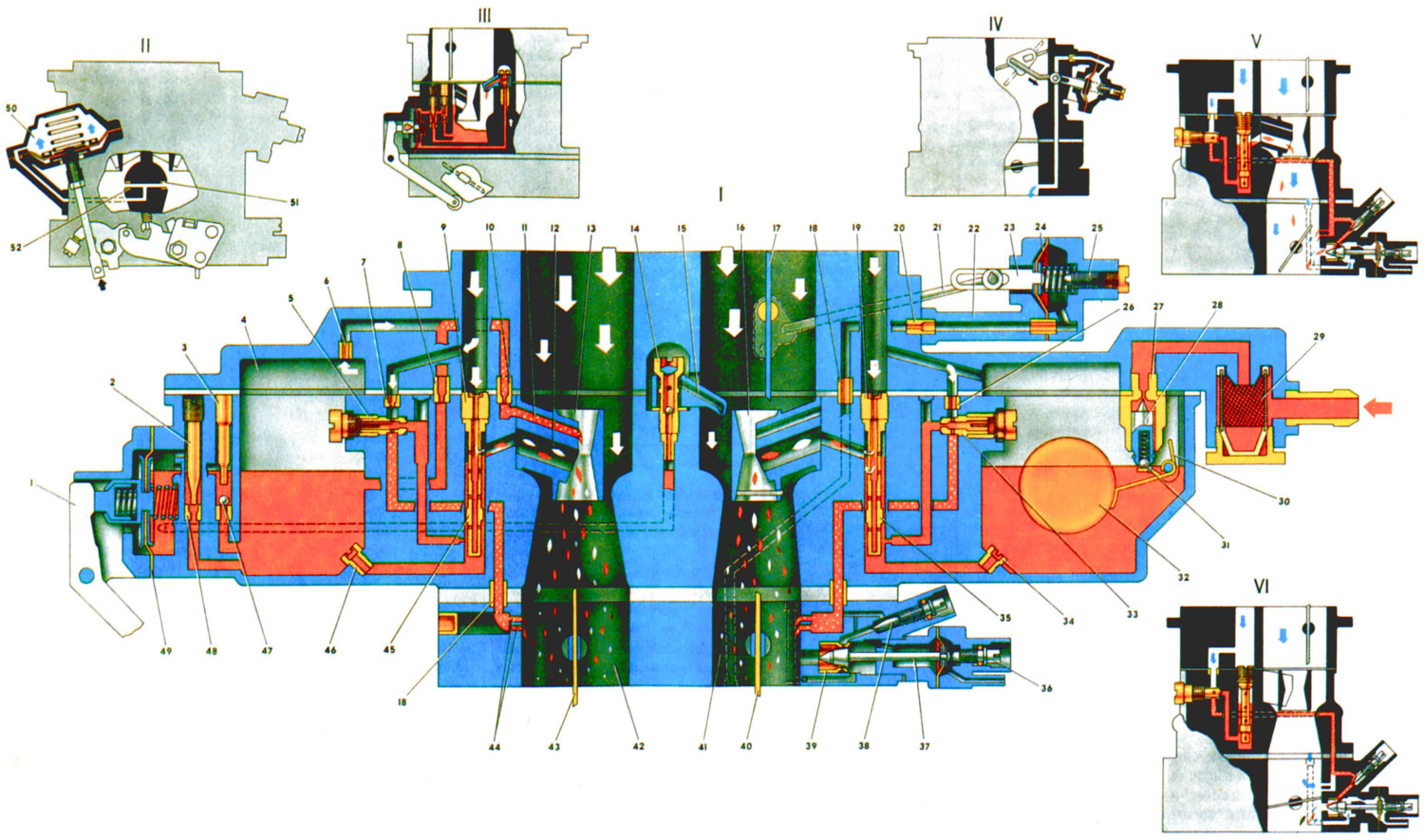
Pic. 10: 1. Accelerator pump lever. 2. Screw for adjusting the fuel supply by the accelerator pump. 3. Check valve plug of the accelerator pump. 4. Float chamber. 5. Fuel jet of the transition system of the second chamber. 6. Economizer air jet (econostat). 7. Air jet transition system. 8. Econostat fuel jet. 9. The main air jet of the second chamber. 10. Econostat emulsion jet. 11. Econostat atomizer. 12. Atomizer of the main dosing system of the second chamber. 13. Small diffuser of the second chamber. 14. Accelerator pump spray valve. 15. Accelerator pump sprayer. 16. Small diffuser of the first chamber. 17. Air damper. 18. Connecting bushings of the carburetor channels. 19. The main air jet of the first chamber. 20. Air jet launcher. 21. Rod connecting the lever of the air damper axis with the rail of the starting device. 22. The channel of the starting device in the throttle space. 23. Launcher rail. 24. Diaphragm of the starting device. 25. Trigger adjustment screw. 26. Air jet of the idle system. 27. Needle valve seat. 28. Needle valve. 29. Fuel filter. 30. Float bracket with stop and tongue. 31. Needle damper ball. 32. Float. 33. Fuel jet of the idle system. 34. The main fuel jet of the first chamber. 35. Emulsion tube of the first chamber. 36. Adjusting screw for the amount of idle mixture. 37. Forced idle economizer needle. 38. Composition adjusting screw (quality) idle mixture. 39. Seat adjusting screw. 40. Throttle valve of the first chamber. 41. The first mixing chamber. 42. Second mixing chamber. 43. Throttle valve of the second chamber. 44. Fixed openings of the transition system. 45. Emulsion tube of the second chamber. 46. The main fuel jet of the second chamber. 47. Check valve accelerator pump. 48. Bypass jet of the accelerator pump. 49. Accelerator pump diaphragm. 50. Pneumatic throttle valve of the second chamber. 51. Pneumatic jet located in the first chamber. 52. Pneumatic jet located in the second chamber. I - Scheme of the carburetor at maximum engine power. II - Scheme of operation of the pneumatic actuator of the throttle valve of the second chamber. III - Scheme of the accelerator pump. IV - Scheme of operation of the starting device. V - Scheme of carburetor operation in throttling modes. VI - Scheme of the carburetor at idle.
Carburetor operation when starting and warming up a cold engine
Due to the low temperature of engine parts and the low speed of air movement, mixture formation through the carburetor deteriorates significantly. For a reliable engine start, a strong enrichment of the combustible mixture is required, which is provided by the carburetor starting device.
When starting a cold engine, close the air damper 17 by pulling the control handle towards you until it stops. In this case, the rod 21 will take the extreme left position in the slot of the rail 23, and the rod 4 (see fig. 9), going down, under the action of turning the three-arm lever 30, it will turn lever 6 and slightly open the throttle valve of the first chamber by the required amount. At the same time, the throttle control pedal must not be pressed to prevent the supply of excess fuel to the engine.
When the crankshaft of the engine is turned by the starter, the resulting vacuum is transmitted both to the holes of the idling system and through the ajar throttle valve 40 (see fig. 10) from the first chamber to the sprayer of the main dosing system. Under the action of rarefaction, the fuel begins to intensively flow out of the holes of the idle system and the atomizer. From the openings of the idle system, the fuel enters in the form of an air-fuel emulsion. Air is mixed with the fuel through the air jet 26. Simultaneously, through the communication channel with the throttle space, the vacuum is transmitted to the working cavity of the diaphragm 24 of the starting device, but it is not enough to overcome the resistance of the diaphragm return spring. When steady flashes appear, the vacuum increases, the diaphragm 24 with the rail 23 are retracted, and the thrust 21 slightly opens the air damper 17. At the same time, the lever 23 (see fig. 9), turning, compresses the spring located in the telescopic rod 24. The starting device, automatically opening or closing the air damper, does not allow excessive enrichment or depletion of the mixture.
As the engine warms up, the air damper is fully opened, returning the starter control handle to its original position. The extreme retracted position of the diaphragm 24 (see fig. 10) adjustable by screw 25. When the trigger handle is fully extended and the rail 23 is manually actuated, the air damper should open slightly, and the gap between its lower edge and the wall of the inlet should be 5.0-5.5 mm. When the air damper is fully closed, the throttle valve of the first chamber should open slightly by 0.7-0.8 mm. This gap is adjusted by bending the rod 4 (see fig. 9).
Carburetor operation at idle
Throttle valves at idle are covered. In this case, the vias of the system are located just above the upper edge of the damper. The air damper is fully closed. The vacuum from under the throttle valve of the first chamber is transmitted through the holes of the idle system to the channels of the system. Under the action of vacuum, the fuel entering the emulsion well from the float chamber through the main fuel jet 34 (see fig. 10), rises to the fuel jet 33, mixes with the air entering through the air jet 26, additionally mixes with the air entering through the vias and through the hole regulated by the screw 38, enters the seat 39. Next, the emulsion passes under the needle 37 and through the holes in the seat 39 into the intake pipe of the engine. Due to the high speeds of the passage of the emulsion through the saddle 39 is a high-quality mixing of fuel with air. In this mode, the vacuum in the small diffuser is insignificant, and fuel from the atomizer of the main dosing system does not enter the engine.
Forced idle economizer operation
The overrun economizer cuts off the air/fuel mixture through the idle system in overrun mode, i.e. when the vehicle is under engine braking with the throttle pedal released and the clutch not disengaged. In over idle mode, the throttle valves are closed and the engine speed exceeds the idle speed. At the same time, atmospheric pressure is created in the working cavity of the forced idle economizer and needle 37, connected to the economizer diaphragm, blocks the exit of the fuel-air emulsion, which eliminates the release of carbon monoxide into the atmosphere (SO) and at the same time reduces fuel consumption. The change in the working cavity from vacuum to atmospheric pressure and vice versa is carried out by an electro-pneumatic valve, which is connected by a hose through pipe 61 (see fig. 9) with the working cavity of the economizer. The electropneumatic valve is operated by a microswitch 32 or an electronic control unit connected in parallel with the microswitch. At a crankshaft speed of 1600-1680 min'1, the electronic unit is turned off, but the electro-pneumatic valve remains open due to the switched on microswitch. In the forced idle mode, the throttle valves are abruptly closed, lever 1 presses the lever of the microswitch 32 and turns it off, the electro-pneumatic valve closes, and the working cavity of the forced idle economizer communicates with the atmosphere. In this case, the needle 37 (see fig. 10) The economizer blocks the outlet of the idle system and the outlet of the fuel-air mixture. With a decrease in the frequency of rotation of the crankshaft to 1200-1260 min-1 the electronic unit turns on the electropneumatic valve and a vacuum is created in the working cavity of the economizer, while the needle 37 is pulled back, the fuel-air mixture is supplied and the engine starts to work again.
Carburetor operation in throttling modes
The first mixing chamber mainly operates on throttling modes. The required composition of the combustible mixture is provided by the joint operation of the main dosing system and the idle system. As the throttle valve of the first chamber opens, the vacuum in the atomizer increases, the fuel in the emulsion well rises and, when it reaches the holes of the emulsion tube 35, it is captured by air entering through the jet 19 and drawn into the atomizer. The vacuum in the mixing chamber is sufficient, so the fuel also comes from the holes of the idle system. Fuel consumption by both systems is limited by the main fuel jet 34.
When a certain vacuum is reached in the mixing chamber, the throttle valve of the second chamber begins to open due to the retraction of the diaphragm and the pneumatic drive rod connected to the throttle lever of the second chamber. Fuel begins to flow out of the sprayer of the main dosing system of the second chamber. The absence of failures in the operation of the engine at the moment of the beginning of the opening of the throttle valve of the second chamber is provided by the openings 44 of the transition system, which comes into operation from this moment. In the future, the second chamber works similarly to the first.
Carburetor operation at maximum engine power
In the maximum power mode, the throttle valves of both chambers are fully open: the main dosing systems, the idle system, transitional systems work, and when the required vacuum is reached, the econostat.
Due to some decrease in vacuum in the channels of the idle system and the transitional system at fully open throttle valves, the outflow of fuel from these systems is insignificant. When sufficient rarefaction is reached in the small diffuser of the second mixing chamber, the econostat comes into operation, enriching the combustible mixture at full load. The fuel from the float chamber enters through the jet 8 of the econostat, mixes with the air coming from the jet 6, and then through the emulsion jet 10 and the atomizer 11 is sucked into the mixing chamber.
Accelerator pump operation
The accelerator pump operates in the engine load increase mode; while the necessary enrichment of the mixture is carried out by injecting an additional portion of fuel into the air flow of the first mixing chamber.
With a sharp increase in load (throttle valve opens abruptly) the accelerator pump drive cam on the damper axis acts on lever 1, which compresses the spring placed inside the telescopic cup of the working diaphragm 49. Expanding, the spring moves the diaphragm, providing a smooth prolonged injection of fuel through the nozzle 15. The profile of the accelerator pump cam provides double injection, the second injection is necessary at the beginning of the opening of the throttle valve of the second chamber.
The operation of the pneumatic actuator of the throttle valve of the second chamber
At low engine loads, when the throttle valve of the first chamber is slightly open, the vacuum in the diffusers is not enough to operate the pneumatic drive, and under the action of the spring, the pneumatic drive rod is lowered down. As the load increases and the throttle valve of the first chamber opens, the vacuum in it increases and at a certain moment leads to the movement of the diaphragm mechanism up to its full stroke with simultaneous twisting of the spring on the axis of the throttle valve of the second chamber. However, the throttle valve of the second chamber remains closed until the throttle valve of the first chamber is opened at an angle of approximately 48°. With a wide open throttle valve of the first chamber and a large air flow (high speed crankshaft) throttle valve of the second chamber is fully opened. The throttle position of the second chamber is adjusted automatically depending on the speed of the engine.
When the vehicle speed is reduced (at a constant full opening of the throttle valve of the first chamber) rotation frequency. the engine crankshaft decreases, the vacuum in the diffusers decreases, and the throttle valve of the second chamber is covered. This achieves an improvement in mixture formation in the first chamber.
When the throttle valve of the first chamber is abruptly closed, the throttle valve of the second chamber is forcibly closed. Jets 51 and 52 eliminate the possible fluctuation of the pneumatic drive mechanism.