




Open large image in new tab »
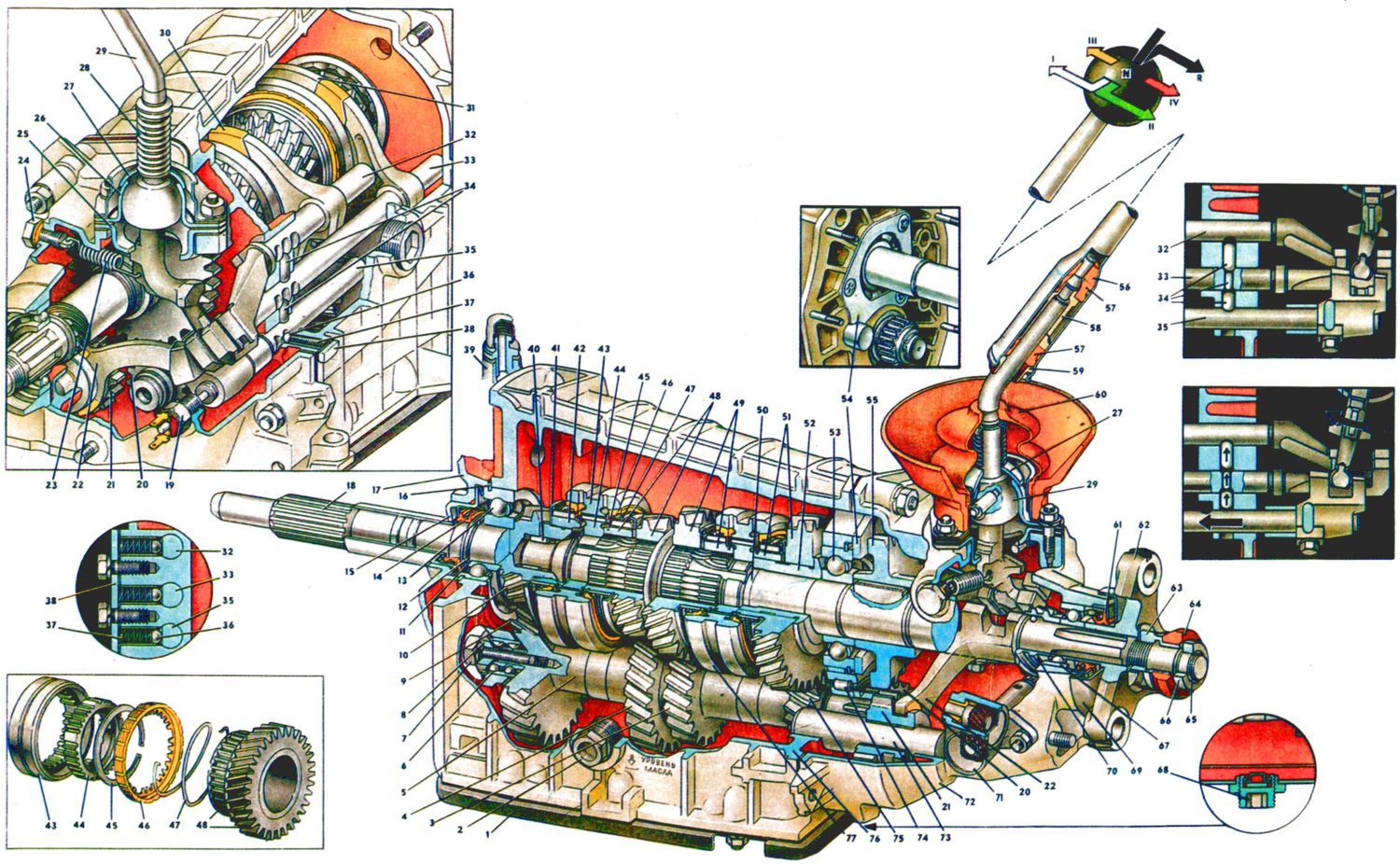
Fig. 16: 1. Lower cover. 2. Filler and inspection plug. 3. Intermediate shaft second gear toothed wheel. 4. Intermediate shaft third gear toothed wheel. 5. Intermediate shaft. 6. Intermediate shaft front bearing. 7. Clamp washer bolt. 6. Intermediate shaft front bearing clamp washer. 9. Intermediate shaft constant mesh toothed wheel. 10. Input shaft constant mesh gear. 11. Spring washer. 12. Retaining ring. 13. Input shaft rear bearing. 14. Input shaft oil seal. 15. Gearbox front cover. 16. Bearing mounting ring. 17. Clutch housing. 18. Gearbox input shaft. 19. Reversing light switch. 20. Intermediate shaft reverse gear. 21. Reverse intermediate gear. 22. Reverse gear engagement fork. 23. Gear shift lever return spring. 24. Return spring bolt. 25. Gear shift lever guide cup. 26. Lever ball joint. 27. Spherical washer. 28. Spring. 29. Gear shift lever. 30. First and second gear engagement fork. 31. Third and fourth gear engagement fork. 32. First and second gear engagement fork rod. 33. Third and fourth gear engagement fork rod. 34. Locking crackers. 35. Reverse gear engagement fork rod. 36. Rod retainer ball. 37. Retainer spring. 38. Retainer cover. 39. Breather. 40. Secondary shaft front end needle bearing. 41. Synchronizer spring thrust washer. 42. Fourth gear synchronizer ring. 43. Third and fourth gear synchronizer sliding sleeve. 44. Third and fourth gear synchronizer sliding sleeve hub. 45. Synchronizer retaining ring. 46. Synchronizer blocking ring. 47. Synchronizer spring. 48. Third gear synchronizer toothed wheel and toothed ring. 49. Second gear synchronizer toothed wheel and toothed ring. 50. Secondary shaft. 51. First gear synchronizer toothed wheel and toothed ring. 52. First gear toothed wheel bushing. 53. Secondary shaft intermediate bearing. 54. Intermediate bearing locking plate. 55. Secondary shaft reverse gear. 5o. Gearshift lever damper elastic cushion. 57. Damper rubber bushing. 58. Damper spacer sleeve. 59. Damper locking sleeve. 60. Gearshift lever inner boot. 61. Secondary shaft rear bearing oil seal. 62. Cardan shaft elastic coupling flange. 63. Nut. 64. Centering ring seal. 65. Centering ring retaining ring. 66. Centering ring. 67. Secondary shaft rear bearing. 68. Drain plug. 69. Mud deflector. 70. Speedometer drive gear. 71. Speedometer drive. 72. Gearbox rear cover. 73. Reverse intermediate gear axle. 74. Intermediate shaft rear bearing. 75. Intermediate shaft first gear pinion. 76. Gearbox housing. 77. First and second gear synchronizer sliding clutch.
The gearbox is used to change the amount of torque transmitted to the drive wheels of the vehicle, to disconnect the running engine from the transmission when the vehicle is parked or stopped, and when it is coasting (by inertia), changing the direction of rotation of the wheels when reverse gear is engaged.
Most cars have a four-speed gearbox, and some cars have a five-speed gearbox. A characteristic feature of the gearbox is that it is compact and simple in design, since it has a small number of gears. The gear wheels of the first, second and third gears have a constant helical engagement, which ensures silent and durable operation of the gearbox. The selected gear ratios provide intensive acceleration, high average speed of the car and economical operation of the engine.
Gear ratios of the gearbox: first gear - 3.67; second - 2.10; third - 1.36; fourth - 1.00; reverse - 3.53.
The gearbox is attached to the clutch housing. The engine assembly with the clutch housing and gearbox form the vehicle's power unit.
All gearbox components are located in two basic parts: in the crankcase 76 and the rear cover 72. The gearbox housing is cast from an aluminum alloy. The outer surface has ribs that provide rigidity of the crankcase and good heat transfer. Three covers are attached to the crankcase: front 15, rear 72 and lower 1. The front cover is pressed into the clutch housing 17 in one position and is sealed in the housing mounting hole with a rubber ring. The front cover closes the rear bearing 13 of the primary shaft 16. Between the cover flange and the bearing 13, there is a spring washer 11. In the front cover, there is an oil seal 14, and in the cover itself there is an opening for draining oil that has leaked through the oil seal. This prevents the clutch discs from getting oily. The cover is installed with the opening down. A guide bushing is soldered to the front cover, on which the clutch release bearing sleeve is located. In the side wall of the crankcase, there is a filler hole, which is also a control hole with a plug 2. The oil level should reach the edge of the filler hole. The rear cover is cast from an aluminum alloy and is attached to the gearbox housing on studs with nuts and spring washers. The speedometer drive 71 is attached to the rear cover. The gearshift lever parts are mounted on top of the cover, and the reverse gear wheels are located inside the cover. The lower cover is stamped from steel. It closes the lower opening of the crankcase, through which the gearbox is disassembled and assembled. The cover is fastened on studs with nuts and spring washers. The cover has a drain hole closed by a plug 68 with a permanent magnet.
The gearbox housing cavity communicates with the atmosphere through breather 39, which is installed in the clutch housing. A spring-loaded valve is installed in the breather housing, preventing water, dirt, and dust from entering the crankcase.
The gearbox housing contains: primary shaft 18, secondary shaft 50 assembled with gear wheels and synchronizers, and intermediate shaft 5.
The primary (leading) shaft rotates in two ball bearings. The front bearing is located at the end of the crankshaft. Part of the bearing length enters the end of the crankshaft, and part enters the flywheel hole, centering it on the crankshaft. The rear bearing 13 is located in the socket of the front wall of the gearbox housing. Its mounting ring 16 is clamped between the clutch and gearbox housings. On the shaft, the bearing is clamped between the shaft flange and spring washer 11, which is locked on the shaft by retaining ring 12. With such fixation of the bearing in the socket and on the shaft, axial displacement of the shaft is excluded.
The primary shaft is manufactured together with the helical ring gear 10, which is in constant engagement with the gear wheel 9 of the intermediate shaft. From the end of the shaft, a straight-toothed ring gear 42 of the fourth gear synchronizer is pressed onto the machined belt and then soldered with copper. In the same end of the shaft, a seat is machined for the needle bearing 40 of the secondary shaft. On the front end of the shaft, splines are cut to accommodate the driven clutch disk.
The secondary (driven) shaft is, as it were, an extension of the primary shaft. It rests on three bearings. Needle bearing 40 is located at the end of the primary shaft, intermediate bearing 53 in the rear wall of the crankcase, and rear double-row ball bearing 67 in the socket of the rear cover of the gearbox. The intermediate bearing is held from displacement in the socket by an adjusting ring and a locking plate 54, which is fastened to the wall of the crankcase with screws. On the shaft, the bearing is clamped between sleeve 52 and reverse gear 55 under the force of spring washer 11, which is held on the shaft by locking ring 12. Rear bearing 67 has a sliding fit in the rear cover. On the shaft, the bearing is clamped by nut 63 between gear 70 of the speedometer drive and flange 62 of the elastic coupling. The nut is secured with a washer which bends back onto the nut edge. At the outlet from the cover, the secondary shaft is sealed with a gland, the working edge of which is adjacent to the ground surface of flange 62. The gland is protected from mechanical damage, water and dirt by mud deflector 69. Rubber seal 64 is tightly seated on the cylindrical belt of the nut, then centering ring 66 is pressed onto the end of the shaft and retaining ring 65 is installed. When installing the elastic coupling of the cardan transmission, the centering ring enters the centering sleeve of the flange of the elastic coupling, which ensures the centering of the secondary shaft of the gearbox and the cardan shaft. In this case, seal 64 is pressed against the end of the centering sleeve, which creates a tight seal for this connection. Gear wheels 48 and 49 of the third and second gears rotate on the heat-treated journals of the secondary shaft. The toothed wheel 51 of the first gear rotates on the steel heat-treated sleeve 52 clamped on the shaft between the bearing 53 and the synchronizer hub. The said toothed wheels have two rims each. The helical rims are in constant engagement with the same-name toothed wheels of the intermediate shaft, and the clutches 43 and 77 of the synchronizers are connected to the spur rims when the first, second or third gear is engaged. To supply oil to the heat-treated journals of the secondary shaft, sleeve 52 and to the needle bearing 40, radial holes are made in the toothed wheels, and longitudinal grooves are cut on the journals of the shaft and sleeve 52 to create a stable oil film. On two belts of the secondary shaft, three deep grooves are made each, into which the projections of the synchronizer clutch hubs enter. The hub 44 of the synchronizer of the third and fourth gears is pressed against the shaft flange by a spring washer and is locked on the shaft by a ring. The other hub is clamped between the bushing 52 and the shaft flange. It is held from axial displacement together with the intermediate bearing 53 and the toothed wheel 55 by a spring washer 11 and a locking ring 12. The toothed wheel 55 of the reverse gear is connected to the shaft by a key.
The synchronizer is of the inertial type, providing shock-free gear engagement. The design of both synchronizers is identical.
The synchronizer of the third and fourth gears consists of a hub 44, a sliding clutch 43, two blocking rings 46, springs 47, locking rings 45 and synchronizer rims of the primary shaft and a gear wheel 48 of the third gear. The blocking ring 46 is connected with the spur rim of the gear wheel 48 by its internal teeth. On the gear rim, the blocking ring is held by the locking ring 45, to which it is pressed by the spring 47. The other blocking ring is connected in the same way to the rim 42 of the primary shaft. The blocking ring is made of bronze. On the conical surface of the ring, fine threads and longitudinal grooves are cut, which contributes to the rapid rupture of the oil film at the moment of contact of the conical surfaces of the sliding clutch and the blocking ring. And this in turn creates increased dry friction between the clutch and the ring. The sliding clutch 43 is mounted on the splines of the hub and can move along them. For this purpose, the gear shift fork 31 enters the annular groove of the clutch.
The intermediate shaft 5 is made in the form of a block of four gear wheels. The shaft rotates in a double-row ball bearing 6 and a cylindrical roller bearing 74. The ball bearing is fastened to the shaft with a bolt 7 through a spring and flat washers. The roller bearing is clamped on the shaft between the shaft flange and the reverse gear wheel 20. This wheel is installed on the shaft splines and is held on them by a retaining ring. A spring washer is installed to create axial tension between the bearing and the wheel. The intermediate shaft is held from axial displacement by the mounting ring of the front bearing, which is clamped between the clutch and gearbox housings.
The intermediate gear wheel 21 of the reverse gear is located on the axis 73 on a metal-ceramic bushing. The axis is installed in the holes of the rear wall of the crankcase and the lug of the rear cover of the gearbox and is locked by the plate 54, which enters the groove of the gear. The fork 22 of the reverse gear engagement enters the annular groove of the wheel 21. The intermediate gear wheel of the reverse gear changes the direction of rotation of the secondary shaft when the reverse gear is engaged. In this case, it connects the gear wheels 55 and 20 of the reverse gear together.
The speedometer drive 71 consists of a housing and two pairs of gear wheels. The gear 70 of the speedometer drive is fixed on the shaft with a locking ball. The gear wheel of the speedometer drive is rigidly connected to the flexible shaft (cable). For connection with the cable, a socket is made in the gear wheel, into which the cable tip is inserted. The cable is fixed in the speedometer drive housing with a union nut.
The gears are engaged and shifted through a mechanical drive consisting of a gear shift lever 29, three rods with forks, locks and a locking device.
The gear shift lever is detachable to facilitate removal and installation of the gearbox on the vehicle. The lever rod is connected to the lever itself through elastic damper bushings that absorb vibrations and provide a softer gear shift.
The lever damper consists of an elastic cushion 56, two rubber bushings 57, a plastic spacer bushing 58 and a locking bushing 59. The latter enters the groove of the rod and locks all the damper parts.
The gear shift lever is mounted in the rear cover of the gearbox. Guide cup 25 of the lever, ball joint 26 and seal flange are attached to the gearbox cover with three studs and nuts with spring washers. Sealing gaskets are installed between them. The gear shift lever has a support ball, which is pressed by spring 28 to the surface of the ball joint. The same spring presses spherical washer 27 from above to the ball joint. To prevent the lever from turning in the ball joint, a pin is pressed into the support ball, the end of which enters the hole in the support. The lower part of the lever is pulled by spring 23 until the limiting ledge stops in the guide cup. In this position, the lower end of the lever is in the groove of rod 33 for engaging third and fourth gears. This position will be neutral. The movement of the lower end of the lever when engaging first and second gears is limited by a bolt screwed into the gearbox housing.
To engage reverse gear, press the lever down, compressing spring 28. In this case, the limiting projection will drop below guide cup 25, which will allow the lever to be moved to the right. Its lower end will enter the groove of the head of the rod 35 of the reverse gear engagement fork. With further movement of the lever back, the rod will move away from the switch 19 of the reverse gear light, and when the reverse gear is engaged, the reverse gear light will light up at the same time.
The ball joint of the lever is protected from contamination by a rubber cover, and the place where the lever exits into the car interior is sealed from below by a cuff, which is installed on the flange of the seal and pressed against the bottom of the body.
The synchronizer clutches and the intermediate reverse gear wheel are moved by forks that are bolted to the rods. Rod 33 of the third and fourth gear engagement fork is installed in the openings of the front and rear walls of the crankcase, and rods 32 and 35 in the openings of the rear wall and the crankcase boss. Grooves are made in the heads of the rods for the passage of the lower end of the gearshift lever. The forward movement of rods 32 and 33 is limited by the stop of the rods against the crankcase wall, and rod 35 of reverse is limited by the stop of the spacer sleeve, put on the rod, against the rear wall. The rearward travel of the rods is limited by the stop of the rods against the bosses of the rear cover of the gearbox. In the engaged and neutral positions, the rods are held by clamps. For their placement, three sockets are made on rods 32 and 33, and two sockets on rod 35.
The locks are located in bushings that are pressed into the crankcase holes and covered by a common cover 38. Spring 37 presses the ball 36 of the lock to one of the rod seats, holding it in the neutral or engaged position. When the gear is engaged, the ball is squeezed out of the rod seat, then goes into another seat, fixing the rod in a new position. The reverse lock spring is more rigid and has a cadmium coating or is painted green for distinction. To prevent the simultaneous engagement of two gears, the drive has a locking device consisting of three locking crackers 34. The two outer crackers of larger diameter are installed in the hole of the rear wall, and the middle one in the hole of rod 33. The rods have seats for crackers. When, for example, reverse gear is engaged, rod 35, moving, pushes out of its socket a cracker, which enters the socket of rod 33 and simultaneously through the middle cracker presses the other extreme cracker to the socket of rod 32. Thus, rods 32 and 33 will be fixed in the neutral position. Any two other rods are locked in the same way when other gears are engaged.