

Open large image in new tab »
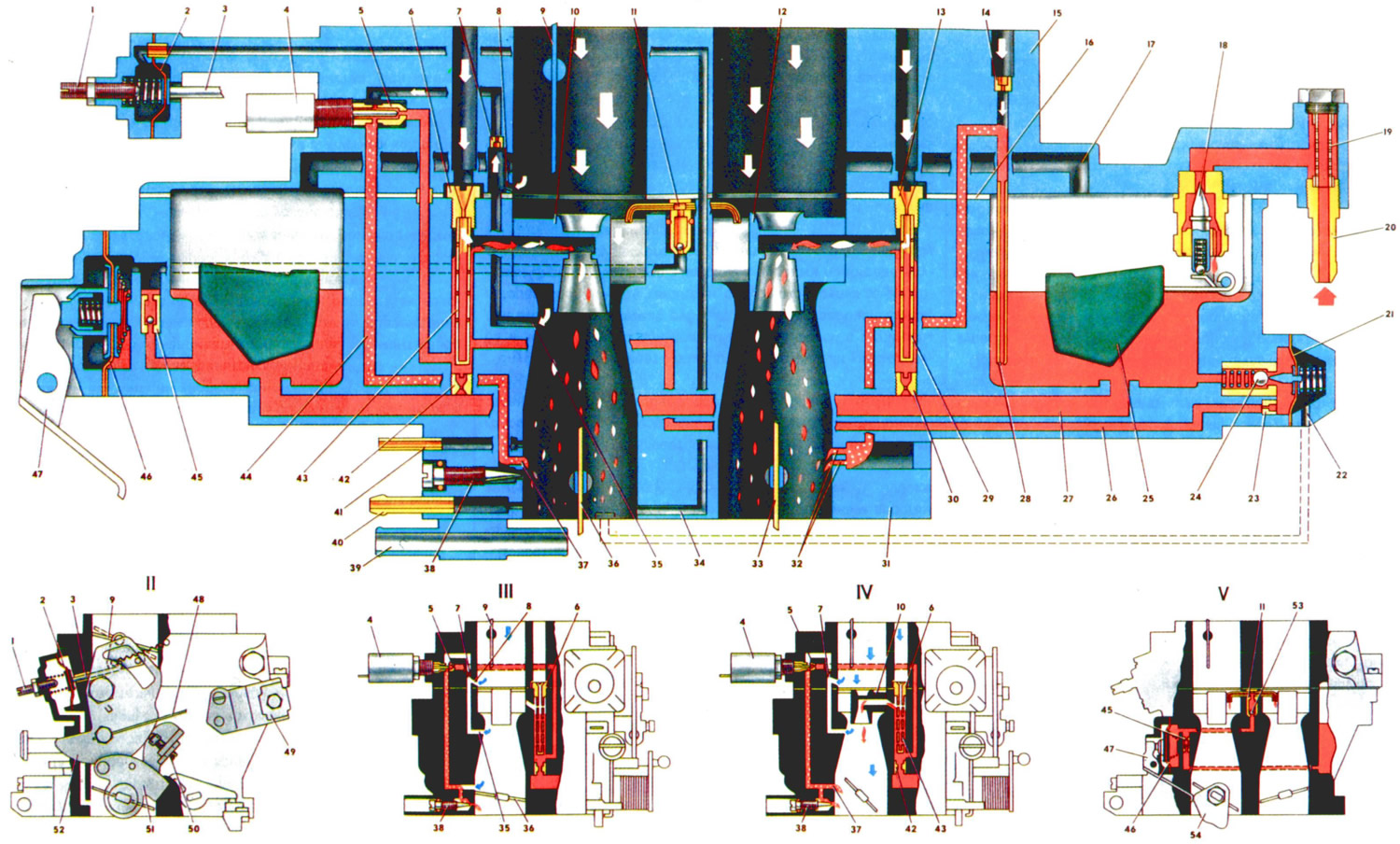
Pic. 12: 1. Trigger adjusting screw. 2. Aperture of the starting device. 3. Trigger rod. 4. Solenoid shut-off valve. 5. Fuel jet idling. 6. The main air jet of the first chamber. 7. Air jet idling. 8. Idle flow channel. 9. Air damper. 10. Atomizer of the main dosing system of the first chamber. 11. Accelerator pump nozzles. 12. Atomizer of the main dosing system of the second chamber. 13. Econostat atomizer. 14. The main air jet of the second chamber. 15. Air jet of the transitional system of the second chamber. 16. Carburetor cover. 17. Hole for balancing the float chamber. 18. Needle valve. 19. Fuel filter. 20. Fuel supply pipe. 21. Economizer diaphragm power modes. 22. Air channel economizer power modes. 23. Fuel jet economizer power modes. 24. Ball valve economizer power modes. 25. Float. 26. Fuel channel economizer power modes. 27. Econostat fuel jet with tube. 28. fuel jet of the transition system of the second chamber with a tube. 29. Emulsion tube of the second chamber. 30. The main fuel jet of the second chamber. 31. carburettor body. 32. Outlets of the transition system of the second chamber. 33. Throttle valve of the second chamber. 34. Air channel of the starting device. 35. Opening of the air channel of idling. 36. Throttle valve of the first chamber. 37. Slot of the transition system of the first chamber. 38. Adjusting screw for the quality of the idle mixture. 39. Carburetor heating block. 40. Branch pipe for suction of crankcase gases. 41. Pipe connected to the vacuum ignition timing controller. 42. The main fuel jet of the first chamber. 43. Emulsion tube of the first chamber. 44. Idle emulsion channel. 45. Ball valve accelerator pump. 46. Accelerator pump diaphragm. 47. Accelerator pump drive lever. 48. Thrust of the handle of the air damper drive. 49. Arm of fastening of a cover of draft of a drive of an air damper. 50. Adjusting screw for slightly opening the throttle valve of the first chamber. 51. Throttle actuator lever. 52. Choke control lever. 53. Ball valve for fuel supply of the accelerator pump. 54. Accelerator pump drive cam. I - Scheme of the carburetor at maximum engine power. II - scheme of operation of the starting device. III - Scheme of the carburetor at idle speed of the engine. IV - Scheme of operation of the carburetor in modes.
The work of the carburetor when starting and warming up the engine
The necessary enrichment of the combustible mixture is provided by the carburetor starting device.
When starting a cold engine, pull the choke control knob towards you as far as it will go. The throttle control pedal is not touched to prevent the supply of an uncontrolled excess portion of fuel to the engine. At the same time, the air damper control lever 52 is rotated counterclockwise, the expanding groove releases the pin of the air damper lever and the damper is held in the closed position due to the return spring. The outer edge of the lever 52 presses on the adjusting screw 50 for slightly opening the throttle valve of the first chamber, as a result, the lever 51 slightly opens the throttle valve of the first chamber by the required amount. When cranking the crankshaft with a starter, the resulting rarefaction of air is transferred to the holes and channels of the idle system and to the sprayer 10 of the main metering system. Under the action of vacuum, fuel will intensively flow out of the holes of the idle system and the main metering system. At the same time, a vacuum is created in the working cavity of the diaphragm 2 of the starting device, but it is not enough to overcome the resistance of the return spring. At the moment of flashes, the vacuum increases, under the influence of which the diaphragm 2 with the rod 3 are retracted and the rod 3 slightly opens the air damper 9 by the lever pin.
The air damper opens or closes automatically when starting and starting to warm up the engine, preventing excessive enrichment or depletion of the mixture. As the engine warms up, the choke is fully opened by returning the choke control handle to its original position.
Carburetor idle
At idle, the throttle valve 36 is closed, while the slot 37 of the transition system of the first chamber is located above the upper edge of the valve. The air damper is fully open. The vacuum through the idle hole, covered with an adjusting screw 38 of the mixture quality, is transmitted to the channels of the idle system and to the fuel jet 5. Under the action of the vacuum, the fuel entering the emulsion well through the main fuel jet 42 rises to the fuel jet 5, partially mixed with air, entering through the air jet 7, mixes again with the air entering through the slot 37 of the transition system, and in the form of an emulsion enters under the adjusting screw 38 into the throttle space.
The vacuum in the small diffuser is insufficient and fuel is not supplied from the atomizer 10 of the main metering system.
To control the operation of the engine at idle, there is an adjusting screw for the amount of the mixture, which regulates the amount of opening of the throttle valve of the first chamber, and an adjusting screw 38 for quality (composition) mixtures.
Forced idle economizer operation
The overrun economizer cuts off the fuel supply through the idle system during the overrun of the engine (when braking the car with the engine, when the throttle pedal is released, and the clutch is not disengaged). In the forced idle mode, the throttle valves are closed and the engine speed exceeds the idle speed.
The economizer includes a limit switch mounted on the idle mixture amount adjustment screw, an electromagnetic shut-off valve 4, an electronic control unit and electrical wires for connecting devices. The economizer will only operate when the throttle pedal is released when the limit switch is connected to "weight". In this case, the lever 51 of the throttle actuator will rest against the limit switch and close it to "mass". In the process of starting a cold engine, the limit switch will not be connected to "weight", as the throttle valve will be ajar.
The electronic control unit supplies power to the windings of the electromagnetic shut-off valve 4 until the crankshaft speed at forced idling increases and does not exceed 2100 min-1. At a higher rotational speed, the power supply to the valve winding stops and valve 4 shuts off the fuel supply. With a decrease in the frequency of rotation of the crankshaft to 1900 min-1 again, the control unit energizes valve 4, the fuel supply is resumed and the engine enters the idle mode.
To obtain information about the frequency of rotation of the crankshaft, the electronic control unit is connected to the ignition coil.
Carburetor operation in throttling modes
The first mixing chamber works mainly, which ensures the operation of the engine in a wide range. In this case, the required composition of the combustible mixture is provided by the joint operation of the main dosing system of the first chamber and the idle system with the transition system.
As the throttle valve of the first chamber opens, the gap 37 of the transition system falls under the effect of vacuum and stops working as an air jet. The air-fuel mixture also begins to flow through it. With further opening of the throttle valve, the vacuum in the atomizer 10 increases, the fuel in the emulsion well begins to rise, when it reaches the holes in the emulsion tube 43, it is captured by air entering through the jet 6 and is carried into the atomizer. From this moment, the joint work of these systems begins.
Operation of the Power Mode Economizer
The economizer eliminates fluctuations in the qualitative composition of the fuel in the combustible mixture during suction pulsations, and also enriches the combustible mixture when the vacuum decreases with a significant opening of the throttle valves.
The suction of the mixture into the engine is intermittent, its pulsation will be the stronger, the lower the engine speed. The pulsation is also transmitted to the nozzles of the main dosing systems. This reduces the efficiency of automatic control of the composition of the mixture by the main dosing system.
The economizer is activated at a certain vacuum under the throttle valve 36. The ball valve 24 is closed while the diaphragm 21 is held by the vacuum. When the vacuum decreases under the action of the spring, valve 24 will open. Fuel through the ball valve will flow into the emulsion well of the first chamber. This fuel will be entrained into the atomizer 10, equalizing the composition of the combustible mixture during suction pulsation. The economizer will also enrich the combustible mixture at low vacuum under throttle valve 36.
Carburetor operation at maximum engine power
After the throttle valve of the first chamber opens by 2/3 of its value, lever 37 (rice. eleven) the throttle valve of the second chamber will also be forced to open. Both dampers come to the fully open position at the same time. The absence of failures in work is ensured by holes 32 (see fig. 12) transitional system of the second chamber.
When the throttle valves are fully opened, the vacuum in the channels of the idling system and transitional systems drops, and in small diffusers and econostat atomizer 13 it increases, as a result of which the air-fuel mixture intensively flows out of atomizers 10 and 13, enriching the combustible mixture. Due to the presence of air jets 6 and 13, which have large flow areas, as well as large flow areas of sprayers and channels, the vacuum in the emulsion wells still remains less than the vacuum at the outlets of the transition systems 32, 37 and the idle system. Therefore, the idling system and transitional systems work as fuel and the mixture does not become leaner. However, the amount of fuel supplied in this mode through the mentioned systems is insignificant.
Accelerator pump operation
Enriches the combustible mixture in the acceleration mode of the car. The accelerator pump injects additional fuel into the air stream passing through the carburetor. Fuel enters the working cavity of the pump from the float chamber through the check ball valve 45. When the throttle valve is suddenly opened, the cam 54 acts on the lever 47, which compresses the spring in the telescopic cup of the diaphragm 46. Expanding, the spring smoothly moves the diaphragm, which ensures prolonged fuel injection through the channel into the valve and further through the nozzles 11 into both mixing chambers.
Cam 54 has a special profile that provides double injection. Moreover, the second injection coincides with the beginning of the opening of the throttle valve of the second chamber.