




Wiring diagram for testing generator 37.3701 on the stand
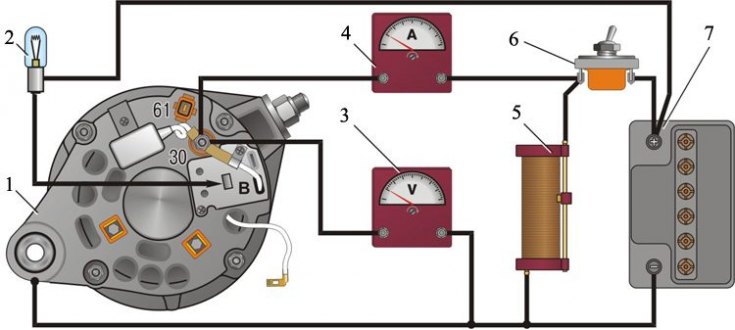
1 – generator; 2 – control lamp 12 V, 3 W; 3 – voltmeter; 4 – ammeter; 5 – rheostat; 6 – switch; 7 – battery
Attention! The "minus" of the battery must always be connected to ground, and the "plus" must be connected to the "30" terminal of the generator. Incorrect reverse connection of the battery will immediately cause increased current through the diodes of the rectifier block of the generator and they will be damaged.
Warning! Do not operate the generator with the battery disconnected. This causes high voltage pulses to appear on the generator terminal "30", which can damage the generator voltage regulator and electronic devices in the vehicle's on-board network.
Attention! It is forbidden to check the generator's performance "for a spark" even by briefly connecting the "30" clamp of the generator to ground. In this case, a significant current flows through the valves and they are damaged. The generator can only be checked using an ammeter and voltmeter.
Attention! It is not allowed to check the diodes of the generator rectifier block with a voltage of more than 12 V or with a megohmmeter, since it has a voltage that is too high for the diodes and they will be broken during the check (a short circuit will occur).
Warning! It is prohibited to check the vehicle's electrical wiring with a megohmmeter or a lamp powered by a voltage greater than 12 V. If such a check is necessary, the wires should first be disconnected from the generator.
(Information taken from the website www.VazBook.ru)
Attention! The insulation resistance of the stator winding should be checked with increased voltage only on a test bench and necessarily with the terminals of the phase windings disconnected from the rectifier unit.
Attention! When electric welding car body components and parts, disconnect the wires from all terminals of the generator and battery.
Testing on a stand allows you to determine the generator's serviceability and whether its characteristics correspond to the nominal ones. The tested generator's brushes should be well ground to the collector's contact rings, and the rings themselves should be clean.
1. Install the generator on the stand and make connections as shown in the diagram. For the G-222 generator, plug "15" is connected directly to the generator's output "30".
2. Turn on the stand's electric motor, use rheostat 5 to set the generator output voltage to 13 V and bring the rotor speed to 5000 min⁻¹.
3. Let the generator run in this mode for at least 10 minutes, and then measure the output current. For a working generator, it should be at least 55 A (45 A for the G-222 generator).
4. If the measured value of the output current is less, this indicates faults in the stator and rotor windings, or damage to the rectifier block diodes. In this case, a thorough check of the windings and diodes is necessary to determine the location of the fault.
5. The generator output voltage is checked at a rotor speed of 5000 min⁻¹. Using rheostat 5, set the output current to 15 A and measure the generator output voltage, which should be 14.1±0.5 V at an ambient air and generator temperature of 25±10°C.
6. If the voltage does not fall within the specified limits, replace the voltage regulator with a new one that is known to be in good working order and repeat the test.
7. If the voltage is normal, then the old voltage regulator is damaged and needs to be replaced. And if the voltage still does not fit within the above limits, then the generator windings and diodes need to be checked.