




Generator connection diagram on the test bench
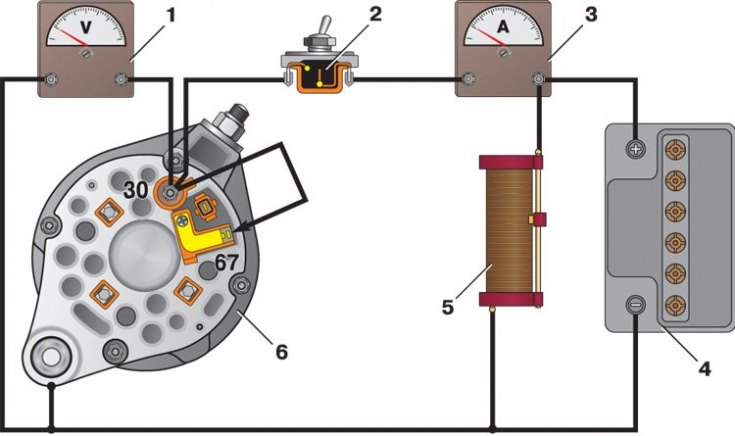
1 – voltmeter; 2 – switch; 3 – ammeter; 4 – battery; 5 – rheostat; 6 – generator
Testing on a stand allows you to determine the generator's serviceability and whether its characteristics correspond to the nominal ones. The tested generator's brushes should be well ground to the collector's contact rings, and the rings themselves should be clean.
1. Install the generator on the stand and make connections as shown in Fig. Wiring diagram of the generator on the test stand.
[The original is available on the website VAZbook.ru]
2. Turn on the stand's electric motor, set the generator output voltage to 14 V using rheostat 5 and bring the rotor speed to 5000 min⁻¹. Let the generator run in this mode for at least 2 minutes, and then measure the output current. A working generator should have at least 44 A.
3. If the measured value of the output current is significantly lower, this indicates faults in the stator and rotor windings, damage to the valves, or wear of the contact rings and brushes. In this case, a thorough check of the windings and valves is necessary to determine the location of the fault.
4. If you suspect a malfunction of the generator rectifier block valves, check the output current on a warm generator. Such a check allows you to better identify a valve malfunction by a sharp decrease in output current when the generator temperature increases.
5. To warm up, let the generator run for at least 15 minutes at a rotor speed of 5000 min⁻¹ and a voltage of 14 V at the generator output. Then measure the output current. On a warmed-up generator, it should be at least 42 A.