




Injection system diagram
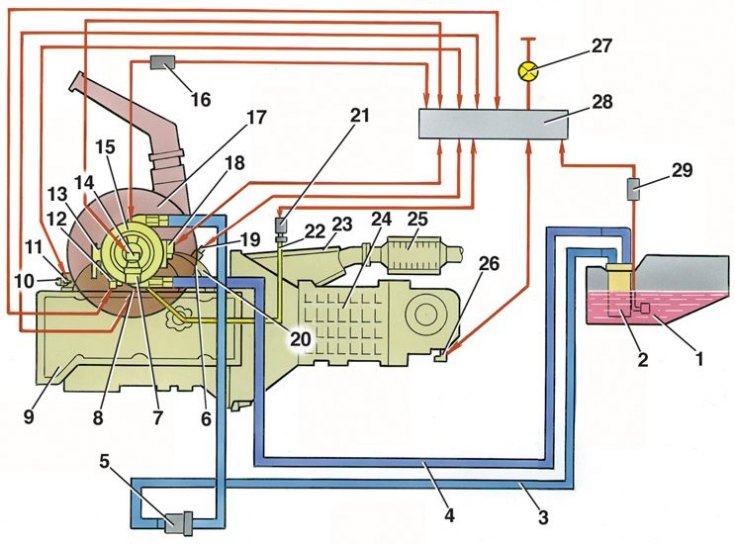
1 – fuel tank; 2 – electric fuel pump with fuel level sensor; 3 – supply line; 4 – drain line; 5 – fuel filter; 6 – inlet pipe with electric heater; 7 – pressure regulator; 8 – air temperature sensor; 9 – engine; 10 – Cooling system outlet pipe; 11 – coolant temperature sensor; 12 – idle speed control; 13 – throttle valve drive sector; 14 – nozzle; 15 – central injection unit; 16 – Intake manifold heater relay; 17 – air filter; 18 – throttle position sensor; 19 – oxygen concentration sensor; 20 – exhaust manifold; 21 – absolute pressure sensor; 22 – vacuum extraction tube; 23 – intake pipe; 24 – gearbox; 25 – catalytic converter; 26 – speed sensor; 27 – control lamp "CHECK ENGINE"; 28 – electronic control unit; 29 – electric fuel pump relay
Electronic control unit
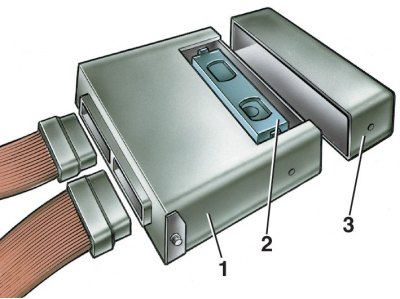
1 – electronic control unit; 2 – programmable read-only memory (PROM); 3 – lid
Electronic control unit (ECU) 28 (see fig. Injection system diagram), located under the glove compartment, it is the control center of the fuel injection system. It continuously processes information from various sensors and controls systems that affect exhaust gas toxicity and vehicle performance. The control unit receives the following information:
- about the position and rotation speed of the crankshaft;
- about absolute air pressure;
- about air temperature;
- about coolant temperature;
- about the throttle position;
- about the oxygen content in exhaust gases;
- about the voltage in the vehicle's on-board network;
- about the speed of the car;
- about the request to turn on the air conditioner (if it is installed on the car);
- signal from the octane potentiometer.
(The material is posted on the website: «VazBook»)
Based on the information received, the unit controls the following systems and devices:
- fuel supply (injector and electric fuel pump);
- ignition system;
- idle speed control;
- electric heating of the intake pipe;
- adsorber of the gasoline vapor recovery system;
- engine cooling system fan;
- air conditioning compressor clutch (if it is on the car);
- diagnostic system.
The control unit includes output circuits (injector, various relays, etc.) by shorting them to ground through the output transistors of the control unit. The only exception is the fuel pump relay circuit. Only to the winding of this relay does the ECU supply 12 V.
The control unit has a built-in diagnostic system. It can recognize malfunctions in the system, warning the driver about them through a warning lamp "CHECK ENGINE". In addition, it stores diagnostic codes that indicate areas of failure to assist technicians in making repairs.
Memory
The electronic control unit has two types of memory: random access memory (RAM) and one-time programmable read-only memory (PROM).
The random access memory is the "notebook" of the electronic control unit. The ECU microprocessor uses it for temporary storage of measured parameters for calculations and for intermediate information. The microprocessor can enter data into it or read it as needed.
The RAM chip is mounted on the ECU printed circuit board. This memory is volatile and requires uninterruptible power supply to be saved. When the power supply is interrupted, the diagnostic trouble codes and calculated data contained in the RAM are erased.
Programmable Read-Only Memory. The EPROM contains a general program that contains a sequence of operating instructions (control algorithms) and various calibration information. This information is the data for controlling injection, ignition, idle speed, etc., which depend on the vehicle weight, engine type and power, transmission ratios, and other factors. The EPROM is also called a calibration memory device.
The contents of the EPROM cannot be changed after programming. This memory does not require power to save the information recorded in it, which is not erased when the power is turned off, i.e. this memory is non-volatile. The EPROM is installed in a socket on the ECU board (see fig. Electronic control unit) and can be removed from the ECU and replaced.
The EPROM is individual for each vehicle configuration, although the same unified ECU may be used on different vehicle models. Therefore, when replacing the EPROM, it is important to set the correct model number and vehicle configuration. And when replacing a defective ECU, you can leave the previous EPROM (if it is in good working order).