




Contents: Coolant temperature sensor ↓ Air temperature sensor ↓ Absolute air pressure sensor ↓ Oxygen concentration sensor ↓ Speed sensor ↓ Octane potentiometer ↓ Throttle position sensor ↓ Crankshaft position sensor ↓ Air conditioner on request signal ↓
Central injection unit
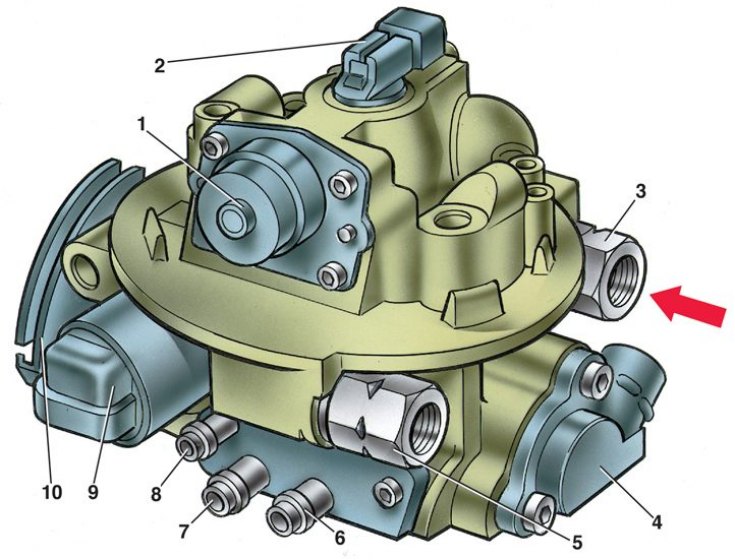
1 – fuel pressure regulator; 2 – nozzle; 3 – fuel supply nipple; 4 – throttle position sensor; 5 – fuel outlet fitting into the tank; 6 – purge pipe of the adsorber; 7 – engine crankcase ventilation pipe; 8 – branch pipe for connecting the absolute pressure sensor; 9 – idle speed control; 10 – throttle valve drive sector from the pedal in the car interior
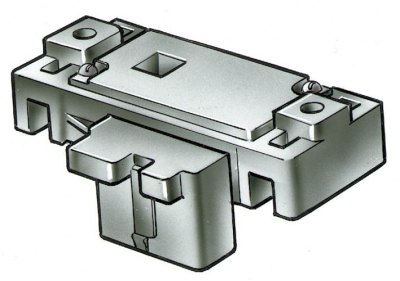
Absolute pressure sensor
Octane potentiometer
Coolant temperature sensor
The coolant temperature sensor is a thermistor, (a resistor whose resistance varies with temperature). The sensor is screwed into the coolant outlet pipe on the cylinder head. At low temperatures, the sensor has a high resistance (more than 100 ohms at -40°C), and at high temperatures, it has a low resistance (177 ohms at 100°C). The ECU calculates the coolant temperature based on the voltage drop across the sensor. The voltage drop is high when the engine is cold and low when it is warm. Coolant temperature affects most of the characteristics that the ECU controls.
Air temperature sensor
The air temperature sensor, wrapped in the bottom of the air filter housing, is also a thermistor. It constantly measures the air temperature and monitors its changes. When the air temperature decreases, its resistance increases, and when it increases, it decreases.
When the temperature fluctuates, the ECU monitors the voltage drop on the sensor and regulates the amount of fuel injected.
Absolute air pressure sensor
Absolute air pressure sensor (see fig. Absolute pressure sensor) fixed in the air intake box and connected by a hose to branch pipe 8 (see fig. Central injection unit). It monitors the air pressure in the intake manifold, which changes as a result of changes in engine load and crankshaft speed.
The sensor's sensitive element is a miniature diaphragm with a resistor sprayed on it. Depending on the air pressure, the diaphragm tension changes and the resistor resistance changes accordingly. The microcircuit built into the sensor converts this change in resistance into a change in voltage at the sensor output.
At idle, a relatively low signal voltage is generated at the sensor output (1–1.5 V). And with the throttle valve fully open, the signal level is the highest (about 4–4.5 V), since in this case the pressure in the intake pipe is equal to atmospheric pressure.
The sensor takes into account barometric pressure, which allows the ECU to automatically make altitude adjustments to the fuel supply.
The ECU uses information from the absolute pressure sensor to control fuel delivery and ignition timing. As the pressure in the intake manifold increases, (the output voltage of the sensor increases) – the fuel supply increases. When the pressure drops (the output voltage of the sensor decreases) – the fuel supply decreases.
Oxygen concentration sensor
The oxygen concentration sensor is installed on the exhaust manifold. Oxygen contained in the exhaust gases reacts with the oxygen sensor, creating a potential difference at the sensor output. It changes from approximately 0.1 V (high oxygen content - lean mixture) to 0.9 V (low oxygen - rich mixture).
For normal operation, the sensor must have a temperature of at least 360°C. Therefore, for quick warming up after starting the engine, a heating element is built into the sensor.
By monitoring the output voltage of the oxygen concentration sensor, the control unit determines which command to send to the injectors to adjust the composition of the working mixture. If the mixture is lean (low potential difference at the sensor output), then a command is given to enrich the mixture. If the mixture is rich (high potential difference) – a command is given to lean the mixture.
Speed sensor
The vehicle speed sensor is installed on the transfer case between the speedometer drive and the flexible shaft end of the speedometer drive. The sensor operates on the Hall effect. The sensor sends rectangular voltage pulses to the ECU with a frequency proportional to the rotation speed of the drive wheels.
Based on the information from the sensor, the ECU sets the idle mode and also turns off the cooling system fan at high vehicle speeds.
Octane potentiometer
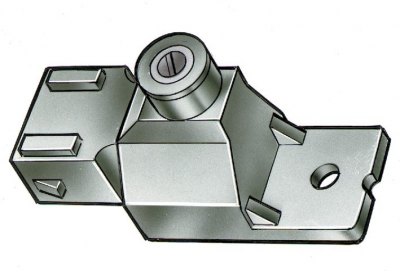
Octane potentiometer (see fig. Octane potentiometer) is installed in the engine compartment on the wall of the air intake box and is a variable resistor. It sends a signal to the electronic control unit to adjust the ignition timing angle. Adjustment of the octane potentiometer is performed only at a service station using diagnostic equipment.
Throttle position sensor
Throttle Position Sensor 4 (see fig. Central injection unit) is installed on the central fuel injection unit and is connected to the throttle valve axis.
The sensor is a potentiometer, to one end of which the positive supply voltage (5 V) is applied, and the other end is connected to ground. From the third output of the potentiometer (from the slider) the output signal goes to the electronic control unit.
When the throttle valve is turned, (from the impact on the control pedal), the voltage at the sensor output changes. When the throttle valve is closed, it is below 0.7 V. When the valve opens, the voltage at the sensor output increases and when the valve is fully open, it should be more than 4 V.
By monitoring the sensor output voltage, the control unit adjusts the fuel supply depending on the throttle valve opening angle (i.e. at the driver's discretion).
The throttle position sensor does not require any adjustment, since the control unit senses idle speed (i.e. complete closing of the throttle valve) as a zero mark.
Crankshaft position sensor
The crankshaft position sensor is an inductive type, designed to synchronize the operation of the control unit with the top dead center of the pistons of the 1st and 4th cylinders and the angular position of the crankshaft.
The sensor is mounted on the camshaft drive cover opposite the timing disk on the generator drive pulley. The disk has 6 slots equally spaced around the circumference and one slot located 100 from one of them and used to generate a synchronization pulse. When the crankshaft rotates, the slots change the magnetic field of the sensor, creating voltage pulses at the sensor output.
The ECU determines the crankshaft rotation speed based on the sensor signals and sends pulses to the injectors.
Air conditioner on request signal
If the car is equipped with air conditioning, the signal comes from the air conditioning switch on the dashboard. In this case, the ECU receives information that the driver wants to turn on the air conditioning.
Upon receiving such a signal, the ECU first adjusts the idle speed controller to compensate for the additional load on the engine from the air conditioning compressor, and then turns on the relay that controls the operation of the air conditioning compressor.