




Piston and connecting rod markings
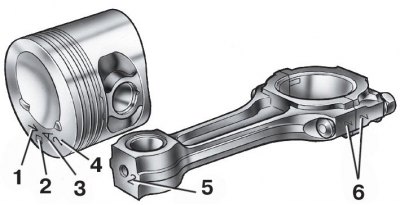
1 – arrow for orienting the piston in the cylinder; 2 – repair size; 3 – piston class; 4 – piston pin bore class; 5 – connecting rod class by piston pin bore; 6 – cylinder number
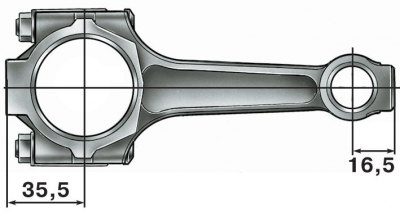
Places where metal may be removed when adjusting the weight of the upper and lower connecting rod heads
Pistons
The diameter of pistons of different classes, measured in a plane perpendicular to the axis of the pin at a distance of 55 mm from the piston bottom, mm:
class A | 81,965 – 81,975 |
class B | 81,975 – 81,985 |
class C | 81,985 – 81,995 |
class D | 81,995 – 82,005 |
class E | 82,005 – 82,015 |
According to the diameter of the hole for the piston pin, the pistons are sorted into three classes through 0.004 mm, as in other VAZ engines. The classes of piston diameters and holes for the piston pin are stamped on the piston bottom (see Fig. Piston and connecting rod markings).
During manufacturing, the piston weight is strictly maintained. Therefore, when assembling the engine, it is not necessary to select pistons of the same group by weight.
The bottoms of repair pistons are marked with a triangle or square. The triangle corresponds to an increase in the outer diameter by 0.4 mm, and the square – by 0.8 mm.
The arrow on the piston bottom shows how to correctly orient the piston when installing it in the cylinder. It should be directed towards the camshaft drive.
Piston pin
The piston pin is of the floating type, i.e. it rotates freely in the piston bosses and connecting rod bushing. The pin is fixed in the piston by two steel retaining rings.
Connecting rod
A steel-bronze bushing is pressed into the upper head of the connecting rod. According to the diameter of the hole in this bushing, the connecting rods are divided into three classes, each with a 0.004 mm increment (the same as pistons). Class 5 number is stamped on the upper head of the connecting rod.
[Original source is on the resource VazBook]
By the weight of the upper and lower heads, connecting rods are divided into classes, marked with paint on the connecting rod rod. Connecting rods of the same weight class must be installed on the engine. The weight of the connecting rods can be adjusted by removing metal from the bosses on the heads to the minimum dimensions of 16.5 and 35.5 mm (see Fig. Places where metal may be removed when adjusting the weight of the upper and lower connecting rod heads).
The connecting rod bolts are pressed into the connecting rod. When disassembling the engine, it is not allowed to press the bolts out of the connecting rods.
Connecting rod classes by weight of upper and lower heads
Mass of connecting rod heads, g | Class | Color of marking | |
top | lower | ||
186±2 | 519±3 | A | white |
525±3 | B | blue | |
531±3 | C | red | |
190±2 | 519±3 | D | black |
525±3 | E | violet | |
531±3 | F | green | |
194±2 | 519±3 | G | yellow |
525±3 | H | brown | |
531±3 | I | orange | |