




2. The connecting rods are placed in an oven already heated to 240°C for 15 minutes.
3. To properly connect the pin to the connecting rod, press the pin as quickly as possible, since the connecting rod cools quickly and after cooling it will not be possible to change the position of the pin.
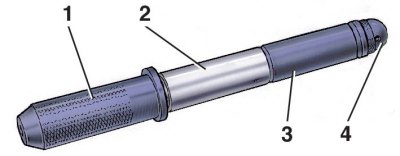
4. Prepare pin 2 for assembly in advance by placing it on shaft 1 of device A.60325, installing guide 3 on the end of this shaft and securing it with screw 4. Tighten the screw loosely to avoid jamming when the pin expands from contact with the heated connecting rod.
5. Quickly clamp the connecting rod removed from the oven in a vice. Put the piston on the connecting rod, making sure that the hole for the pin matches the hole in the upper head of the connecting rod.
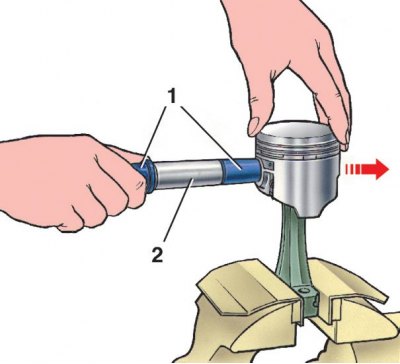
6. Using the device A.60325, push the secured piston pin 2 into the piston hole and into the upper head of the connecting rod so that the shoulder of the device contacts the piston (1 - device A.60325). During this operation, the piston should be pressed with its boss against the upper head of the connecting rod in the direction of pressing the pin (shown by arrow). This way the finger will be in the correct position.
Attention! If there is a hole for oil to escape on the lower head of the connecting rod, then the piston and connecting rod must be connected so that the "P" mark on the piston and the hole on the connecting rod are on the same side.
7. After the connecting rod has cooled, lubricate the pin with engine oil through the holes in the piston bosses.
8. When installing piston rings, position their locks at 120° intervals. Install the rings so that the groove on the outer surface of the second (scraper) compression ring was facing down, and the chamfers on the outer surface of the oil scraper ring were facing up (see Fig. Main dimensions of piston, connecting rod, piston pin and piston rings).
9. The connecting rod is machined together with the cap, so the connecting rod caps are not interchangeable. To avoid confusion during assembly, the connecting rod and the corresponding cap are stamped with the number of the cylinder in which they are installed. During assembly, the numbers on the connecting rod and cap must be on the same side.