

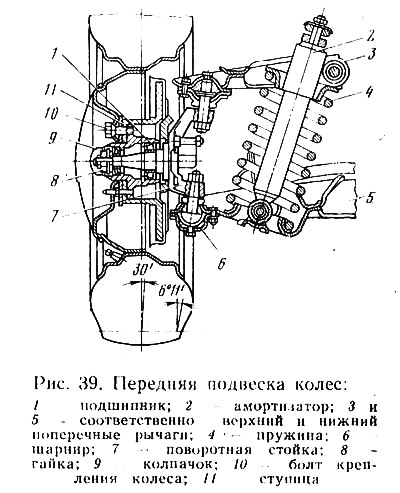
The only thing that is common to almost all designs is the same principle of operation of the main suspension elements. Elastic elements (for VAZ cars - springs 4) perceive vertical loads applied to the wheels. Guide elements (jet rods, stabilizer) provide a movable connection of the wheels with the body and transmit to it the reactive forces acting in the horizontal plane. Damping elements (hydraulic shock absorbers 2) absorb the energy of vibrations of the body relative to the wheels and ensure their reliable contact with the road.
Suspensions are dependent and independent, that is, this means that in the first case the wheels depend on each other, and in the second they do not.
On VAZ cars, the rear wheels are attached to a rigid beam of the rear axle, which means they are mutually dependent. At the car VAZ-2121 «Niva» all four wheels are in this dependence. Front wheels of all VAZ vehicles, except for VA3-2121 «Niva», suspended on double transverse levers 3 and 5. Their axes are attached to the body, and the outer ends are hinged 6 connected to the swivel struts 7. In this case, the springs and shock absorbers rest on the lower levers.
Given the presence of bearings, shock absorbers, hinges, ball bearings, torque rods and other elements in the wheel suspensions, the number of factors that affect the behavior of a car when driving on the road is large.
In this regard, at each maintenance, it is imperative to check and adjust, if necessary: clearance in the front wheel hub bearings; condition of front and rear suspension parts; front wheel alignment angles.