




Reason for skidding: The grip on a slippery road is very small. Braking forces should not exceed the grip force. Even a slight press on the brake pedal on a slippery road causes the wheels to lock and the car to skid.
Reason for skidding: blocking of all four wheels simultaneously does not occur due to different response times of each working brake cylinder, the state of the braking system, the state of the tires, sharp gas, sharp rotation of the steering wheel, different adhesion of the left and right wheels of the car. For example, on one axle the left wheel is blocked, does not rotate, and the right wheel, due to the above reasons, continues to rotate, and the car rotates around the blocked wheel. Studies have shown that the difference in braking torques of the right and left wheels reaches 25-30%. This is quite enough for the car to start spinning. And if any obstacle appears in the path of the wheel moving in a circle (a frozen rock, a stick, a frozen track or even just a piece of ice), then the car may roll over.
First of all, you need to learn how to control a car while sliding in a straight direction - skidding. To do this, you need to drive out to a free area of 50x200 m with a slippery surface, preferably with a smooth asphalt concrete surface, watered. When driving straight, brake sharply, using emergency braking. In this case, the wheels will not rotate, as they say, they will lock, and the car will move forward a few meters. After this, get out of the car and examine the trace left by the car when braking. You will see a dry trace on the road surface, which appeared as a result of the wheels sliding. The length of these stripes depends on the type of road surface, the effectiveness of the brakes and the condition of the tire treads.
After this, you should repeat the maneuver, with the "feel" inherent in a good driver, so that the wheels do not lock. Continue training until you are sure that there are no streaks on the wet road behind the car.
This exercise should be performed immediately after the dry road braking techniques we discussed earlier. By performing this exercise now, you will determine which of these four slippery road braking techniques is most effective.
Next, on this platform, you learn to make turns on a slippery surface. By braking the car sharply and strongly on a turn, you make sure that the locked wheels stop guiding the car along a curve and move straight. You practically choose such a trajectory of movement and a method of braking so that the car's movement remains controllable.
When performing these exercises, you must ensure that the length of the car's skidding zone depends not only on the value of the tire-road traction coefficient, but also on the speed you are developing. At high speed, the length of the direct skidding zone can be more than 100 m.
So remember: the lower the speed, the less skidding!
Next, it is necessary to study in practice the lateral slip, which is primarily experienced by the rear wheels of the car; drivers call this type of sliding a skid.
When braking, the car's center of gravity moves forward, and the sharper the braking, the greater the load on the front wheels and less on the rear.
The rear wheels of the car have less grip on the road. Consequently, the probability of locking the rear wheels is higher and the rear axle skidding is more frequent.
Remember well the four basic rules when skidding.
- 1. Never brake. It will not help, but will only make the skid worse. An unknown force and the desire to stop irresistibly pull your foot to the brake. Don't do it.
- 2. Don't press the clutch pedal. It does practically nothing for you.
- 3. Do not release the gas pedal abruptly. This braking worsens the skid. But if you smoothly increase the gas a little, you can reduce the skid. If the skid is severe, release the gas pedal completely.
- 4. Turn the steering wheel in the direction of the skid. If the car skids to the left, turn the steering wheel to the left. If the rear part has slid to the right, turn the steering wheel in the same direction. This should be brought to automaticity, done without jerking, but quickly. Hands turn the steering wheel on the lateral sector. Moreover, the more the car skids, the more the wheels should be turned. This is the only way to control the car during a lateral skid.
Features of control of the front-wheel drive "ten" during skidding and when cornering on a slippery road:
- the traction force is on the front wheels and when driving on a straight road this car is much less prone to skidding;
- a hatchback is less likely to skid than a sedan, and even less so than a station wagon. If the rear axle does skid, the duration of the skid and its amplitude will also be less;
- loss of traction of wheels with the road occurs on turns;
- reduce speed before turning;
- when turning, move at a constant speed or with slight acceleration;
- if the rear wheels have lost traction, increase the fuel supply, this may be enough to stabilize the car;
- do not turn the steering wheel sharply, but carefully in the direction of the skid;
- at high speed or with a sharp increase in gas supply on a turn, the leading front wheels may lose traction and the car will begin to skid, in this case do not turn the steering wheel, the wheels are uncontrollable; reduce the fuel supply. This will restore the drive wheels' grip on the road and the car will become controllable.
Information taken from the website: vazbook.ru
Then proceed to practice getting the car out of a skid, using the controls as shown in Fig. 12.
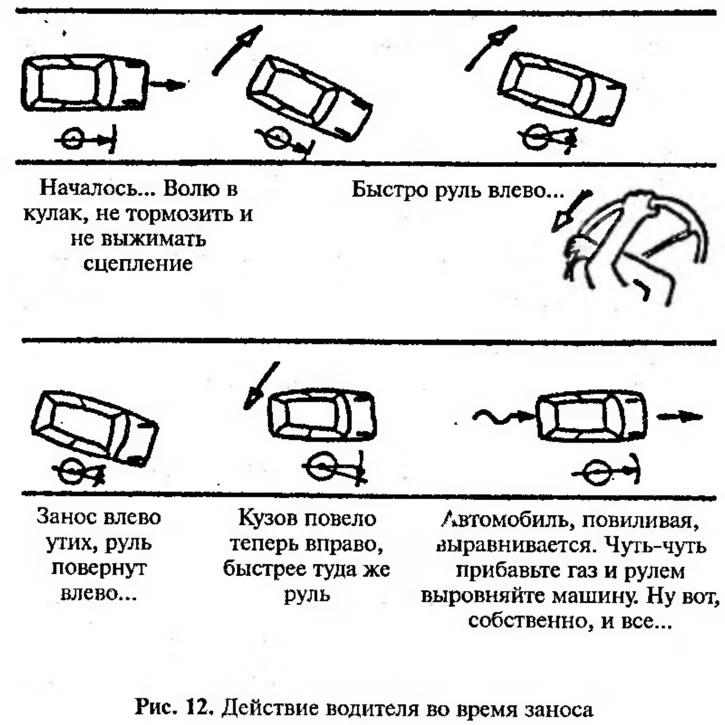
Please note: the front wheels should always "look" strictly in the direction of travel. This is what you should strive for. An extra turn of the steering wheel in a panic may not stabilize the rotation, but rather increase the deviation of the rear of the car even more. Therefore, turn the steering wheel quickly, but at a certain angle. You should feel it during training. You should start turning the steering wheel in the other direction a little earlier than the skidding of the rear of the car stops. At the same time, try to keep the engine speed so that the drive wheels roll without slipping.
When driving on slippery roads:
- it's better to prevent a skid than to try to get out of it; take into account road conditions and allow time for reaction; rock the steering wheel from side to side at a frequency of up to 2 times per second. This will allow you to be in a state of constant readiness to take action to eliminate the skid;
- no theory can replace practice. Master the technique of safe driving on a slippery surface. Even one or two lessons with an experienced instructor will allow you to feel confident on the road in any situation.
Quick and complete elimination of a skid depends on your experience, abilities and ability to take your will into a fist. By practicing this maneuver, you will be able not only to master the skid, but also to accurately determine whether a skid can occur on a given road and in given conditions. You will learn to adapt the speed of your car to the driving conditions, especially on turns.