




If the snow layer is thin and compacted, there are no obstacles to movement, provided that you know that the coefficient of adhesion to the road is much lower than on a dry or even wet road. If the snow lies in a thick layer, then you should consider the possibility of the car skidding and getting stuck. It is especially difficult to drive when deep ruts have formed in the snow. In these conditions, you need to move slowly, because the ruts are never even and straight, and jumping out of the rut at high speed leads to loss of control of the car. Snowdrifts several meters long should be overcome with acceleration. And large snow-covered sections of the road must be inspected in advance by walking along them, because they threaten to get stuck. If you see that you were unable to overcome a large snowdrift the first time, do not allow yourself to get completely stuck. You need to stop and go back along the old track, thus compacting the rut, then accelerate the car forward again, trying to overcome the remaining section of the skid. Obviously, this technique has a chance of success only when the length of the snowdrift allows it. If the car in front of you is stuck in a snowdrift, never try to drive through without stopping. You need to stop, get out of the car, get acquainted with the situation and help your colleague get out of this situation. Then you can easily drive in his tracks.
It may happen that your car gets stuck so much that it "sits" in the snow with the lower part of the body, and the wheels may even hang in the air. Do not try to get out backwards by slipping the wheels, it leads to even more "digging" of the drive wheels in the snow. You need to dig out the car with a shovel, throwing snow from under the body until the wheels touch the road. Then you need to dig up the snow under the front and rear wheels. Only then can you try to slowly move backwards.
The following actions give very good results when exiting snowdrifts:
- placing sand, gravel, stones, boards and even mats taken from your car under the wheels;
- alignment of the front wheels. If the wheels are straight, they offer little resistance to movement, if they are turned sideways, they make it impossible to leave;
- correct pressing of the gas pedal and clutch. You need to press the gas pedal lightly, give low revs, and engage the clutch smoothly, holding it slightly at the end.
The traction force should be less than the traction force. And on a snowy road, the traction force is small;
- "rocking" the car back and forth, as the wheels compact the track over a length of 10-20 cm, which will allow the car to reach the required speed for exiting;
- pushing a car by another person; this must be done carefully and not on the side of the track, but in the middle of the car body; not only snow and dirt fly out from under the wheels, but also the stones you just put there;
- starting off in second gear, when the traction force is less and it is easier to get going.
Driving on snow will not create any particular difficulties for you in controlling your car, provided that you:
- increase the distance to the car in front;
- constantly assess the situation ahead and be prepared for the unexpected;.
- stop at an increased distance if the car in front has stopped;
- check the efficiency of your brakes periodically. Snow can get into the brake mechanism and the efficiency of the brakes will be weakened;
- you will clean the front, rear windows and lights. Windscreen wipers and heaters may not cope with a large amount of snow, and there will be uncleaned areas;
- think through a plan in advance to overcome snowdrifts and drifts. You can't act hastily, frivolous attempts to get out will only lead to worsening the situation;
- you will shift to a lower gear in advance;
- reduce speed before turning;
- turn the steering wheel smoothly, avoid sudden movements;
- brake intermittently or in stages on the "ten" in icy conditions (these methods were previously considered); braking on ice with the engine is more dangerous, as the drive wheels slip and make the car uncontrollable. In this situation, in addition to intermittent pressing of the brake pedal, intermittent pressing of the clutch pedal has an effect. When the clutch disengages, the wheels stop slipping.
In areas with long winters, it is recommended to additionally equip the vehicle with:
- keep a spare set of studded tires and install them on your car when necessary; at least special tires with a tread that has good grip on snow should be installed on the drive wheels. This does not pose any threat to the car when driving on a dry road, it only creates increased noise; keep your tire pressure normal.
Attention! The stud works only when it goes deep into the surface, only on the ice it penetrates. If it protrudes by 1.5 mm, then the ice should be no less thick. And if the ice is thin, up to hundredths of a millimeter, the stud is useless for such ice. Be careful when driving with studs on thin ice, do not rely on them. Snow, even packed snow, is soft for the stud, and it is not capable of creating a large grip force;
- have a shovel, it will help you get out of a snowdrift;
- have sand, at least in the garage or nearby. In winter it is difficult to leave the garage or parking places;
- have old bags that need to be carried in the trunk.
Snow covers road markings and may cover signs and traffic lights, so be careful when driving.
Driving a car on ice during oncoming traffic, overtaking, acceleration and especially braking causes great difficulties. And performing these maneuvers requires not only theoretical knowledge, but also practical special training.
Icing can be continuous over a large section of the road or over small sections. Usually, the edges of the ice are the edge of the forest, roadside buildings, so in these places you should expect a change in the condition of the road surface. Even at positive temperatures, ice can form on bridges, in hollows and lowlands, on dams and other windy areas. The problem is aggravated by the fact that ice takes many by surprise: after all, there was good traction just now. The first ice is especially insidious; in November-December, the number of accidents increases significantly compared to other months of the year. According to statistics, more than 60% of accidents are related to loss of control. The reason is that some drivers do not have time to change their driving style after the summer, and many simply do not understand the peculiarities of driving a car on a slippery road. When tires hit ice, their traction with the road immediately drops by 4-5 times, during rain and snowfall only by 2-3 times and gradually. The braking distance increases as many times as the road grip decreases.
Ice comes in different forms. It is the most slippery when the air temperature is around 0°C. At temperatures below -20°C, it is not so slippery, since there is no water in it. If you suspect black ice, you need to reduce the speed of the car to 10 km/h and brake slightly: if you feel a skid, then your suspicion is confirmed; if there is no skidding, then there is no ice. Experienced drivers know: if the car "plays" under them, then the road is washed with ice.
Before starting off on a slippery road, you must:
- align the front wheels;
- engage first, or better yet, second gear;
- smoothly press the gas pedal, achieving low stable revs;
- release the clutch pedal smoothly, holding it at the end;
- move slowly;
- if the wheels start to slip, do not accelerate: the wheels will dig even deeper into the ice, the ice will melt due to friction, the traction will be even less, and the wheels will slip even more. Only after a long acceleration, when all the ice under the wheel has melted and the wheel touches the ground or asphalt, the car will move. This is mockery of the car. Often it is enough to just push the car or rock it back and forth for it to move.
If you find yourself on icy roads, the main thing is not to get lost, but to remember the basic rules for ensuring safe movement in these conditions:
- be careful and focus on driving properly;
- if you lose control, press the clutch pedal intermittently;
- release the gas very smoothly, brake intermittently;
- shift to a lower gear, revving deeply, and, very smoothly releasing the clutch pedal, hold it at the end;
- you need to drive as slowly as possible, at a constant speed, it should be such that you do not lose the feeling of driving the car: it should obey you;
- calculate your movement, look as far as possible;
- increase the distance from the car in front: the more times the braking distance increases, the more times the distance should be increased;
- increase the interval with both passing and oncoming traffic;
- do not turn the steering wheel sharply, the car may skid from a sharp turn. You wanted to change the direction of movement and turned the steering wheel sharply, but the car continues its rectilinear translational sliding straight, although the wheels are turned. This is physics, the law of conservation of inertia.
Let's take a closer look at the rules for braking on ice. What to do if you need to brake urgently on ice?
You noticed the obstacle too late, you need to brake, and there is ice under the wheels. Keep in mind that abrupt braking leads to skidding, and your driving experience is limited. The simplest but surest way: simultaneously press the brake pedal with your left foot and the gas pedal with your right. Press smoothly but firmly. Then the torque supplied by the engine will prevent the wheels from locking, and therefore, skidding, and the braking distance will be shorter than with skidding. With such actions, the engine may stall, then ease off the force on the brake pedal, and if your car has a brake booster, do not reduce the pressure on the brake pedal and continue driving the car if it continues to move.
If you have experience and strong nerves, then use the intermittent braking method that we discussed earlier. Press the brake pedal; as soon as you feel the wheels start to skid, force yourself to release the brake pedal for a moment, then press it again, but more weakly. And so continue pressing and releasing the brake pedal until you come to a complete stop, each time weakening the pressure. This technique prevents the wheels from constantly skidding, so the braking distance will be even shorter.
Experienced drivers use the most effective method of braking - stepwise. We also looked at it, it can be used in any conditions when you need to quickly stop the car. Press the brake pedal smoothly but decisively, slightly lowering (not completely, as in intermittent). Keep your foot on the pedal all the time, ready to ease off if a blockage occurs, then increase the pressure on the pedal again. This is very delicate work. It is only possible after training on a safe platform. Statistics show that in 70 out of 100 pedestrian collisions, the car is only 1 meter short of stopping.
Let's consider possible options for driving a car on ice when turning, going uphill and going downhill.
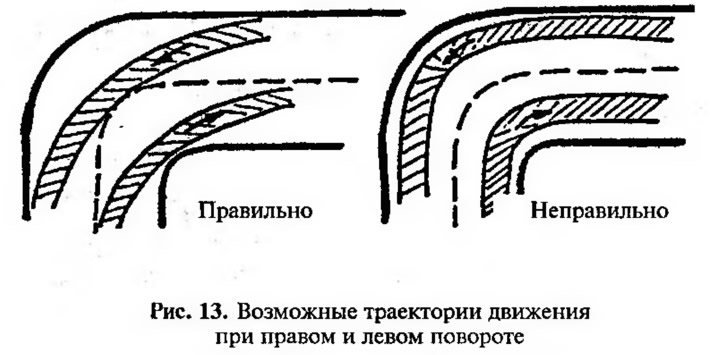
When turning, the car is subject to centrifugal force. It is directly proportional to the square of the speed and inversely proportional to the radius of the turn, i.e. the greater the speed and the sharper the turn. Therefore, before a slippery turn, you need to:
- reduce speed as much as possible in advance before turning;
- soften the trajectory of movement as much as possible, moving as shown in Fig. 13;
- when turning, press the gas pedal slightly, which will increase the stability of the car, but skidding is dangerous here, be prepared for this;
- turn the steering wheel smoothly.
The driver's actions to overcome an icy slope are as follows:
- accelerate your vehicle smoothly before climbing;
- choose the right gear and speed in advance so that you don't have to change them on the climb itself;
- try not to add gas, handle it carefully, otherwise it will start to slip and even slide back;
- if you didn't manage to overcome the climb the first time, don't worry, it happens to many people. If the road is clear, it's better to go down, braking carefully, and try to climb up again, taking into account the mistakes of the first time;
- if you can't do it the second time, try the third. If the road is clear, carefully go down, turn around and try to overcome the climb in reverse. This is especially necessary on front-wheel drive "tens", since half the weight of the car falls on the front drive wheels. When moving forward uphill, they slip more often than rear-wheel drive;
- the road is not clear, attempts to overcome the climb did not allow; carefully moving in reverse, pull over to the side of the road, stop the car, put a stop under any convenient wheel. Let the engine "rest", and think about how best to overcome this rise, or refuse to overcome it at all, using a long and reliable road. Well, and if you need to overcome, then make a track from sand, cement, stocked up by you in advance. The road service also assumes overcoming difficult winter roads and prepares sand and gravel in places where it is usually needed.
On icy slopes, brake with the engine, engaging second gear at the top. If you press the brake, the car will skid, like on a sled. Do not turn the steering wheel sharply.