




The gear shift patterns are shown in Fig. 9.
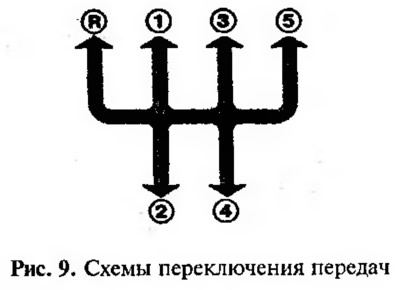
Using the gear shift lever, the driver can discretely transfer torque from the engine to the car's wheels.
The first gear is the most powerful, transmits the greatest torque and is used for starting off, overcoming difficult sections of the road, when driving with a large load uphill. The speed in this gear is up to 40 km/h.
The second, third and fourth gears respectively transmit less torque. The crankshaft speed decreases and the wheel speed increases.
Second gear is used to accelerate the car and move it at speeds from 20 to 60 km/h. Third gear is used to accelerate and move the car at speeds from 30 to 90 km/h. Fourth gear (direct) creates less torque and has the largest speed range, from 40 km/h to maximum.
The fifth gear has a low gear ratio of 0.7-0.8. The crankshaft rotates at a lower speed than the wheels. This economical gear is used for straight sections of the road, without heavy loads, since it is very weak.
The reverse gear is also powerful and transmits a lot of torque, has a large gear ratio. It is used for reversing. The neutral position of the gearshift lever disengages all gears.
To engage reverse gear, press the clutch pedal and, after 3 seconds, press the gear shift lever all the way down and move it to the reverse gear engagement position.
Everyone needs to learn how to smoothly start a car from a standstill, observing a certain sequence, safety requirements and traffic rules.
A bit of theory. When moving, a car overcomes a number of forces that create resistance to its movement. The main forces are: the rolling resistance force of the wheels, the air resistance force, the inertia force, and the lifting resistance force.
The car moves when the force of adhesion of the wheels to the road is equal in magnitude to the traction force or greater. If the traction is greater than the forces of adhesion (the "ten" has a greater traction force than most other domestic cars), then the drive wheels will slip. In this case, a large load falls on the clutch and gearbox, which can quickly fail. Fans of a sporty driving style should especially remember this. On the "ten", the gearbox is not "Mercedes". When starting off on a level section of road, it is only necessary to overcome the rolling resistance force of the wheels and the force of inertia.
Before you set off, you must:
- conduct a vehicle inspection;
- check the neutral position of the gear lever;
- depress the clutch pedal (develop this habit in yourself, it will allow you to avoid many troubles);
- turn on the ignition;
- start the engine;
- carefully examine the road you plan to drive on through the rear-view mirrors, external and internal, and by turning your head left and right check the "blind spot" behind and on the sides;
- turn on your turn signal if you are sure it is safe. Do not turn on your turn signal if there are other vehicles or pedestrians nearby to whom you must give way;
- press the clutch pedal all the way down with your left foot and hold it in that position. The clutch pedal needs to be pressed sharply, this disengages the clutch, disconnects the rotation of the crankshaft and the primary shaft of the gearbox;
- hold the steering wheel with your left hand and move the gear shift lever to the first or second gear position with your right hand (when it is necessary to engage second gear, we will consider below).
Note. The first (second) gear may not engage immediately, do not try to force it. Move the gearshift lever to neutral, release the clutch pedal, depress the clutch pedal all the way again and repeat engaging the first (second) gear. This will cause the gearbox gears to turn and the gear should engage easily;
- look carefully at the road again through the mirrors and your left shoulder, make sure it is safe once again;
- if you can start moving, then release the parking brake lever down;
- press the gas pedal lightly with your right foot; feel how the crankshaft speed has increased slightly. This is especially clearly visible on the tachometer;
- release the clutch pedal slowly and gently with your left foot, gradually engage it and smoothly transfer torque from the engine crankshaft through the first gear of the gearbox to the wheels, while the crankshaft speed will begin to decrease due to the load. You can hear this from the engine noise or see it on the tachometer;
- hold the clutch pedal at the end and press the gas pedal slightly, increasing the crankshaft speed and the traction force, which begins to overcome the rolling resistance of the wheels and the force of inertia; the car starts moving smoothly;
- after starting to move, continue to smoothly release the clutch pedal until the end, then you must remove your foot from the pedal.
The clutch pedal in first gear must be released smoothly, held at the end, and then smoothly released to the end.
When starting off, drivers make two main mistakes that lead to a strong jerk or engine stalling. The reasons for the first mistake: abruptly releasing the clutch pedal and pressing hard on the gas pedal (high crankshaft speeds lead to a strong jerk of the car, and on a slippery road and for drivers with a sporty driving style and on dry asphalt - and to wheel slippage). Elimination of the error if the engine has not stalled: abruptly squeeze the clutch and reduce the pressure on the gas pedal - reduce the crankshaft speed. Repeat starting off. Note the smooth release of the clutch pedal and less pressure on the gas pedal.
Reasons for the second error: abrupt release of the clutch pedal and weak pressing of the gas pedal - the crankshaft speed is low. Troubleshooting: restart the engine. In this case, once again pay attention to the smooth release of the clutch pedal and stronger pressing of the gas pedal compared to the first attempt.
When using two pedals - the clutch and the gas pedal - in a coordinated manner, the gentle pressing and releasing of the gas pedal should always be slightly ahead of the pressing and releasing of the clutch pedal.
It is easier to start off on the "ten", which has a 2112 engine. When starting off, you do not need to press the gas pedal. Control is simpler. The car picks up speed without high revs. And the traction reserve allows you to change gears less often.