




Contents: Removal ↓ Installation ↓
To complete the work you will need:
- inspection pit or overpass;
- beard.
Removal
1. Prepare the car for work (see "Preparing the car for maintenance and repair").
2. Remove the front wheel (see "Wheel - replacement").
3. Remove the engine splash guard (see "Engine Mudguard - Removal and Installation").
4. Unscrew the two bolts securing the ball joint to the steering knuckle (see "Ball joint of the rack - removal and installation").
Warning! Be careful when removing the bolt, the stabilizer is under tension.
5. Remove the bolt securing the stabilizer bar to the lever (see "Anti-roll bar - replacement of struts").
6. With two keys by 19 mm we unscrew the nut of the bolt that secures the transverse arm to the body bracket and remove the bolt.
The original is on the portal [www.vazbook.ru]
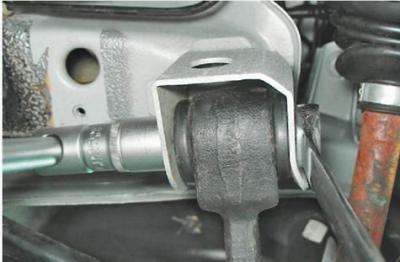
7. To minimize the misalignment of the steering axis caster angle when installing the lever, count and record the number of adjusting washers located at the rear end of the longitudinal brace.
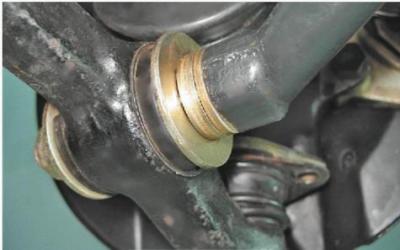
8 Hold the tensioner from turning with an open-end wrench by 24 mm using a socket wrench of the same size with a long handle, unscrew the nut at the rear end of the tensioner.
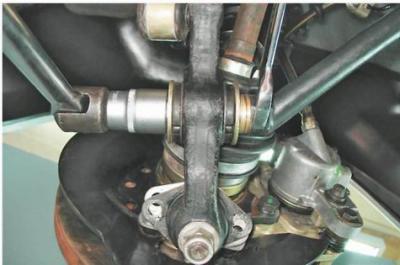
9 Remove the thrust washer from the rear end of the longitudinal tensioner.
10 Remove the lower arm assembly with the ball joint from the longitudinal strut.
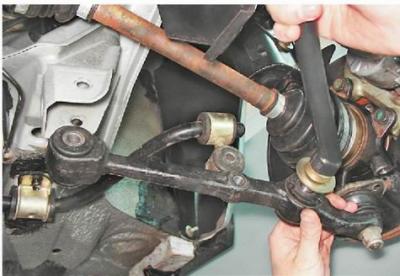
11. To avoid losing them, remove the thrust and adjusting washers from the tensioner.
12. If necessary, clamp the lever in a vice and press the ball joint pin out of it (see "Ball joint of the rack - removal and installation").
Installation
We install the lever in the reverse order.
Note: The holes in the adjusting washers have a chamfer on one side. When installing the washers, the chamfer must be turned towards the bend of the brace.
Recommendation: The final tightening of the rubber-metal hinge fastening nut is performed only after the vehicle is installed on the wheels.