




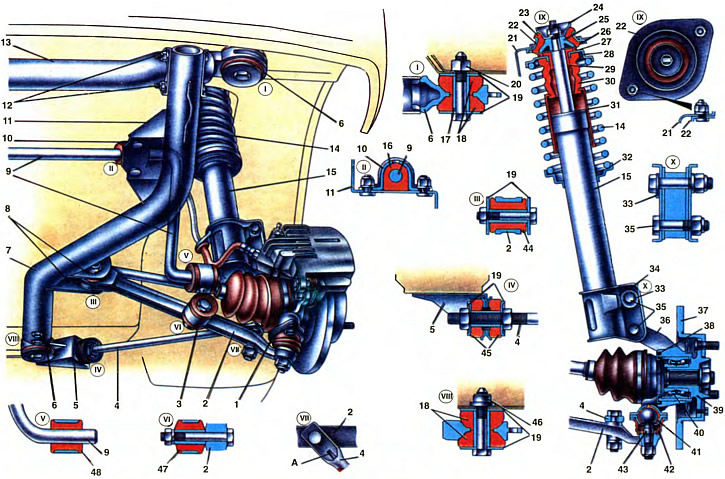
1. Ball joint of the suspension arm. 2. Lower suspension arm. 3. Anti-roll bar link. 4. Strut. 5. Subframe bracket for attaching the strut. 6. Subframe eye. 7. Subframe side member. 8. Subframe bracket for attaching the suspension arm. 9. Anti-roll bar rod. 10. Sleeve. 11. Subframe bracket for attaching the stabilizer bar. 12. Fastening bolts for the left side member of the subframe. 13. Front cross member of the subframe. 14. Suspension spring. 15. Front suspension strut. 16. Stabilizer bar cushion. 17. Expansion sleeve. 18. Rubber bushings for mounting the subframe. 19. Thrust washers. 20. Welded-on body nut for fastening the subframe. 21. Body mudguard strut. 22. Upper support housing. 23. Rubber part of the upper support. 24. Upper support race. 25. Lower support race. 26. Thrust washer of the plain bearing. 27. Bearing sealing ring. 28. Upper support cup of the spring. 29. Bearing bushing. 30. Compression buffer. 31. Protective cover. 32. Lower support cup of the suspension spring. 33. Bolt eccentric. 34. Suspension strut terminal bracket. 35. Suspension strut-to-steering knuckle fastening bolts. 36. Steering knuckle. 37. Brake disc. 38. Mud deflector ring. 39. Front wheel hub. 40. Wheel hub bearings. 41. Ball joint bearing. 42. Ball joint protective boot. 43. Ball pin. 44. Rubber-to-metal joint of suspension arm. 45. Stretch mount cushion. 46. Welded-on body bushing for subframe mounting. 47. Rubber-to-metal joint of stabilizer bar strut. 48. Rubber bushing of stabilizer bar strut.
A - mark
Front suspension independent, "swinging candle" type (McPherson), is aggregated together with the power unit and steering on the subframe. The suspension is compact and simple, it combines well with the rack-and-pinion steering and the transverse arrangement of the power unit.
The layout of the front suspension and the specific design of a number of its units create a negative roll shoulder, when the intersection point of the wheel rotation axis with the road surface lies outside the outer part of the vehicle track. The negative roll shoulder creates conditions for the use of a diagonal drive of the wheel brake mechanisms, in which the probability of skidding during braking is practically excluded. This increases the safety of driving.
The front suspension is the connecting link between the body and the front wheels. The front suspension elements transmit forces acting on the wheels to the body. The components included in the front suspension soften dynamic loads, reduce body vibrations, and provide good stability and smooth running of the car.
The subassembly, which includes the power unit with wheel drives, front wheel brakes, steering gear and front suspension, pre-adjusted on a special device, is mounted from below during vehicle assembly on the conveyor.
The subframe assembly with the mounted units and assemblies is attached to the body at four points with bolts with support washers 19 through rubber bushings 18. The subframe mounting bolts are screwed into welded nuts 20 and bushings 48 of the body.
The subframe consists of two longitudinal side members 7 and a front cross member 13, made of pipes. They are connected to each other: the right side member and the cross member are welded, the left side member and the cross member are bolted 12. The support 5 is bolted to the rear part of the side members (see chapter 26) steering gear. Bolted connection of the left side member with the cross member 13 (see chapter 23) and steering gear support 5 (see chapter 26) allows you to remove the gearbox from the car without removing the entire subframe with the units and assemblies installed on it.
The following are welded to the subframe side members: brackets 11 for attaching the stabilizer bar 9, brackets 8 for attaching the suspension arms, brackets 5 for attaching the tensioners 4, and brackets for attaching the power unit. Eyes 6 for attaching the subframe to the body are welded to the ends of the cross member 13 and behind the side members.
The suspension consists of a guide device, elastic and damping elements.
The suspension guide device determines the nature of the wheel movements relative to the body, and also transmits forces and moments from the wheels to the body. The guide device includes the lower arm 2 with the tensioner 4, the telescopic strut 15 and the steering knuckle 36, which connects the strut and the arm to each other. The guide device also includes the anti-roll bar 9.
The lower V-shaped suspension arm is formed by a transverse forged arm 2 and a brace 4 made of a rod directed backwards. The brace is connected to the transverse arm by a bolt in one position, in which the mark A (rib) on the brace is directed upwards. The other end of the brace is connected to the front bracket 5 of the subframe by means of two nuts and rubber cushions 45 with thrust washers 19. By moving the brace, carried out by screwing or unscrewing the nuts of its fastening, the longitudinal inclination of the pivot axis is adjusted.
When the suspension moves, lever 2 rotates within the limits of elastic deformation of the rubber-metal hinge 44 and rubber cushions 45. In this case, turning of the rubber-metal hinge in the lever socket or its bushings relative to each other is not allowed.
Telescopic rack 15 suspension double-pipe, double-acting, with variable fluid flow. The telescopic rack combines in one unit the functions of a carrier and guide device, as well as a damping element.
The upper part of the pillar 15 is secured in the pillar 21 of the mudguard of the body with two self-locking nuts through a highly elastic support 22. The design of the upper support ensures "swinging" of the pillar during its telescoping and good damping of high-frequency vibrations transmitted by the tires to the body. Rotation of the pillar when turning the wheels is ensured by a friction bearing (pos. 26, 29), located in the upper support 22.
The lower part of the pillar 15 is connected to the steering knuckle 36 by means of a clamp bracket 34 with an eccentric device for adjusting the camber of the front wheels.
The telescopic stand is equipped with: a 14-gauge coil spring, a 30-gauge polyurethane foam buffer with compression stroke (elastic suspension elements) and the upper support assembly with the plain bearing and mounting bolts. The suspension spring is installed between the upper 28 and lower 32 support cups. The lower cup 32 is welded to the suspension strut, the upper 28 is attached together with the support on the strut rod. The compression stroke buffer 30 is installed on the rod assembly with the protective cover 31, which protects the rod from mechanical damage.
Spring 14 is made of special spring steel and, depending on the length under test load, is divided into two classes: A and B. Class A springs are marked with yellow paint on the outside of the middle coils, and class B springs are marked with green paint.
The compression stroke buffer 30 limits the compression stroke of the suspension. At the moment of limitation, the buffer support pressed onto the body of the telescopic strut rests against it. The buffer is made of fine-cell polyurethane, on the outer surface it has two annular grooves that determine the place of deformation of the buffer. The polyethylene protective casing 31 enters the third lower annular groove.
The upper support provides an elastic connection between the pillar and the body and is one of the points relative to which the wheel axis rotates. The support consists of a housing 22, to the surface of which a rubber bushing 23 is vulcanized. Two bolts for fastening the upper support are pressed into the support housing and then welded. The rubber part of the support housing is clamped on the rod with a nut between the lower 25 and upper 24 support collars.
The plain bearing consists of a plastic bushing 29, on the upper end of which there is a layer of Teflon fabric, and a thrust washer 26 adjacent to this fabric. The bearing bushing is installed in the upper support cup of the spring. The contact surface of the sliding pair is protected from dirt by a rubber sealing ring 27, clamped between the thrust washer of the bearing and the support cup of the spring.
Despite the short base of the car, a lateral stability stabilizer is used to dampen lateral roll. It is made in the form of a rod 9, which is attached to the brackets 11 of the subframe by clamps 10 with rubber cushions 16. The ends of the rod are connected to the suspension arms 2 through short struts 3. The following are pressed into the heads of the struts: a rubber bushing 48 in the upper one, and a rubber-metal hinge 47 in the lower one. The stabilizer rod passes through the upper head of the strut, and the lower head is fastened with a bolt to the suspension arm 2.
The lower end of the suspension arm is connected by means of a ball joint 1 to the steering knuckle 36. The pin 43 of the ball joint enters the conical hole of the arm 2 and is secured with a self-locking nut.
The ball joint consists of a one-piece housing, into which a bearing 41 made of low-friction Teflon fabric is filled with a special resin. It covers the ball head of the pin 43. The internal cavity of the joint is sealed with a protective reinforced cover 42. When assembling the joint, the cover is filled with SHRB-4 grease, designed for the entire service life of the car, provided that the protective cover is kept tight. The joint housing is attached from below to the steering knuckle with two bolts.
The upper part of the steering knuckle is attached to the telescopic strut bracket with two bolts 35. The upper bolt has an eccentric 33, which rests against the flange of the bracket cheek, and the cylindrical part of the bolt passes through the oval hole of the bracket and the cylindrical hole of the steering knuckle. This fastening ensures the movement of the steering knuckle relative to the strut bracket when turning the upper bolt, which allows you to adjust the camber of the front wheels.
A double-row ball bearing 40 of the closed type with "eternal lubrication" is installed in the cavity of the steering knuckle. It is fixed in the steering knuckle with two retaining rings. The hub 39 of the front wheel rotates on this bearing, which is connected to the tailpiece of the wheel drive hinge housing by means of splines. The hub is fastened to the tailpiece with a nut, under which a thrust washer is installed. From the outside, the hub cavity is closed with a cap. From the inside, the cavity of the steering knuckle is protected from contamination by a mud-deflecting ring 38, which enters the annular groove of the knuckle, forming a labyrinth seal. The brake disc 37 is fastened to the flange of the wheel hub with two bolts.
During the compression stroke, when the car wheel moves upward, the suspension spring 14 is compressed due to the telescoping of the strut. The lower arm 2 of the suspension together with the tensioner 4 rotates in its hinges. In this case, the tilt angle of the telescopic strut changes and at the same time the hydraulic element of the strut is triggered, absorbing the vibration energy. Then the buffer 30 of the compression stroke comes into action, resting against the support of the suspension strut.
During the recoil stroke, the spring 14 forces the car wheel downwards, the suspension strut is stretched and at the same time its angle of inclination changes. When the strut is stretched, the hydraulic element of the strut is also triggered. The "swinging" of the strut during its telescoping occurs due to the deformation of the rubber part 23 of the upper support. When the suspension arm is moved, twisting occurs (unwinding) 9 stabilizer bars, which work as a torsion bar. The bar creates the greatest resistance towards the roll of the body, thereby reducing its tilt.
The stability of the car, wear of the front tires and fuel consumption largely depend on the angles of the front wheels. The following wheel alignment angles are distinguished.
Camber is the tilt of the wheels in the vertical plane relative to the center line of the car. Camber can be positive if the wheels are tilted outward, or negative if the wheels are tilted inward. The camber angle mainly affects the uniformity of wear of the front tire tread. When it is disturbed, increased wear of the inner or outer tracks of the tread occurs. Camber is adjusted with the upper bolt 35 with the nuts of the steering knuckle mounting bolts loosened.
Toe-in is the position of the front wheels when the distance between the inner edges of the wheel rims is smaller at the front than at the rear. The distance is measured at the level of the wheel axle. Normal toe-in increases the stability of the car and reduces tire wear. Toe-in is adjusted by changing the length of the steering rods. In a front-wheel drive car, toe-in is close to zero, since the traction forces applied to the wheels tend to bring the wheels together at the front.
Angle of longitudinal tilt of the pivot axis. The axis around which the wheel turns has such an inclination that the upper part of the axis is tilted backwards. Such an angle of tilt of the axis is called positive, as opposed to negative, at which the upper part of the axis is tilted forwards. With a positive value of the angle, the self-return of the wheels to the middle position after turning improves, with a negative value, it worsens. The angle of longitudinal tilt of the pivot axis is adjusted by nuts of the tensioner 4 with the nut of the tensioner fastening to the lower suspension arm loosened. To decrease the angle of longitudinal tilt, the nuts are screwed onto the tensioner and, conversely, to increase the angle, they are unscrewed.
For a new, run-in vehicle in running order and with a full load of 225 kgf, which is distributed 75 kgf on the two front seats, and 75 kgf in the center of the rear seat, the wheel alignment angles should have the following values:
- camber — 0°±30
- toe-in — 0±1 mm
- longitudinal angle of inclination of the axis - 2°±30