




Note: Voltage regulator, rectifier block and capacitor tests are shown above (see relevant sections). You can check the stator and rotor winding for breakage without removing the generator from the car. To do this, you need to remove the rectifier unit.
To complete the work you will need:
- three or two jaw puller;
- homemade mandrel from a cup puller kit.
Disassembly
1. Remove the generator from the car (see above, "Generator - removal and installation").
2. Remove the voltage regulator (see "Voltage Regulator - Checking and Replacing").
3. Remove the rectifier block together with the capacitor (see "Rectifier block and capacitor - checking and replacement").
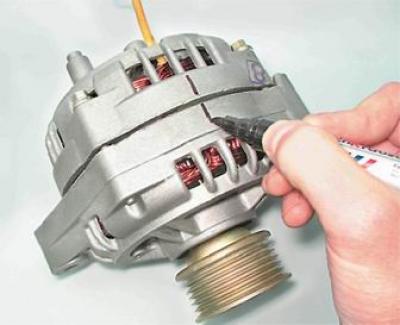
4. Using a marker, mark the relative positions of the front and rear covers of the generator (to simplify assembly).
5. With a socket wrench by 8 mm we unscrew the four bolts that hold the front and rear covers of the generator together.
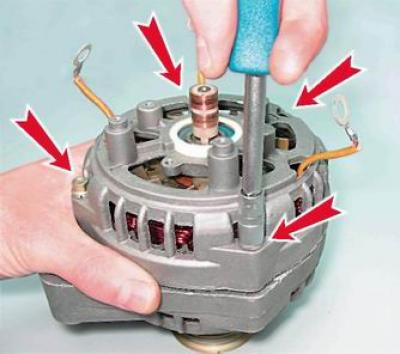
6. Using a slotted screwdriver, carefully move the generator covers apart.
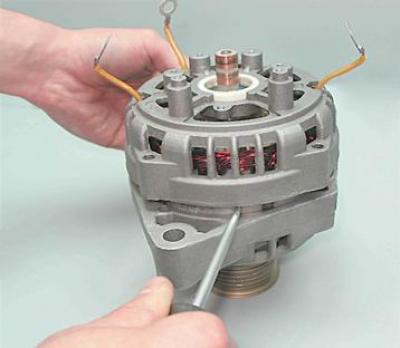
7. Disconnect the rear cover together with the stator winding from the front cover.
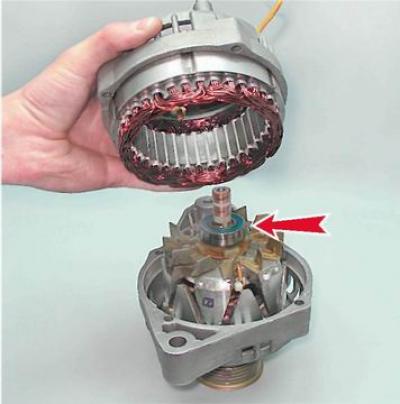
Recommendation: To determine the technical condition of the rear bearing, shake it from side to side and vigorously rotate its outer ring. The bearing should not have significant play, the ring should rotate freely without jamming or extraneous noise. A faulty bearing must be replaced.
The article is taken from an online resource VazBook.ru
8. Using a marker, mark the relative positions of the stator and the rear cover.
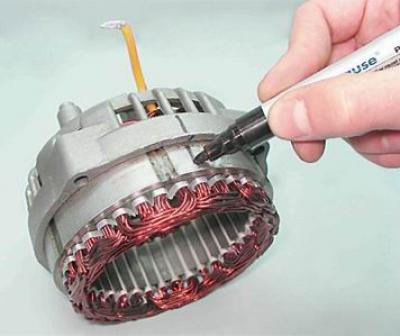
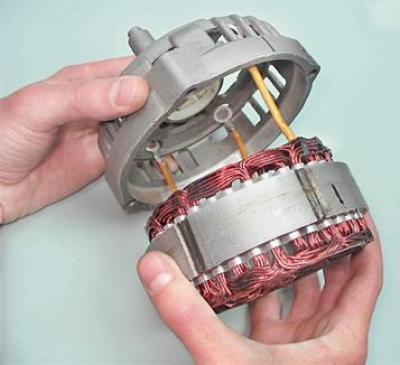
9. Remove the stator from the rear cover of the generator.
10. To determine the technical condition of the front bearing, hold the pulley with your hand, rotate and rock the front cover from side to side.
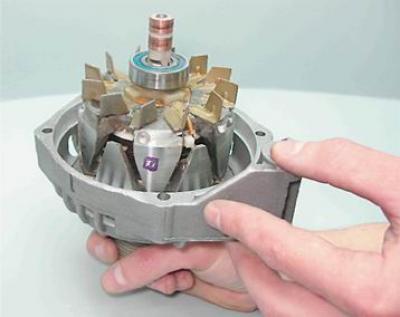
Recommendation: If the bearing is seized, has significant play, or makes a lot of noise when the cover is rotated vigorously, it must be replaced.
Advice: The manufacturer does not recommend replacing the front rotor bearing, as the bearing is rolled into the front generator cover. However, given that the cost of the bearing is significantly lower than the cost of a new front cover and, especially, the generator assembly, it is advisable to press out and replace the faulty bearing.
11. If it is necessary to replace the front bearing of the generator with a socket wrench by 24 mm we unscrew the pulley mounting nut, holding the pulley with sliding pliers.
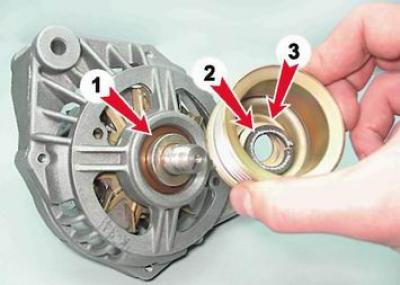
12. Remove the pulley (3) with the spring and flat washers (2) and the spacer sleeve (1) from the rotor shaft.
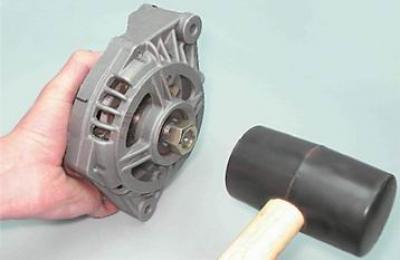
13. Screw the pulley mounting nut onto the rotor shaft thread (flush with end). Using a rubber-headed hammer, press the rotor out of the front bearing on the nut.
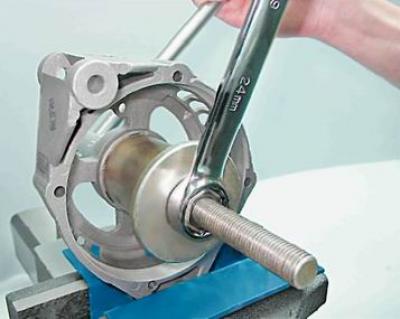
14. If it is necessary to replace the front generator bearing, install the front cover in a vice.
15. Having selected suitable mandrels from the cup puller kit, press out the bearing from the mounting hole of the front cover.
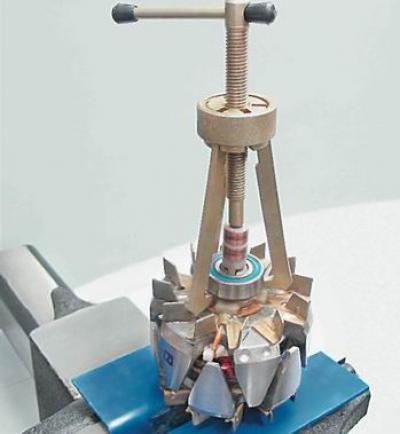
16. Having secured the rotor in a vice with soft pads on the jaws, using a universal puller of the appropriate size, press the rear bearing off the rotor shaft.
Examination
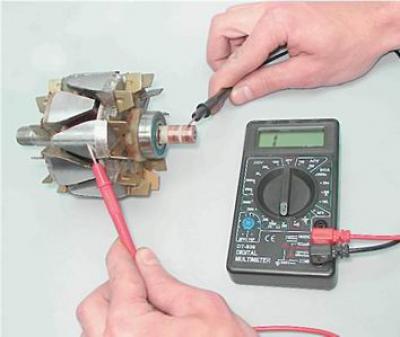
1. Applying the ohmmeter probes to the rotor contact rings, we check the excitation winding for breakage. The resistance of a serviceable excitation winding should be 5-10 Ohms.
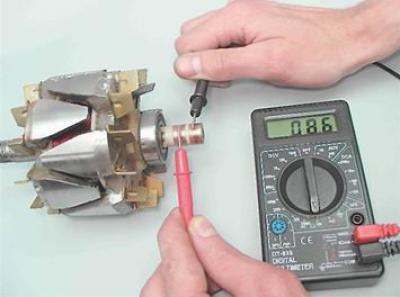
2. By connecting the ohmmeter probes to any contact ring and to the rotor, we check the excitation winding for short circuit to ground. If the rotor winding is in good condition, the ohmmeter should show infinite resistance.
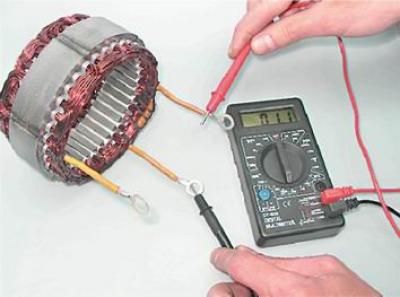
3. Alternately connecting the ohmmeter probes to the stator winding terminals, we check the stator windings for breakage. If there is no breakage, the ohmmeter will show a small electrical resistance (about 10 Ohm).
4. Having connected the ohmmeter probes to any terminal of the winding and to the stator, we check the stator winding for the absence of a short circuit to "ground". If there is no short circuit, the ohmmeter should show infinitely high resistance.
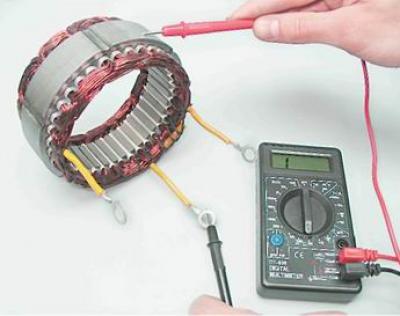
We replace the faulty rotor and stator.
Assembly
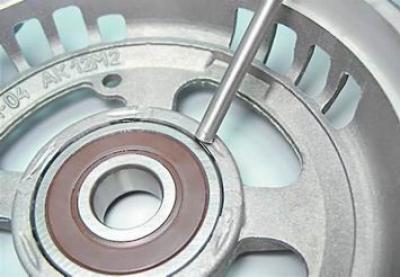
Warning! Before pressing the bearing into the front cover of the generator, it is necessary to check the bearing seat and, if necessary, use a knife or scraper to restore the chamfer where the edges of the hole remain dented. When pressing the front bearing into the cover, force must be applied only to the outer ring of the bearing.
1. Having selected suitable mandrels from the cup puller kit, press the new bearing into the front cover of the generator until it stops.
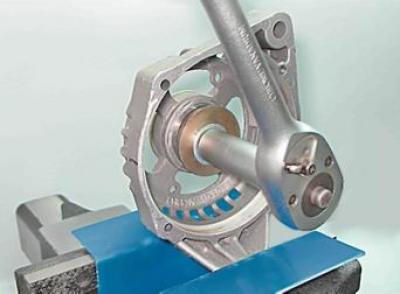
2. Using light hammer blows through a punch, restore the bearing crimp in the cover.
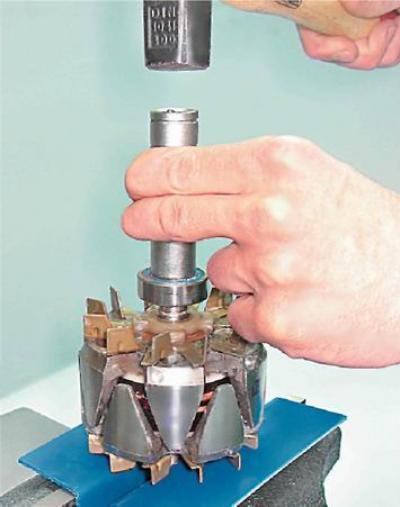
3. Using a tube of suitable diameter (you can use a deep head by 19 mm), we press the rear bearing onto the rotor shaft until it stops.
Warning! Before installing the rear generator bearing, make sure the shaft is securely clamped in a vice. Place a suitable sized block of wood under the rotor shaft to avoid damaging the front rotor impeller during pressing. To avoid damaging the bearing, only strike the inner bearing ring.
Further assembly of the generator is performed in the reverse order of disassembly. In this case, align the marks applied to the covers and the generator stator. Finally, tighten the tie bolts evenly, crosswise, in several steps of half a turn. Having tightened the bolts, make sure that the rotor rotates easily (rotor jamming can be caused by skewing of the covers). Before tightening the stator winding terminal fastening bolts, make sure that insulating washers are placed under their heads.