




If there is a suspicion of coolant getting into the crankcase, the cylinder block is checked for leaks on a special stand. To do this, having plugged the openings of the cooling jacket of the cylinder block, water at room temperature is pumped into it under a pressure of 0.3 MPa. There should be no water leakage from the cylinder block within 2 minutes.
If oil is observed getting into the coolant, then without completely disassembling the engine, check for cracks in the cylinder block in the oil channel areas. To do this, drain the coolant from the cooling system, remove the cylinder head, fill the cooling jacket of the cylinder block with water and supply compressed air to the vertical oil channel of the cylinder block. If air bubbles appear in the cooling jacket, replace the cylinder block.
Check the plane of the cylinder block joint with the head using a ruler and a set of feeler gauges. The ruler is installed along the diagonals of the plane and in the middle in the longitudinal direction and across. If the non-flatness exceeds 0.1 mm, the cylinder block is replaced.
Cylinder repair
They check whether the cylinder wear does not exceed the maximum permissible value of 0.15 mm.
The cylinder diameter is measured with a bore gauge in four zones, both in the longitudinal and transverse directions of the engine (figure 56). To set the bore gauge to zero, a ring gauge with an internal diameter equal to the nominal cylinder diameter with a tolerance of ±0.003 mm is used. For 1111 engines, gauge A.96137 [internal diameter (76±0.003) mm] is used, and for 11113 engines, gauge 67.8125.950 [internal diameter (82±0.003) mm] is used. In the zone of belt 1, the cylinders are practically not worn out. Therefore, the difference in measurements in belt 1 and the other belts can be used to judge the wear of the cylinders.
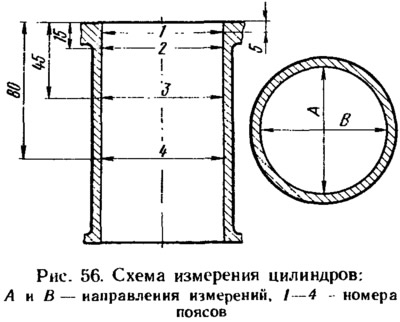
If the maximum wear of the cylinders exceeds 0.15 mm, then the cylinders are bored to the nearest repair size, leaving an allowance of 0.03 mm on the diameter for honing. Then the cylinders are honed, maintaining such a diameter that when installing the selected repair piston, the gap between it and the cylinder is 0.025-0.045 mm.