




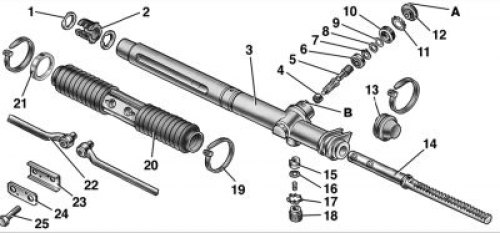
Steering gear parts: A, B - marks; 1 – rack bushing ring; 2 – rack support sleeve; 3 – steering gear housing; 4 – roller bearing; 5 – drive gear; 6 – ball bearing; 7 – retaining ring; 8 – protective washer; 9 – sealing ring; 10 – bearing nut; 11 – lock washer; 12 – boot; 13 – protective cap; 14 – rack; 15 – rack stop; 16 – sealing ring; 17 – retaining ring; 18 – stop nut; 19 – clamp; 20 – protective cover; 21 – spacer ring; 22 – inner tie rod end; 23 – connecting plate; 24 – locking plate; 25 – bolt for fastening the rod to the rack
2. Clamp the steering gear in a vice with soft jaws.
3. Remove the protective cap 13 (see fig.), having first removed the clamp holding it in place.
4. Remove clamps 19 securing protective cover 20, right support and spacer ring 21, and then cover 20 from the steering gear housing pipe.
5. Using the 67.7812.9537 octagonal head wrench, unscrew the nut 18 of the stop and remove the spring and the locking ring 17. To remove the rack stop 15, turn the drive gear 5 counterclockwise until it stops. Then, having turned the gear by a small angle, move the stop. Using special pliers with round jaws inserted into the recess of the stop under the spring, remove the rack stop from the crankcase.
6. Remove dust cover 12 from the gear and lock washer 11, use key 67.7812.9536 to unscrew nut 10. Using a special tool, remove the gear from the housing together with ball bearing 6.
7. Remove the protective washer 8, the retaining ring 7 and press the ball bearing off the gear shaft.
8. Remove the steering rack 14 towards the removed protective cap 13.
9. Remove the support sleeve 2 of the rack from the crankcase.
10. If roller bearing 4 is damaged or worn, press it out of the steering gear housing using puller 67.7801.9535.
11. Wash all metal parts in kerosene or in a cleaning solution. Wash rubber parts with warm water and wipe with a clean cloth.
12. Carefully inspect the working surfaces of gear 5 and rack 14 for signs of wear, scoring or scratches. Remove minor damage with fine-grained sandpaper or a velvet file. Replace worn and damaged parts.
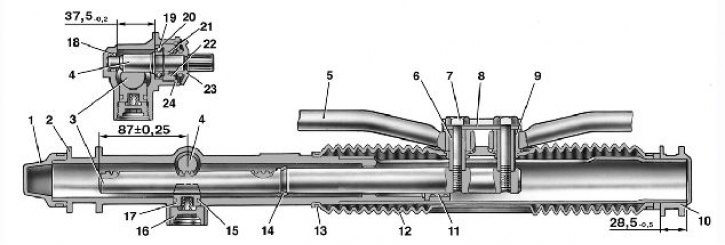
Sectional view of steering mechanism: 1 – protective cap; 2 – steering gear housing; 3 – rack; 4 – drive gear; 5 – inner tie rod end; 6 – spacer sleeve; 7 – steering rod mounting bolt; 8 – connecting plate; 9 – support sleeve; 10 – steering gear support; 11 – rack support sleeve; 12 – protective cover; 13 – clamp; 14 – rack limiting ring; 15 – rack stop sealing ring; 16 – nut; 17 – rack stop; 18 – roller bearing; 19 – ball bearing; 20 – retaining ring; 21 – nut sealing ring; 22 – gear bearing fastening nut; 23 – boot; 24 – lock washer.
13. Ball bearing 6 should rotate freely, without jamming. Bearing 4 must be replaced after pressing out. If there is the slightest doubt, replace the bearings with new ones.
14. Check the condition of the protective cover 12 (Fig. "Steering gear section"), cap 1 and support 10. If they are cracked or torn, replace them with new ones.
(The text is copied from the online portal VAZBOOK)
15. Check the condition of the support bushing 2 (see Fig. "Steering gear parts") of the rack and its fit in the steering gear housing. Replace a damaged bushing.
16. Replace the rack stop sealing rings, drive pinion bearing nuts and rack support bushing rubber rings with new ones regardless of their technical condition. Also replace the clamps and locking plate 24 and washer 11.
Warning! When assembling, pay special attention to ensure that no dirt, chips or other foreign bodies get into the steering gear housing.
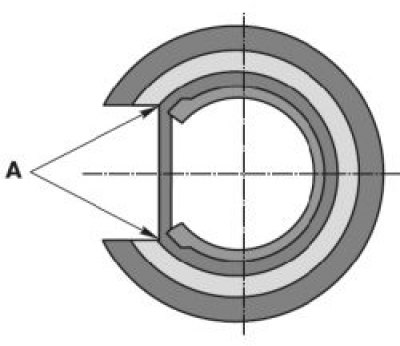
Installing the rack support bushing: A – places where the sealing ring is cut after installing the bushing in the steering gear housing.
17. Using mandrel 67.7853.9574, press ball bearing 6 onto the drive pinion shaft until it stops. Using mandrel 41.7853.4006, install retaining ring 7 into the groove on the pinion shaft, making sure it is not tilted, then install protective washer 8 and sealing ring 9.
18. Install new damping rings 1 in the grooves of the support sleeve 2 so that the thin part of the rings is opposite the cut of the sleeve. Insert the sleeve into the crankcase so that its cut part is opposite the hole for the steering rod mounting bolts, and fix it by inserting the projections of the sleeve into the holes of the crankcase. After installing the support sleeve in the crankcase, cut the rings along the contour of the sleeve, removing the cut parts (see fig above).
19. Press the roller bearing into the steering gear housing using mandrel 67.7853.9585. The pressing depth is 37.5 mm, the pressing force is 2000–5000 N (203.9–509.7 kgf). To avoid damaging the bearing during pressing, the mandrel used must have a stop limiting the pressing depth.
20. Having generously lubricated the rack teeth with Fiol-1 grease and a thin layer of its other surfaces, install the rack in housing 2 (see Fig. "Steering mechanism section"), pushing it through support sleeve 11 until it stops in a special device in order to maintain the size of (87±0.25) mm from the end of the rack to the axis of the rack stop.
21. Apply Fiol-1 grease to the teeth of the drive gear and put it into the ball bearing. Then install the gear into the housing so that the chamfer on its shaft faces to the right (in the direction of the vehicle's movement), and press the bearing into the housing until it stops. The maximum bearing pressing force is 1500 N (152.9 kgf).
22. Using wrench 67.7812.9536, tighten the drive gear nut to a torque of (50±5) N·m [(5±0.5) kgf·m], install lock washer 11 until it stops (see Fig. ";Steering gear parts") and fill the cavity above the nut with Uniol-1 grease.
23. Check and, if necessary, set the drive gear to the position of straight-line movement of the vehicle [determined by the size (87±0.25) mm].
24. Place the sealing ring 16 on the stop 15 (see Fig. "Steering gear parts") of the rack and insert it into the housing until it stops against the rack.
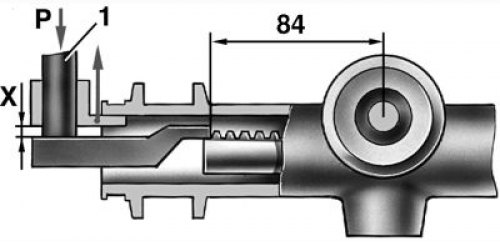
Checking the gap between the rack stop and the nut: 1 – punch
25. Install retaining ring 17, stop spring and tighten nut 18 with wrench 67.7812.9537 to a torque of 11–14 N·m (1.12–1.37 kgf·m).
26. Install the device on the rail and load the punch 1 (see fig above) with a force of P = (500±20) N [(51±2) kgf], then loosen the nut by two divisions (24°) to ensure a gap of no more than 0.12 mm between the nut and the rack stop, necessary to compensate for thermal expansion of the parts and manufacturing tolerances for their manufacture. The torque for unscrewing the nut must be at least 4.5 N·m (0.45 kgf·m).
27. Install boot 12 on the pinion shaft (see Fig. "Steering gear parts") so that marks A on the boot and B on the housing coincide, and the boot fits tightly against the end face of the housing. After this, make sure that the gear rotation torque over the entire stroke is within 50–200 N cm (5.1–20.1 kgf cm) at a rotation speed of 30 min⁻¹. If the gear rotation torque is not within the specified limits, determine and eliminate the causes of the jamming of the parts, paying particular attention to the rack stop, drive pinion and rack. After this, stake nut 18 of the stop at two opposite points, squeezing the housing thread without affecting the nut. For control, mark the position of the nut with paint.
28. Install protective cover 12 (see Fig. "Steering mechanism section") and spacer ring in place so that the right end of the ring is at a distance of 28.5 mm from the end of the pipe; secure the cover with clamps. Then install support 10 so that it fits tightly against the spacer sleeve.
29. After assembly, make sure that there are no bulges or pinches on the protective cover 12 when the gear rotates at a frequency of 30 min⁻¹, and the gear rotation torque (at the same rotation speed) in the area of the entire stroke is within 50–200 N cm (5.1–20.4 kgf cm). Otherwise, eliminate the causes of the detected defects. Check the gear rotation torque using dynamometer 02.7812.9501 with adapter sleeve 67.7812.9540.