




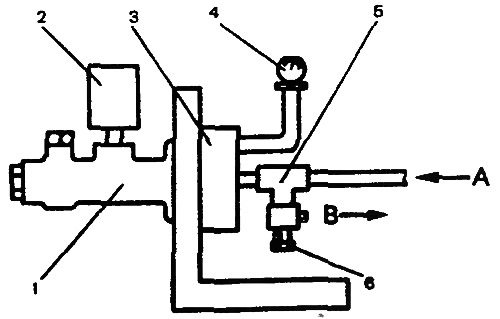
Fig. 3-10. Checking the tightness of the rear sealing ring: 1 - master cylinder; 2 - vessel; 3 - adapter with seal; 4 - pressure gauge; 5 - tee; 6 - adjusting screw; A - air from the compressor; B - air release
Check the air pressure using the pressure gauge, which should be within 0.05-0.08 MPa (0.5-0.8 kgf/cm²). If the pressure is lower, replace the rear sealing ring.
Checking the tightness of the front sealing ring. Install the master cylinder on the stand and connect it to a vessel filled with hydraulic fluid and to pressure gauges (Fig. 3-11).
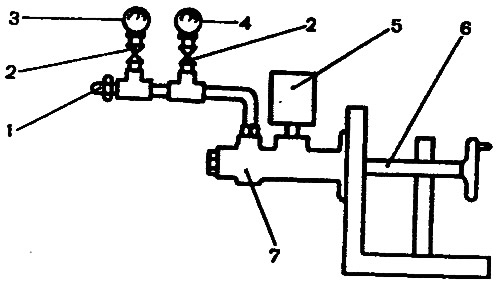
Fig. 3-11. Checking the tightness of the front sealing ring: 1 - bleed screw; 2 - crane; 3 - pressure gauge with a division value of 0.2 MPa (2 kgf/cm²), 4 - pressure gauge with a division value of 0.005 MPa (0.05 kgf/cm²); 5 - vessel; 6 - pusher; 7 - master cylinder
Close the pressure gauge valve 3 and, by moving the master cylinder pusher, ensure a stable pressure of 0.2 MPa (2 kgf/cm²).
With the plunger secured and no fluid leaking, the pressure should remain constant for 2 minutes.
Close the pressure gauge tap 4 and open the pressure gauge tap 3. Move the plunger and set a stable pressure of 10 MPa on the pressure gauge (100 kgf/cm²).
With the pushrod secured and no fluid leaking, the specified pressure should remain constant for at least 2 minutes. Otherwise, replace the front sealing ring.
[The article is taken from an online resource: www.vazbook.ru]